What Is Zenchain? How an Emerging Cross-Chain Ecosystem Connects Bitcoin and Ethereum

Beginner
Quick Reads
Last Updated 2026-03-26 01:00:17
Reading Time: 1m
A thorough breakdown of Zenchain (ZTC), covering its project positioning, technical features, and current price movements. Gain insights into its cross-chain framework, token economics, and ecosystem progress to inform your next strategic move.

What is Zenchain?


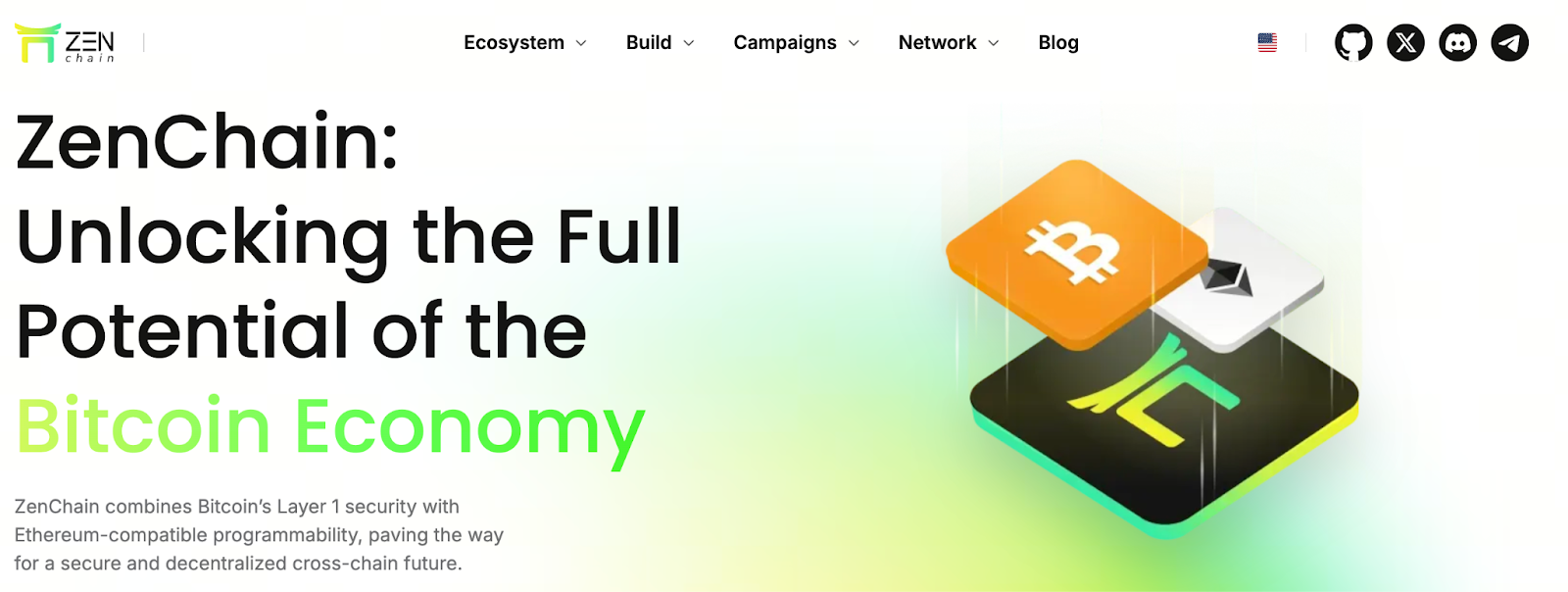
Image: https://www.zenchain.io/

Zenchain is a Layer 1 blockchain network built on Bitcoin-grade security and compatible with the Ethereum Virtual Machine (EVM). It aims to address the cross-chain isolation effect prevalent in today’s blockchain ecosystem. Through its innovative consensus mechanism and cross-chain protocol, Zenchain enables Bitcoin assets to interact securely and directly with the Ethereum ecosystem and other EVM chains, unlocking BTC’s broader potential as a value carrier beyond its traditional role as a store of value.

The project’s core native token, ZTC, serves multiple ecosystem functions, including payment of network fees, staking, and governance voting. Unlike conventional bridges, Zenchain is designed around a trust-minimized approach to cross-chain value transfer.

Technical Architecture and Core Strengths

Zenchain’s architecture features several key technical advantages:

  • Bitcoin-grade security and EVM compatibility: Integrates Bitcoin’s robust security model with Ethereum’s smart contract capabilities, supporting mainstream development tools such as Solidity.
  • Low costs and rapid confirmations: Short block times and minimal transaction fees enhance user experience and network scalability.
  • Cross-Liquidity Consensus Mechanism (CLCM): This unique consensus protocol is designed to strengthen security and promote fair competition among network participants.
  • AI security layer: Incorporates AI-powered security mechanisms for real-time threat detection and defense, improving resilience against attacks.

Additionally, Zenchain is developing the ZIP-20 asset standard and the Cross-Chain Interoperability Module (CCIM), which will support seamless asset transfers and management across more blockchains in the future.

ZTC Tokenomics and Market Performance

ZTC is Zenchain’s native token, with a fixed total supply of 21 billion. The latest official token allocation plan is as follows:

  • 7% for airdrops;
  • 20% for the project team and development;
  • 15% for marketing and community incentives;
  • 58% to the public market and liquidity.

In terms of price performance, ZTC saw significant volatility in its first few days post-launch. As of January 15, 2026, ZTC was trading at approximately $0.0023, with a 24-hour decline exceeding 10%, far below its historical high. This drop is attributed to TGE-related selling pressure, valuation concerns, and overall weakness in the altcoin market. Trade here: https://www.gate.com/trade/ZTC_USDT

Such volatility is typical for newly launched crypto assets, especially when initial token unlocks are substantial and liquidity is uneven, making sharp price swings more likely.

Latest Developments and Ecosystem Progress

Zenchain’s ecosystem has recently seen several notable developments:

  • Cross-chain bridge and testnet successfully launched: Official data reports significant transaction volume and wallet activity, paving the way for the mainnet release.
  • Multiple exchange channels expected: While not all are officially confirmed, some platforms have signaled potential cooperation to list ZTC.
  • Community building and staking initiatives are actively advancing, helping to drive ecosystem engagement.

These updates show that Zenchain is focused not only on token issuance but also on broader ecosystem deployment.

Summary and Outlook

Zenchain’s combination of Bitcoin-grade security and EVM compatibility gives it a distinctive position and strong technical potential. Its cross-chain solution addresses blockchain fragmentation and represents a significant step toward greater ecosystem interoperability.

However, as a newly launched Layer 1 project still in the early stages of market exploration, price volatility remains closely linked to project milestones and implementation progress. Monitoring development updates, mainnet launch, and partnership announcements will be key to evaluating its real value.

For more technical details, refer to the official documentation and whitepaper for developer-focused information.

Author: Max
Disclaimer
* The information is not intended to be and does not constitute financial advice or any other recommendation of any sort offered or endorsed by Gate.
* This article may not be reproduced, transmitted or copied without referencing Gate. Contravention is an infringement of Copyright Act and may be subject to legal action.

Related Articles

AI-Native Settlement Layers: How United Stables Is Building the Next Financial Rail
Beginner

AI-Native Settlement Layers: How United Stables Is Building the Next Financial Rail

Stablecoins were originally designed as dollar substitutes within exchanges, primarily used for asset pricing and trade settlement. As on-chain financial ecosystems have matured, their role has expanded beyond simple payments to include collateral assets, cross-chain liquidity mediums, and unified settlement units. In particular, as AI systems and automated agents begin to participate directly in economic activity, demand has risen sharply for programmable value units capable of instant settlement. This shift is pushing stablecoins toward the role of foundational financial infrastructure.
2026-03-25 03:16:17
DePIN Identity Network and Real World Applications: How Humanity Protocol Brings on-chain Identity Into the Physical World
Beginner

DePIN Identity Network and Real World Applications: How Humanity Protocol Brings on-chain Identity Into the Physical World

Most Web3 identity systems remain confined to on-chain environments and struggle to achieve meaningful adoption in real world settings. Through a DePIN architecture and physical verification hardware, Humanity Protocol aims to bring decentralized identity into access control systems, hospitality, public services, and offline events, allowing on-chain identity to function not just as a digital credential, but as foundational infrastructure for real world access.
2026-03-25 07:40:53
The ve(3,3) Flywheel Explained: How AERO Tokenomics Powers Aerodrome’s DeFi Economy
Beginner

The ve(3,3) Flywheel Explained: How AERO Tokenomics Powers Aerodrome’s DeFi Economy

In the competition for DeFi liquidity, high-inflation mining alone is no longer enough to build lasting advantages. Aerodrome applies the ve(3,3) economic model to redesign token emissions, voting mechanisms, and revenue distribution, creating a liquidity flywheel centered on governance and cash flow. This article examines AERO tokenomics, the veAERO locking mechanism, and protocol revenue models to explain how Aerodrome builds a sustainable DeFi economic system.
2026-03-25 06:41:58
Aerodrome Tokenomics: How ve(3,3) Powers Base's Most Profitable DEX
Beginner

Aerodrome Tokenomics: How ve(3,3) Powers Base's Most Profitable DEX

AERO is the native token of Aerodrome Finance, a core decentralized exchange and liquidity protocol in the Base ecosystem. It is primarily used for liquidity incentives and ecosystem operations. veAERO is a governance NFT that users receive by locking AERO, representing both voting power and the right to share protocol revenue. Through a dual track structure of AERO as a utility token and veAERO as a governance credential, Aerodrome separates liquidity usage value from long term governance power, allowing participants to act as liquidity providers, governance decision makers, and revenue sharers within the same system.
2026-03-25 06:40:31
Aster vs Hyperliquid: Which Perp DEX Will Prevail?
Beginner

Aster vs Hyperliquid: Which Perp DEX Will Prevail?

Aster and Hyperliquid are the two representative protocols of the "purpose-built L1 path" within the current decentralized perpetual exchange (Perp DEX) sector. As a pioneer in the field, Hyperliquid has built a deep liquidity moat through its highly mature order book architecture and strong community consensus. Conversely, Aster, as a rising challenger, seeks to leapfrog the competition in high-performance trading through more aggressive multi-chain aggregation logic, private transaction modules, and an underlying execution environment optimized for 2026 market demands.
2026-03-24 11:58:33
Gold Price Forecast for the Next Five Years: 2026–2030 Trend Outlook and Investment Implications, Could It Reach $6,000?
Beginner

Gold Price Forecast for the Next Five Years: 2026–2030 Trend Outlook and Investment Implications, Could It Reach $6,000?

Analyze current gold price trends alongside authoritative five-year forecasts, integrating an evaluation of market risks and opportunities. This gives investors insight into the potential trajectory of gold prices and the main drivers expected to shape the market over the next five years.
2026-03-25 18:13:30





