As Web3 moves toward mainstream adoption, usability barriers, regulatory pressure, and cross chain fragmentation have become major industry challenges. Through the infrastructure design of Vision Chain and Vision Protocol, combined with cross chain liquidity aggregation, a unified token economic model, and MiCAR compliance strategy, Vision aims to build a European style Web3 base layer that balances scalability, compliance, and real financial applications. This approach allows both institutions and retail users to participate in on-chain assets and decentralized finance within a legal and controlled environment, improving the real world applicability of blockchain in traditional finance scenarios.
This article starts with the origin and ecosystem architecture of Vision, explains the technical roles of Vision Chain and Vision Protocol, analyzes VSN’s unified token design and token economic model, and details its real use cases in staking rewards, governance, fee payments, and loyalty systems. It also covers supply structure, buyback and burn mechanisms, and RWA compliance strategy, while discussing Vision’s position and future challenges within the European Web3 infrastructure landscape.

(Source: vsntoken)
Vision (VSN) is the native token of the Bitpanda Web3 ecosystem. It is designed as a unified asset that carries both utility and governance functions. Unlike most exchange tokens that serve a single platform, VSN is built as a cross product and cross protocol value hub, covering wallets, public chains, cross chain protocols, and token issuance infrastructure.
The core objective of VSN is to lower the entry barrier to Web3, allowing decentralized finance to move beyond technical users and become accessible to retail users and institutions. Through VSN, Bitpanda aims to establish a European Web3 base layer that combines compliance, scalability, and real application scenarios.
Vision was officially launched by Bitpanda in 2025, during a period when the Web3 ecosystem was growing rapidly while facing increasing usability and regulatory pressure. As blockchain applications move toward mass adoption, retail users demand smoother user experiences, while institutional capital prioritizes compliance and risk management.
In this context, Vision is not positioned as just another Web3 product. Instead, it seeks to build a bridge between decentralized innovation and real world regulatory frameworks, providing a tokenized solution that balances ease of use and compliance for both individuals and institutions, and serving as an important gateway between traditional finance and the crypto ecosystem.
The technical foundation of the Vision ecosystem consists of two core modules:
Together, these two components form the technical base that allows Vision to function as a multi-chain token infrastructure layer.
The emergence of Vision represents a fundamental restructuring of the token system. Previously, the Bitpanda ecosystem operated with two separate tokens:
While this dual-token structure allowed each token to serve a specific function, it also resulted in fragmented liquidity and a more complex user experience. In 2023, Bitpanda officially merged BEST and PAN into a single token, Vision (VSN), establishing a unified token model.
Following the integration, VSN inherits:
This consolidation removes the need for multiple tokens to operate in parallel within the Bitpanda ecosystem. Instead, a single token is used to connect centralized and decentralized product lines under a unified token framework.
VSN is designed as a single utility and governance token that integrates the functions of BEST and PAN. Its purpose is to reduce fragmentation and improve cross-product usability across Bitpanda’s Web3 offerings. The goal is to consolidate loyalty mechanisms, interoperability, and tokenized capabilities into one unified token.
Vision is not positioned as a governance-only token. Instead, it functions as a utility token spanning multiple product modules within the ecosystem.
Its main use cases include:
As a result, VSN simultaneously serves as a yield instrument, a governance token, and a platform access token.
Through these functions, VSN acts simultaneously as a yield instrument, a governance token, and a platform access pass.
Vision’s token economic model is built around three primary drivers:
This structure positions VSN as a token whose effective supply tightens as usage increases.
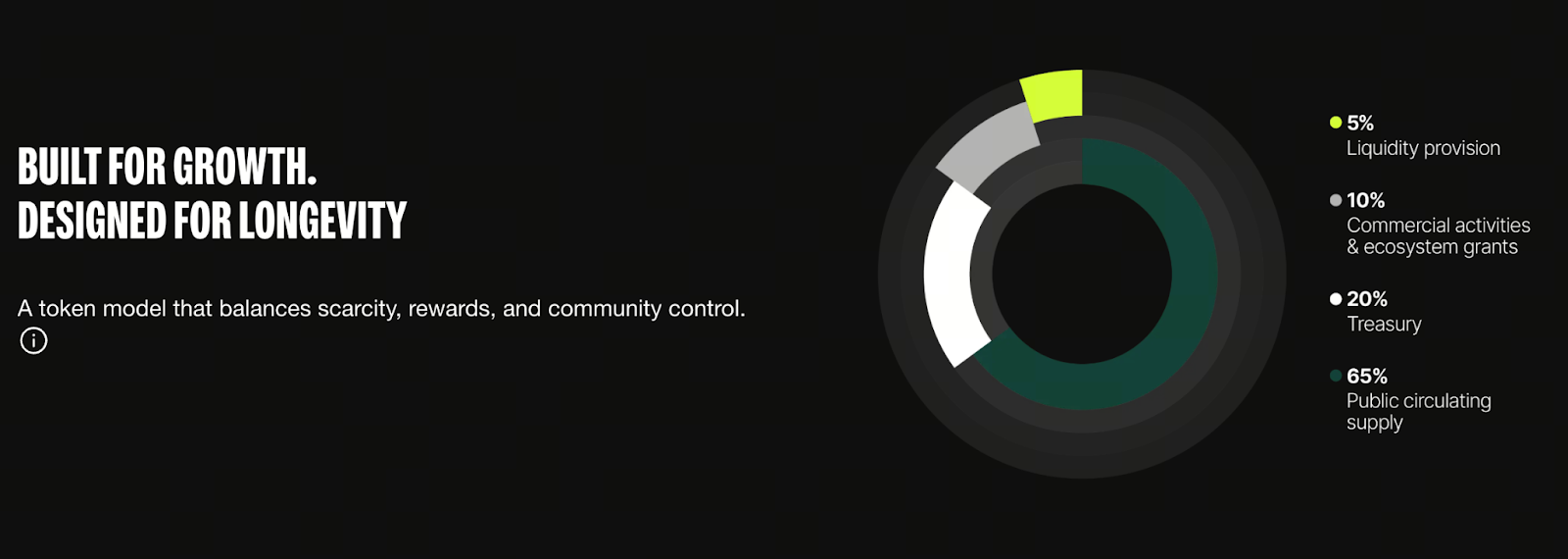
According to publicly available data, VSN has a total supply of approximately 4.2 billion tokens, with a circulating supply of around 3.4 billion tokens.
The allocation structure is as follows:
| Allocation Category | Share |
|---|---|
| Public circulation | 65% |
| Treasury | 20% |
| Business and ecosystem development | 10% |
| Liquidity allocation | 5% |

(Source: vsntoken)
Overall, the allocation design prioritizes ecosystem-driven distribution rather than heavy private sales or venture capital concentration.
Compared with many AI and DAO focused protocols, Vision does not position itself around a single autonomous agent or automated governance tool. Instead, it approaches the financial infrastructure layer, prioritizing real world issues such as identity, compliance, and asset tokenization.
Many AI and DAO projects focus on improving governance efficiency through AI generated proposals, automated voting, or data driven decision support. However, these often remain experimental or limited to community tooling. Vision places greater emphasis on integration with real financial scenarios. Through a unified token architecture and compliance modules, Vision enables DAOs not only to make decisions, but also to operate legally and settle value in practice.
This path from governance tools toward institutional grade infrastructure positions Vision as a more practical long term financial protocol rather than a purely conceptual innovation.
Vision’s most distinctive positioning lies in its direct focus on compliant European RWA markets. VSN is designed as institutional grade tokenization infrastructure, supporting security token issuance, fractional ownership, on-chain settlement, and liquidity enhancement while aligning with the EU MiCAR regulatory framework. This allows traditional financial institutions to enter blockchain markets within a legal framework. As the RWA market continues to expand, Vision aims to become a standard tool for tokenized financial assets in Europe.
VSN officially launched in July 2025 and was subsequently listed on platforms such as Gate and Uniswap, rapidly establishing liquidity and market accessibility. On the marketing side, Bitpanda strengthened brand exposure through sports partnerships and platform integration, increasing general awareness of VSN.
However, Vision still faces several practical challenges. These include high compliance costs in Europe, intense competition within the Web3 ecosystem, and the slower pace of RWA adoption due to traditional financial constraints. As a result, VSN represents a long term infrastructure token rather than a short term narrative driven asset.
Vision (VSN) is not a typical exchange token chasing market hype. It is a core infrastructure asset designed by Bitpanda for the future of European Web3. Through a unified token architecture, staking reward model, buyback and burn mechanism, and MiCAR compliant RWA strategy, VSN attempts to bridge decentralized efficiency with traditional financial regulation.
How is Vision (VSN) different from typical exchange platform tokens?
VSN does not serve a single trading platform. It is the unified token for Bitpanda’s entire Web3 ecosystem, covering wallets, public chains, cross chain protocols, and token issuance infrastructure. It functions as both a utility token and a governance asset, positioning it closer to an infrastructure level value hub rather than a simple discount token.
Why were BEST and PAN merged into VSN?
The original dual token structure caused liquidity fragmentation and user complexity. By merging BEST and PAN into VSN, Bitpanda combined platform benefits with cross chain capabilities into one token, simplifying user experience and improving capital efficiency across the ecosystem.
What practical benefits do users get from holding VSN?
Users can stake VSN to earn approximately 10% annual yield, participate in governance voting, receive fee discounts in wallet and cross chain operations, and unlock loyalty benefits. In addition, part of platform fees is used to buy back and burn VSN, creating a positive feedback loop between ecosystem growth and token value.