What Is Power Protocol? Building the Next-Generation Infrastructure for the Web3 Entertainment Economy

Beginner
Quick Reads
Last Updated 2026-03-26 23:46:39
Reading Time: 1m
This comprehensive overview covers the vision, tokenomics, ecosystem architecture, and technical framework of the Power Protocol project. It enables users to grasp its critical role and long-term potential as a foundational infrastructure for the Web3 entertainment economy.

Power Protocol Project Overview
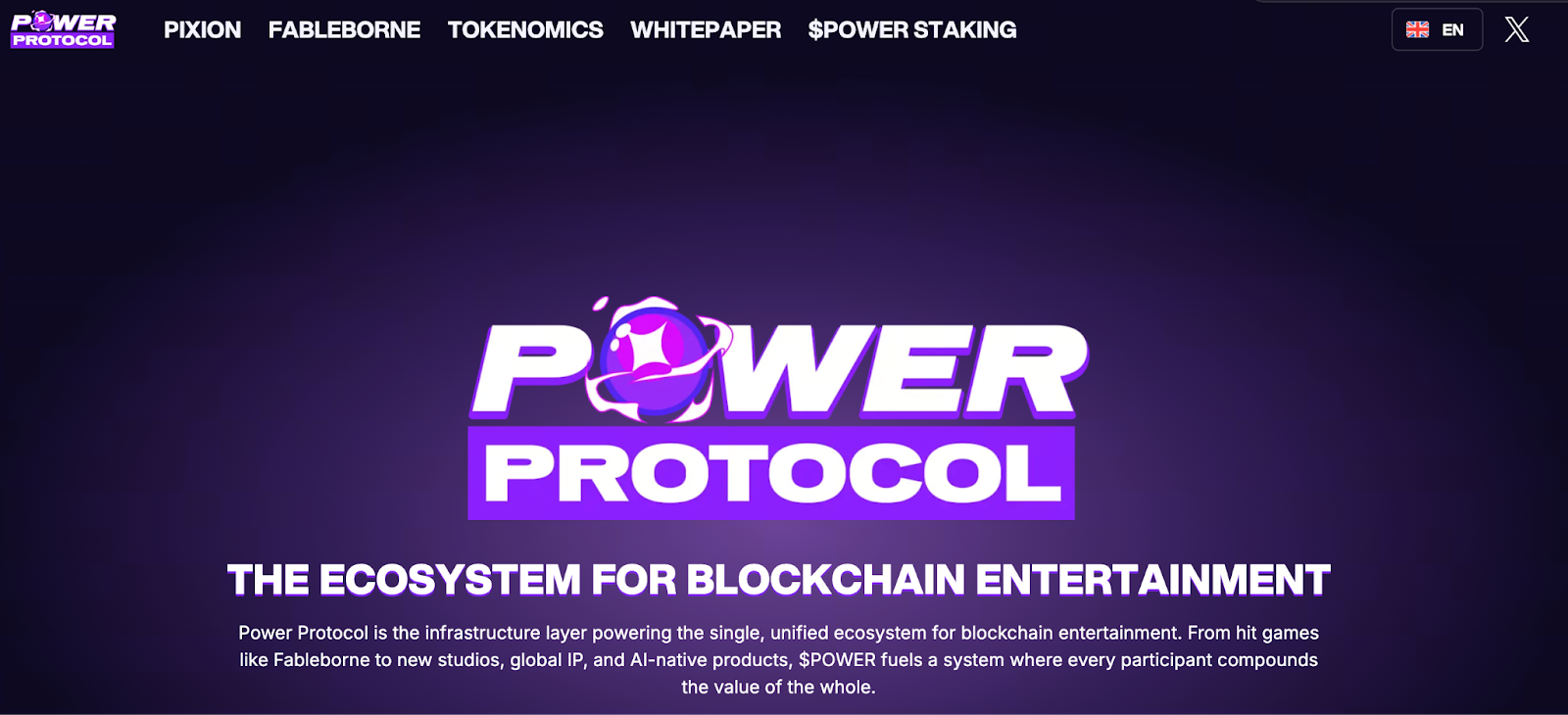

Image source: https://powerprotocol.xyz/en

Power Protocol is a blockchain protocol dedicated to the Web3 Entertainment Economic Layer. It aims to deliver a unified incentive structure and value connectivity for games, consumer-facing applications, and on-chain interactive activities.

Traditional Web3 games and applications often suffer from fragmented rewards, siloed economic systems, and inefficient token circulation. Power Protocol addresses these challenges by enabling diverse applications to share an economic layer and reward structure. Its sustainable value feedback mechanism increases user engagement and boosts developer revenue.

Core Vision: Building a Unified Entertainment Economic Layer

Power Protocol’s vision centers on three core objectives:

1. Delivering a Universal Economic Engine for Web3 Applications

Unlike token models built for a single game, Power Protocol creates an economic layer shared across multiple applications.

Developers can integrate directly with the protocol, using $POWER to facilitate rewards, task incentives, and value distribution.

2. Monetizing User Behavior with Value Feedback

Every user action in games, social platforms, or consumer apps is recorded and rewarded by the protocol, ensuring that greater contributions result in greater rewards.

3. Building a Sustainable Circulating Web3 Entertainment Economy

While traditional GameFi projects often face inflation and death spirals, Power Protocol’s shared economic layer relieves pressure on individual project models and enhances ecosystem sustainability.

Power Protocol Technical Architecture

The Power Protocol architecture comprises four primary modules:

Incentive Layer

Delivers standardized reward interfaces for all integrated applications, including:

  • Task rewards
  • Activity rewards
  • User behavior points
  • Application feedback mechanisms

Developers can deploy incentive programs without building complex economic models from scratch.

Reward Engine

Handles intelligent reward distribution and value feedback through:

  • Allocating rewards based on user participation
  • Weighting by contribution behaviors
  • Managing cross-application reward logic

This is the core component of Power Protocol.

Treasury & Value Loop

The protocol’s value circulation mechanism creates two-way feedback between application revenue and user behavior, injecting a portion of value into the protocol treasury to maintain a long-term positive cycle.

Developer Toolkit

Power Protocol equips application developers with:

  • API / SDK
  • Task system templates
  • Incentive modules
  • Visual economic parameter configuration

This dramatically lowers the development barrier and accelerates ecosystem participation.

$POWER Token Design and Utility

As the protocol’s core token, $POWER fulfills several key roles:

1. Application Rewards

Developers use $POWER to provide players with task rewards, engagement incentives, and more.

2. Protocol Incentives

The protocol distributes $POWER based on user contributions, encouraging long-term participation.

3. Ecosystem Governance

In the future, $POWER will be used for proposal voting and protocol governance decisions.

4. Value Circulation Component

As a medium of circulation, $POWER integrates application spending, user activity, and developer incentives into a unified economic layer.

Power Protocol Ecosystem

Power Protocol’s current ecosystem focuses on:

GameFi Applications

Games can leverage Power Protocol’s reward system to incentivize players, driving higher retention and engagement.

Entertainment and Consumer Applications (Social / Consumer Apps)

Examples include:

  • Social interaction platforms
  • Task platforms
  • User acquisition and growth apps

All can enhance their user incentive models with $POWER.

Multi-Project Shared Economic Layer

Applications can share users and reward systems, creating multi-level value collaboration.

Project Advantages and Long-Term Potential

Cross-App Shared Economic Layer

Power Protocol’s multi-game, multi-app shared economic layer is its key differentiator from traditional projects.

Sustainable Incentive Model

The value circulation mechanism mitigates the risk of individual application economic collapse.

Low-Barrier Developer Tools

This reduces the difficulty of building on-chain economies and accelerates ecosystem growth.

Enhanced User Retention

A unified rewards and identity system allows users to accumulate value across multiple applications, increasing retention.

Conclusion

Power Protocol is a purpose-built, advanced Web3 entertainment economic infrastructure. With its shared economic layer, intelligent reward engine, and cross-application value system, it is creating a sustainable economic framework for the next generation of Web3 entertainment products. For both users and developers, Power Protocol’s unified incentive structure and value circulation model will be a foundational force driving mainstream adoption of Web3 applications.

Gate listed Power Protocol on December 11, 2025. Click here to trade: https://www.gate.com/trade/POWER_USDT

Author: Max
Disclaimer
* The information is not intended to be and does not constitute financial advice or any other recommendation of any sort offered or endorsed by Gate.
* This article may not be reproduced, transmitted or copied without referencing Gate. Contravention is an infringement of Copyright Act and may be subject to legal action.

Related Articles

AI-Native Settlement Layers: How United Stables Is Building the Next Financial Rail
Beginner

AI-Native Settlement Layers: How United Stables Is Building the Next Financial Rail

Stablecoins were originally designed as dollar substitutes within exchanges, primarily used for asset pricing and trade settlement. As on-chain financial ecosystems have matured, their role has expanded beyond simple payments to include collateral assets, cross-chain liquidity mediums, and unified settlement units. In particular, as AI systems and automated agents begin to participate directly in economic activity, demand has risen sharply for programmable value units capable of instant settlement. This shift is pushing stablecoins toward the role of foundational financial infrastructure.
2026-03-25 03:16:17
DePIN Identity Network and Real World Applications: How Humanity Protocol Brings on-chain Identity Into the Physical World
Beginner

DePIN Identity Network and Real World Applications: How Humanity Protocol Brings on-chain Identity Into the Physical World

Most Web3 identity systems remain confined to on-chain environments and struggle to achieve meaningful adoption in real world settings. Through a DePIN architecture and physical verification hardware, Humanity Protocol aims to bring decentralized identity into access control systems, hospitality, public services, and offline events, allowing on-chain identity to function not just as a digital credential, but as foundational infrastructure for real world access.
2026-03-25 07:40:53
Gold Price Forecast for the Next Five Years: 2026–2030 Trend Outlook and Investment Implications, Could It Reach $6,000?
Beginner

Gold Price Forecast for the Next Five Years: 2026–2030 Trend Outlook and Investment Implications, Could It Reach $6,000?

Analyze current gold price trends alongside authoritative five-year forecasts, integrating an evaluation of market risks and opportunities. This gives investors insight into the potential trajectory of gold prices and the main drivers expected to shape the market over the next five years.
2026-03-25 18:13:30
Aster vs Hyperliquid: Which Perp DEX Will Prevail?
Beginner

Aster vs Hyperliquid: Which Perp DEX Will Prevail?

Aster and Hyperliquid are the two representative protocols of the "purpose-built L1 path" within the current decentralized perpetual exchange (Perp DEX) sector. As a pioneer in the field, Hyperliquid has built a deep liquidity moat through its highly mature order book architecture and strong community consensus. Conversely, Aster, as a rising challenger, seeks to leapfrog the competition in high-performance trading through more aggressive multi-chain aggregation logic, private transaction modules, and an underlying execution environment optimized for 2026 market demands.
2026-03-24 11:58:33
Aerodrome Tokenomics: How ve(3,3) Powers Base's Most Profitable DEX
Beginner

Aerodrome Tokenomics: How ve(3,3) Powers Base's Most Profitable DEX

AERO is the native token of Aerodrome Finance, a core decentralized exchange and liquidity protocol in the Base ecosystem. It is primarily used for liquidity incentives and ecosystem operations. veAERO is a governance NFT that users receive by locking AERO, representing both voting power and the right to share protocol revenue. Through a dual track structure of AERO as a utility token and veAERO as a governance credential, Aerodrome separates liquidity usage value from long term governance power, allowing participants to act as liquidity providers, governance decision makers, and revenue sharers within the same system.
2026-03-25 06:40:31
The ve(3,3) Flywheel Explained: How AERO Tokenomics Powers Aerodrome’s DeFi Economy
Beginner

The ve(3,3) Flywheel Explained: How AERO Tokenomics Powers Aerodrome’s DeFi Economy

In the competition for DeFi liquidity, high-inflation mining alone is no longer enough to build lasting advantages. Aerodrome applies the ve(3,3) economic model to redesign token emissions, voting mechanisms, and revenue distribution, creating a liquidity flywheel centered on governance and cash flow. This article examines AERO tokenomics, the veAERO locking mechanism, and protocol revenue models to explain how Aerodrome builds a sustainable DeFi economic system.
2026-03-25 06:41:58





