U.S. Government Shutdown Ends: Between Political Compromise and Market Confidence

Beginner
Quick Reads
Last Updated 2026-03-27 23:01:29
Reading Time: 1m
After a 40-day stalemate, the U.S. Senate has reached a temporary agreement. This resolution ends the longest recorded government shutdown. The agreement resumes federal agency operations and shows both parties made strategic compromises in response to political realities.

Government Shutdown Crisis Resolves
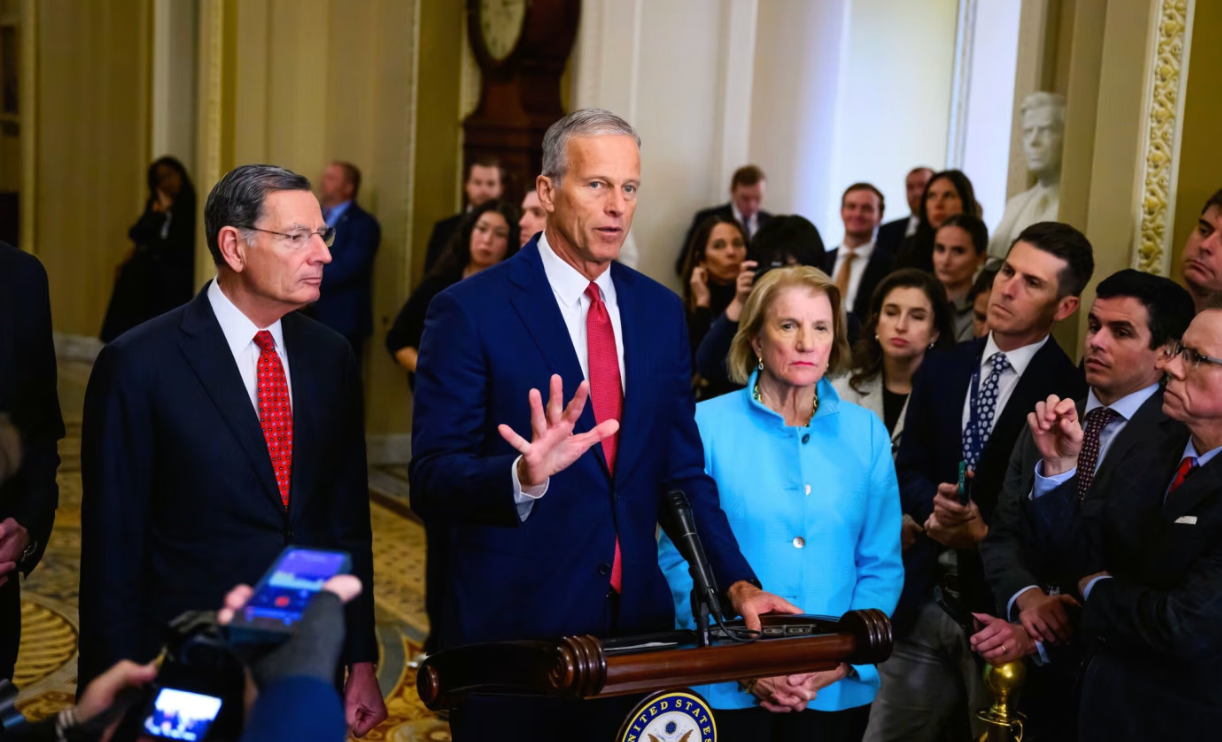

(Source: Pete Kiehart / Bloomberg News)

After 40 days under the threat of a shutdown, the U.S. federal government has finally received relief. In November 2025, following extensive bipartisan negotiations, the Senate reached a temporary funding agreement, ending the longest shutdown on record. The deal extends government funding until January 30, 2025, giving a brief window for further fiscal discussions. For Washington, this marks a compromise born of political necessity; for the markets, it provides much-needed stability.

Key Elements of the Temporary Agreement

The agreement focuses on immediate relief. Beyond extending funding, it introduces several symbolic amendments:

  • Repeals executive orders from the Trump administration allowing dismissal of federal employees, restoring stability to the administrative system;
  • Ensures the Supplemental Nutrition Assistance Program (SNAP) remains funded through fiscal year 2026, preventing disruptions in social support;
  • Adds budget stabilization provisions to guard against future shutdowns, requiring both parties to complete fiscal talks within set deadlines;
  • Separates Medicaid issues from this round of negotiations with a distinct vote on the Affordable Care Act (ACA).

This strategy reflects a classic phased political compromise: postponing divisive policies in exchange for short-term institutional stability.

Democratic Party Strategic Shift

For Democrats, the shutdown served as both a test of resilience and a strategic turning point. While the party initially insisted on maintaining healthcare reform, strong resistance from Trump supporters and conservatives led to a tactical concession—separating healthcare issues to restart government operations.

Some progressives criticized the move as excessive, but mainstream Democrats emphasized that political compromise is essential for governance. Amid high inflation and market turbulence, keeping federal agencies closed would be far more costly than prioritizing governance over specific policy issues. The party is shifting from issue-driven tactics to prioritizing governance over specific policy issues, signaling a more pragmatic, practical style of politics.

Delayed Governance and Eroded Trust

The 40-day shutdown was not just an administrative halt—it signaled a deeper breakdown in institutional trust. Budget freezes caused federal departments to suspend operations, which delayed economic data releases, hampered corporate decisions, and interrupted social assistance.

These delays in government operations affected market confidence more than the immediate fiscal costs. Data from the American Federation of Government Employees shows more than 800,000 federal workers faced payroll delays during the shutdown. Public transportation and food assistance systems stalled in several regions. Congress faces both political risk and a warning about the integrity of the governance structure.

Market Reaction

Once the agreement was reached, U.S. equity futures rallied. S&P 500 futures jumped over 1.2%, demonstrating investors’ strong appetite for short-term stability. Analysts noted that, while the solution doesn’t address the root budget issues, it signals that institutional mechanisms can still bridge political divides. Most observers expect this reprieve to buy time for year-end budget negotiations. It also provides a clearer context for Federal Reserve monetary policy decisions.

Conclusion

The end of the government shutdown highlights the U.S. political system’s resilience under pressure—but also exposes its vulnerabilities. The temporary nature of the agreement means the crisis is delayed, not resolved. In Washington, consensus usually follows exhaustion and stress, while market participants rebuild confidence amid uncertainty. As efficient governance grows increasingly scarce, political compromise itself has become an essential component of financial stability.

Author: Allen
Disclaimer
* The information is not intended to be and does not constitute financial advice or any other recommendation of any sort offered or endorsed by Gate.
* This article may not be reproduced, transmitted or copied without referencing Gate. Contravention is an infringement of Copyright Act and may be subject to legal action.

Related Articles

AI-Native Settlement Layers: How United Stables Is Building the Next Financial Rail
Beginner

AI-Native Settlement Layers: How United Stables Is Building the Next Financial Rail

Stablecoins were originally designed as dollar substitutes within exchanges, primarily used for asset pricing and trade settlement. As on-chain financial ecosystems have matured, their role has expanded beyond simple payments to include collateral assets, cross-chain liquidity mediums, and unified settlement units. In particular, as AI systems and automated agents begin to participate directly in economic activity, demand has risen sharply for programmable value units capable of instant settlement. This shift is pushing stablecoins toward the role of foundational financial infrastructure.
2026-03-25 03:16:17
DePIN Identity Network and Real World Applications: How Humanity Protocol Brings on-chain Identity Into the Physical World
Beginner

DePIN Identity Network and Real World Applications: How Humanity Protocol Brings on-chain Identity Into the Physical World

Most Web3 identity systems remain confined to on-chain environments and struggle to achieve meaningful adoption in real world settings. Through a DePIN architecture and physical verification hardware, Humanity Protocol aims to bring decentralized identity into access control systems, hospitality, public services, and offline events, allowing on-chain identity to function not just as a digital credential, but as foundational infrastructure for real world access.
2026-03-25 07:40:53
The ve(3,3) Flywheel Explained: How AERO Tokenomics Powers Aerodrome’s DeFi Economy
Beginner

The ve(3,3) Flywheel Explained: How AERO Tokenomics Powers Aerodrome’s DeFi Economy

In the competition for DeFi liquidity, high-inflation mining alone is no longer enough to build lasting advantages. Aerodrome applies the ve(3,3) economic model to redesign token emissions, voting mechanisms, and revenue distribution, creating a liquidity flywheel centered on governance and cash flow. This article examines AERO tokenomics, the veAERO locking mechanism, and protocol revenue models to explain how Aerodrome builds a sustainable DeFi economic system.
2026-03-25 06:41:58
Aerodrome Tokenomics: How ve(3,3) Powers Base's Most Profitable DEX
Beginner

Aerodrome Tokenomics: How ve(3,3) Powers Base's Most Profitable DEX

AERO is the native token of Aerodrome Finance, a core decentralized exchange and liquidity protocol in the Base ecosystem. It is primarily used for liquidity incentives and ecosystem operations. veAERO is a governance NFT that users receive by locking AERO, representing both voting power and the right to share protocol revenue. Through a dual track structure of AERO as a utility token and veAERO as a governance credential, Aerodrome separates liquidity usage value from long term governance power, allowing participants to act as liquidity providers, governance decision makers, and revenue sharers within the same system.
2026-03-25 06:40:31
Aster vs Hyperliquid: Which Perp DEX Will Prevail?
Beginner

Aster vs Hyperliquid: Which Perp DEX Will Prevail?

Aster and Hyperliquid are the two representative protocols of the "purpose-built L1 path" within the current decentralized perpetual exchange (Perp DEX) sector. As a pioneer in the field, Hyperliquid has built a deep liquidity moat through its highly mature order book architecture and strong community consensus. Conversely, Aster, as a rising challenger, seeks to leapfrog the competition in high-performance trading through more aggressive multi-chain aggregation logic, private transaction modules, and an underlying execution environment optimized for 2026 market demands.
2026-03-24 11:58:33
Gold Price Forecast for the Next Five Years: 2026–2030 Trend Outlook and Investment Implications, Could It Reach $6,000?
Beginner

Gold Price Forecast for the Next Five Years: 2026–2030 Trend Outlook and Investment Implications, Could It Reach $6,000?

Analyze current gold price trends alongside authoritative five-year forecasts, integrating an evaluation of market risks and opportunities. This gives investors insight into the potential trajectory of gold prices and the main drivers expected to shape the market over the next five years.
2026-03-25 18:13:30





