Users usually search for Slonks vs CryptoPunks to understand whether the two are merely visually similar, or whether they are fundamentally different in image generation, on-chain structure, and NFT mechanics. Although Slonks is visually connected to CryptoPunks, the two follow completely different NFT design logic.
This question usually involves three layers: how the images are generated, how NFT scarcity is formed, and how users participate in the ecosystem.
What Is Slonks?
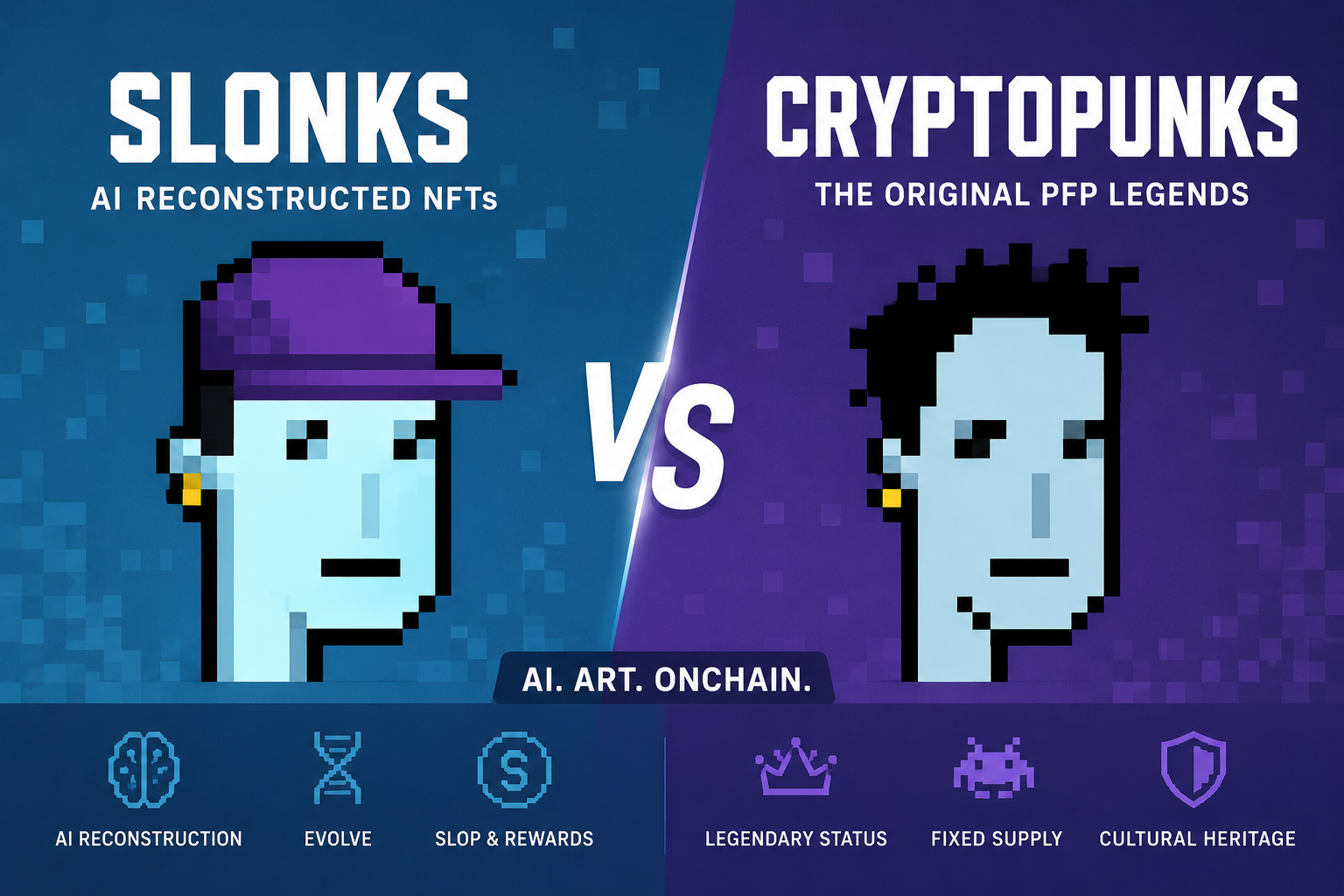
The core of Slonks is the use of an AI neural reconstruction mechanism to regenerate CryptoPunks images and allow NFT states to keep changing through on-chain mechanisms. Slonks can be understood as a type of AI reconstruction NFT. Its focus is not on copying a classic PFP, but on integrating image errors, NFT merging, and token generation into an on-chain experimental system.
Structurally, Slonks gameplay revolves around Merge, Void, slop values, and SLOP. First, the user holds a Slonk NFT. Then, the user can choose Merge, where one NFT is consumed to strengthen another. Next, the user can also use Void to convert the NFT’s slop value into SLOP. Ultimately, Slonks’ active supply, image state, and token cycle all change as a result of user behavior.
The importance of this mechanism is that Slonks expands NFTs from static avatars into interactive on-chain assets. Its collecting logic does not come only from the image’s appearance, but also from NFT state, slop value, changing scarcity, and the user’s participation path.
What Is CryptoPunks?
The core value of CryptoPunks comes from its classic PFP structure, fixed supply, and early position in NFT culture. It can be understood as a classic NFT collection built around pixel avatars, with collectible value formed mainly through rare traits, historical status, and market consensus.
Mechanically, CryptoPunks images and traits are essentially fixed after issuance. First, users identify a Punk’s type, traits, and rarity. Then, the market forms trading prices around these fixed characteristics. Next, collectors judge value based on rare traits, historical significance, and community recognition. Ultimately, each CryptoPunk keeps its original image and identity, without structural changes caused by user actions.
This structure makes CryptoPunks a representative example of classic PFP NFTs. Compared with Slonks, it places more emphasis on static scarcity and historical consensus than on changing NFT states through on-chain mechanics.
Differences in Generation Architecture Between Slonks and CryptoPunks
The generation architecture difference between Slonks and CryptoPunks mainly lies in “AI reconstruction” versus “fixed pixel generation.” Slonks uses a neural model to generate images that deviate from the original Punks, while CryptoPunks images remain essentially unchanged after issuance.
Structurally, Slonks images are not static asset combinations in the traditional sense. They are built around AI Reconstruction. The system generates new pixel results based on model output, then uses the slop value to measure the difference between the generated image and the original Punk. First, Slonks uses CryptoPunks images as reference objects. Then, the AI model reconstructs the images. Next, the system calculates pixel deviations between the reconstructed result and the original. Finally, this deviation affects NFT state and the SLOP mechanism.
CryptoPunks’ generation architecture is closer to the logic of a fixed collection. The images, traits, and identities are determined after issuance, while users mainly hold, display, and trade them. This difference shows that Slonks places greater emphasis on the generation process and state changes, while CryptoPunks emphasizes originality and fixed scarcity.
Differences in Artistic Mechanisms Between Slonks and CryptoPunks
Slonks’ artistic mechanism is built on AI error and image deformation, while CryptoPunks’ artistic mechanism is built on minimalist pixel style and fixed trait combinations. Both belong to the context of pixel art, but they express it in different ways.
From an artistic perspective, Slonks focuses on “reconstructed imperfection.” The AI model does not fully restore CryptoPunks. Instead, it generates images with deviation, distortion, and a sense of misalignment. The higher the slop value, the more obvious the difference between the image and the original Punk. First, users see a visual foundation connected to classic Punks. Then, AI reconstruction introduces deformation. Next, Merge may further change the image state. Ultimately, the artistry of Slonks comes from ongoing change and uncertainty.
CryptoPunks’ artistic mechanism places more emphasis on the cultural symbol of the original pixel avatar itself. Each Punk’s trait combination, type, and rarity form the basis of its collectible value. By comparison, Slonks is more like an on-chain experimental reinterpretation of classic NFT imagery, while CryptoPunks is more like an original visual source in NFT history.
Differences in Scarcity Logic Between Slonks and CryptoPunks
The scarcity logic of Slonks and CryptoPunks differs in one key way: one comes from dynamic change, while the other comes from fixed supply. The number and state of Slonks NFTs are affected by Merge, Void, and Revival actions, while CryptoPunks scarcity mainly comes from fixed total supply and trait distribution.
| Comparison Dimension |
Slonks |
CryptoPunks |
| Supply logic |
Changes with Merge and Void |
Fixed total supply |
| Image state |
Can change through mechanisms |
Mostly fixed |
| Source of scarcity |
User behavior and on-chain state |
Trait combinations and historical consensus |
| Token relationship |
Related to the SLOP mechanism |
No native token mechanism |
| Gameplay traits |
Experimental and game oriented |
Mainly collecting and trading |
| Value judgment |
Affected by state, slop, and scarcity together |
Affected by type, traits, and market consensus |
This table shows that Slonks scarcity is not fixed once and for all. It is continuously shaped by user behavior. First, Merge consumes some NFTs. Then, Void moves NFTs into a contract state and generates SLOP. Next, Revival may bring some Void state NFTs back into circulation. Ultimately, Slonks’ supply structure changes with ecosystem behavior.
CryptoPunks scarcity is easier to understand because each Punk’s traits and quantity are relatively stable. Its value foundation comes from classic collecting logic, while Slonks’ value foundation depends more on mechanism participation and dynamic state.
Differences in Ownership and On-Chain Structure Between Slonks and CryptoPunks
The differences between Slonks and CryptoPunks in ownership and on-chain structure mainly come from whether the NFT can be continuously changed by protocol mechanisms. Slonks NFT states are affected by contract logic, while CryptoPunks places more emphasis on the stability of asset identity.
Structurally, Slonks’ on-chain mechanisms include Merge, Void, SLOP generation, and Revival. First, users trigger contract processes through NFT operations. Then, the system changes NFT states or generates tokens according to its rules. Next, some NFTs may enter the Void pool. Ultimately, NFT states within the ecosystem continue changing under contract logic.
CryptoPunks’ on-chain structure leans more toward ownership records and transfer of trades. After a user holds a Punk, its core image identity does not change because of project gameplay. In other words, the focus of CryptoPunks ownership is “who owns this fixed NFT,” while Slonks ownership also involves “what state this NFT is currently in.”
This difference makes Slonks closer to an on-chain mechanism experiment, while CryptoPunks is closer to a classic digital collectible asset.
How Slonks and CryptoPunks Differ in Ecosystem and Gameplay
Slonks ecosystem gameplay revolves around user actions, while the CryptoPunks ecosystem mainly revolves around collecting, displaying, trading, and cultural identity. Both belong to the NFT field, but users participate in clearly different ways.
In Slonks, users do not simply hold an image. First, users can choose to keep a Slonk. Then, they can perform Merge, sacrificing one NFT to change the state of another. Next, users can use Void to convert the NFT’s slop value into SLOP. Finally, they may burn SLOP to participate in Revival, allowing some Void state NFTs to return to active circulation.
CryptoPunks gameplay is closer to classic collectible logic. Users focus on Punk type, trait rarity, historical sales, and community identity. Trading usually revolves around fixed traits and market recognition, rather than changing the NFT itself through contract gameplay.
Therefore, Slonks emphasizes “participating in mechanisms,” while CryptoPunks emphasizes “holding an identity.” This ecosystem difference determines that the two appeal to different kinds of NFT participation logic.
Which NFT Users Pay More Attention to Slonks or CryptoPunks?
Users who pay attention to Slonks usually care more about on-chain experimentation, AI image reconstruction, and NFT state changes. Users who pay attention to CryptoPunks tend to care more about classic PFP collecting, historical status, and fixed scarcity.
From a user structure perspective, Slonks is more likely to attract people interested in mechanism design. First, these users study how Merge, Void, and SLOP affect NFT supply. Then, they pay attention to slop values, state changes, and on-chain game dynamics. Next, they may view Slonks as an NFT mechanism experiment rather than simply an avatar collection. Ultimately, their judgment focuses on gameplay depth and system structure.
CryptoPunks is more likely to attract people who value NFT historical assets and cultural symbols. These users pay attention to Punk types, rare traits, holder structure, and market recognition.
Therefore, Slonks and CryptoPunks are not simple substitutes for each other. They represent two different directions for NFTs: one is dynamic mechanism experimentation, and the other is the classic PFP collecting model.
Conclusion
The core difference in Slonks vs CryptoPunks is not whether both are related to pixel avatars, but how they understand what an NFT can be.
Slonks uses AI reconstruction, Merge, Void, slop values, and SLOP mechanics to turn NFTs into experimental assets that change with on-chain behavior. CryptoPunks uses fixed images, rare traits, and historical consensus to form a classic PFP collecting system.
Across generation architecture, artistic mechanism, scarcity, on-chain ownership, and ecosystem gameplay, Slonks emphasizes mechanism evolution, while CryptoPunks emphasizes original collectible value. Together, they reflect different development paths for NFTs, from static avatar assets to on-chain experimental systems.
FAQs
What Is the Biggest Difference Between Slonks and CryptoPunks?
The biggest difference between Slonks and CryptoPunks lies in their mechanism structure. Slonks forms a dynamic NFT system through AI reconstruction, Merge, Void, and SLOP, while CryptoPunks mainly relies on fixed images, rare traits, and historical collectible value.
Is Slonks a Copy of CryptoPunks?
Slonks is not simply a copy of CryptoPunks. It uses CryptoPunks images as references, then generates new images with deviations through AI neural reconstruction and adds on-chain mechanisms such as Merge, Void, and SLOP.
Why Is CryptoPunks Considered a Classic PFP?
CryptoPunks is considered a classic PFP because it built collecting consensus through fixed pixel avatars, rare traits, and its early position in NFT culture. Its core value comes from historical status and fixed scarcity.
Why Is Slonks Scarcity Dynamic?
Slonks scarcity is affected by Merge, Void, and Revival. Merge reduces active NFTs, Void moves NFTs into a contract state, and Revival may bring some NFTs back into circulation.
Which Users Are More Suited to Following Slonks?
Users who care more about on-chain mechanisms, AI generated art, NFT state changes, and token cycles are usually better able to understand Slonks’ value structure. It is closer to a mechanism based experimental NFT.
Which Users Are More Suited to Following CryptoPunks?
Users who care more about classic NFT collecting, historical status, rare traits, and fixed digital identity are usually better able to understand CryptoPunks’ value structure. It is closer to a classic PFP collectible asset.