Real-Time ENA Coin Price Fluctuation: From Latest Movements to Future Outlook

Beginner
Quick Reads
Last Updated 2026-04-03 16:29:46
Reading Time: 1m
ENA Coin has seen considerable price swings in recent periods. This article examines the factors driving its downturn, TVL growth, token unlock risks, and key technical support, providing strategic insights tailored for new investors.

ENA Coin Overview

ENA Coin serves as the core token of the Ethena protocol. Ethena is focused on developing an on-chain synthetic dollar, USDe, which leverages innovative derivatives mechanisms to deliver a stablecoin pegged to the US dollar—without reliance on traditional banking infrastructure. ENA is integral to governance and staking within the protocol and forms the foundation for distributing USDe yield.

Current Price and Market Performance
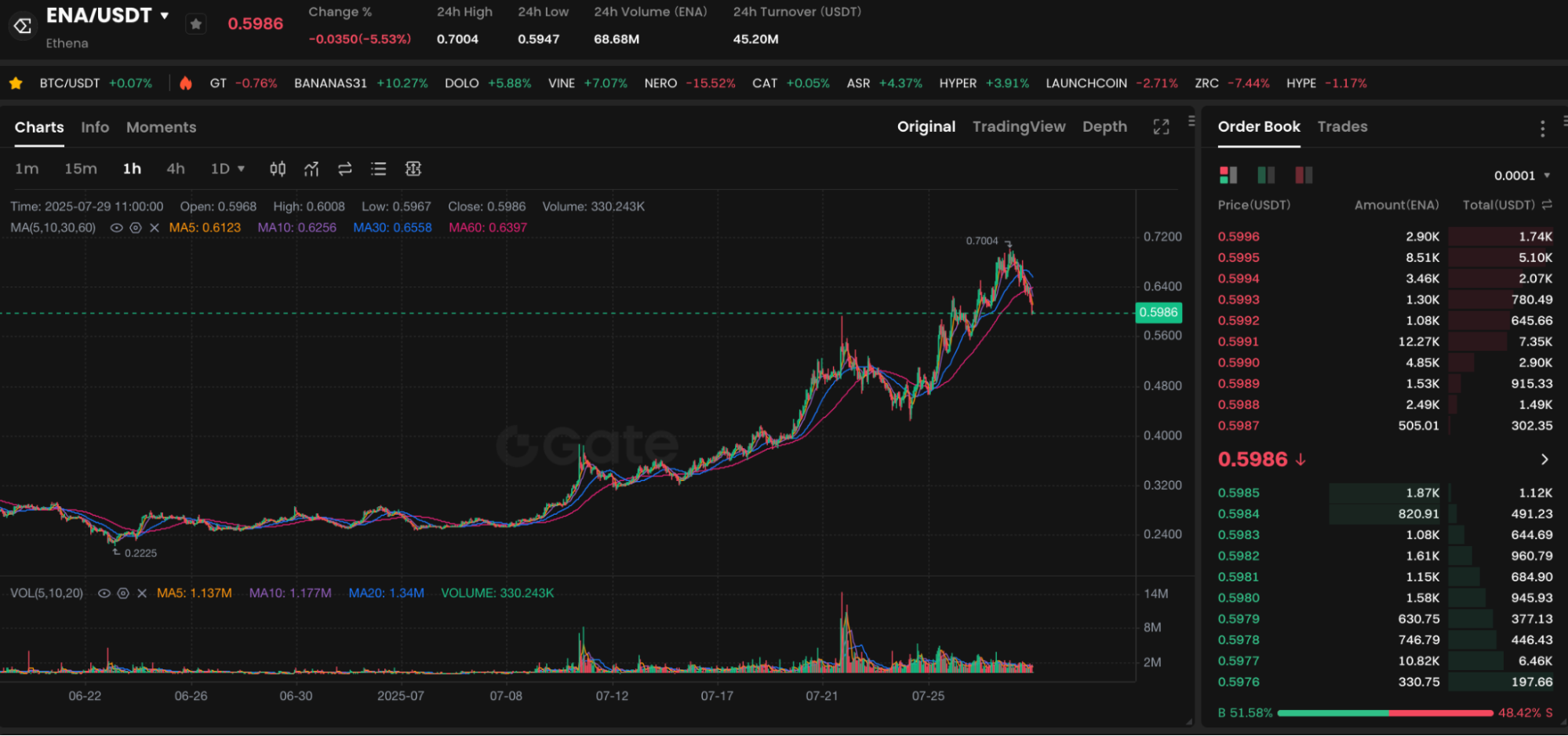

Chart: https://www.gate.com/trade/ENA_USDT

Based on Gate data, as of July 29, 2025, ENA Coin was priced at 0.5976 USDT, marking a 9.42% drop over the previous 24 hours. The session high reached 0.7004 USDT, while the low touched 0.5965 USDT. Trading volume climbed to 67.87 million ENA, with total turnover surpassing $44.73 million, reflecting a highly active market environment.

Despite near-term price pressure, trading activity remains strong, suggesting that market participants still retain a degree of confidence in ENA’s outlook.

TVL Sets New Record: Growth Drivers Analysis

In late July, Ethena’s on-chain Total Value Locked (TVL) exceeded $260 million, reaching an historic peak. The main drivers of this TVL growth include:

  1. USDe offers an annual yield up to 10%, attracting substantial capital to the protocol;
  2. The introduction of a buyback mechanism, with protocol-generated yield used for weekly ENA buybacks;
  3. Improved user confidence, driven by community engagement and increased media coverage.

An expanding TVL strengthens protocol security and capital efficiency. This lays the groundwork for medium- and long-term price support for ENA.

Token Unlock Risk Analysis

According to Token Unlocks, from July 28 to early August, Ethena will unlock tokens valued at approximately $686 million, releasing a significant portion of early investor and team-held tokens into the market.

If some of these holders choose to realize profits and exit their positions, short-term volatility could increase. Investors should closely monitor on-chain transfers and large wallet activity.

Technical Chart Patterns and Trend Analysis

From a technical analysis perspective:

  • Support level: 0.55 USDT
  • Resistance level: 0.70 USDT
  • Trendline: Currently positioned at the lower boundary of a descending channel

MACD and RSI indicators suggest the market is oversold, which could present short-term rebound opportunities. However, if the price falls below 0.55, investors should carefully consider further downside risk.

Practical Recommendations

For new participants:

  • Avoid chasing upward momentum; consider staggered entries in the 0.55 to 0.58 USDT range;
  • Set stop-losses below 0.52 USDT;
  • Set target levels at 0.70 and 0.80;
  • Monitor capital flows after the August unlock period.

The ENA project demonstrates clear, rational fundamentals. However, short-term price swings can be significant. Rigorous risk controls are essential. Long-term monitoring of the project’s DeFi positioning and USDe’s adoption is recommended.

Author: Max
Disclaimer
* The information is not intended to be and does not constitute financial advice or any other recommendation of any sort offered or endorsed by Gate.
* This article may not be reproduced, transmitted or copied without referencing Gate. Contravention is an infringement of Copyright Act and may be subject to legal action.

Related Articles

AI-Native Settlement Layers: How United Stables Is Building the Next Financial Rail
Beginner

AI-Native Settlement Layers: How United Stables Is Building the Next Financial Rail

Stablecoins were originally designed as dollar substitutes within exchanges, primarily used for asset pricing and trade settlement. As on-chain financial ecosystems have matured, their role has expanded beyond simple payments to include collateral assets, cross-chain liquidity mediums, and unified settlement units. In particular, as AI systems and automated agents begin to participate directly in economic activity, demand has risen sharply for programmable value units capable of instant settlement. This shift is pushing stablecoins toward the role of foundational financial infrastructure.
2026-03-25 03:16:17
The ve(3,3) Flywheel Explained: How AERO Tokenomics Powers Aerodrome’s DeFi Economy
Beginner

The ve(3,3) Flywheel Explained: How AERO Tokenomics Powers Aerodrome’s DeFi Economy

In the competition for DeFi liquidity, high-inflation mining alone is no longer enough to build lasting advantages. Aerodrome applies the ve(3,3) economic model to redesign token emissions, voting mechanisms, and revenue distribution, creating a liquidity flywheel centered on governance and cash flow. This article examines AERO tokenomics, the veAERO locking mechanism, and protocol revenue models to explain how Aerodrome builds a sustainable DeFi economic system.
2026-03-25 06:41:58
DePIN Identity Network and Real World Applications: How Humanity Protocol Brings on-chain Identity Into the Physical World
Beginner

DePIN Identity Network and Real World Applications: How Humanity Protocol Brings on-chain Identity Into the Physical World

Most Web3 identity systems remain confined to on-chain environments and struggle to achieve meaningful adoption in real world settings. Through a DePIN architecture and physical verification hardware, Humanity Protocol aims to bring decentralized identity into access control systems, hospitality, public services, and offline events, allowing on-chain identity to function not just as a digital credential, but as foundational infrastructure for real world access.
2026-03-25 07:40:53
Aerodrome Tokenomics: How ve(3,3) Powers Base's Most Profitable DEX
Beginner

Aerodrome Tokenomics: How ve(3,3) Powers Base's Most Profitable DEX

AERO is the native token of Aerodrome Finance, a core decentralized exchange and liquidity protocol in the Base ecosystem. It is primarily used for liquidity incentives and ecosystem operations. veAERO is a governance NFT that users receive by locking AERO, representing both voting power and the right to share protocol revenue. Through a dual track structure of AERO as a utility token and veAERO as a governance credential, Aerodrome separates liquidity usage value from long term governance power, allowing participants to act as liquidity providers, governance decision makers, and revenue sharers within the same system.
2026-03-25 06:40:31
Aster vs Hyperliquid: Which Perp DEX Will Prevail?
Beginner

Aster vs Hyperliquid: Which Perp DEX Will Prevail?

Aster and Hyperliquid are the two representative protocols of the "purpose-built L1 path" within the current decentralized perpetual exchange (Perp DEX) sector. As a pioneer in the field, Hyperliquid has built a deep liquidity moat through its highly mature order book architecture and strong community consensus. Conversely, Aster, as a rising challenger, seeks to leapfrog the competition in high-performance trading through more aggressive multi-chain aggregation logic, private transaction modules, and an underlying execution environment optimized for 2026 market demands.
2026-03-24 11:58:33
Gold Price Forecast for the Next Five Years: 2026–2030 Trend Outlook and Investment Implications, Could It Reach $6,000?
Beginner

Gold Price Forecast for the Next Five Years: 2026–2030 Trend Outlook and Investment Implications, Could It Reach $6,000?

Analyze current gold price trends alongside authoritative five-year forecasts, integrating an evaluation of market risks and opportunities. This gives investors insight into the potential trajectory of gold prices and the main drivers expected to shape the market over the next five years.
2026-03-25 18:13:30





