As DeFi trading volume continues to grow, MEV has become an important factor affecting the on-chain trading experience. Transaction information in the public mempool is exposed to network participants before it is included in a block, and some bots use this information to position their own trades in advance for additional profit.
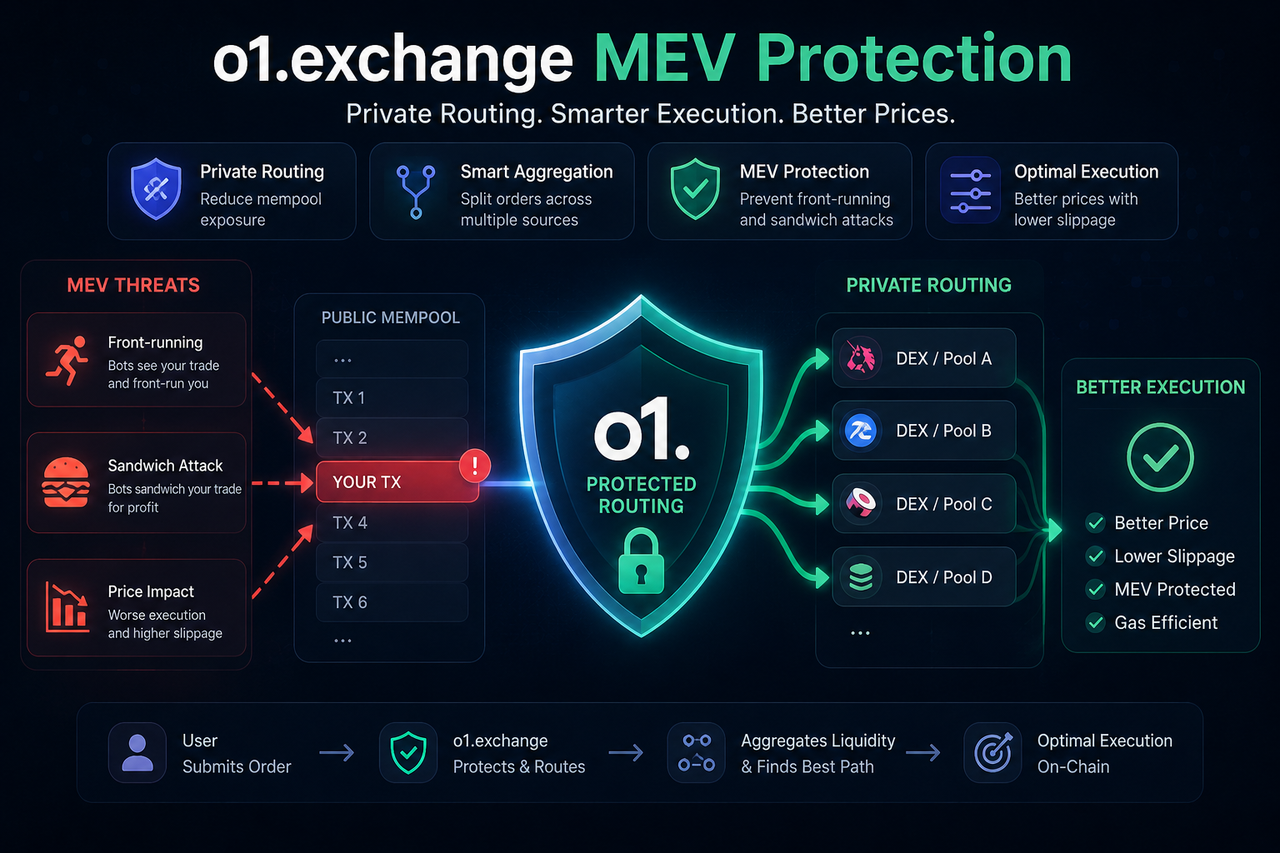
o1.exchange reduces MEV risk through technologies such as aggregation routing, trade protection mechanisms, slippage optimization, and private execution paths. Its goal is to reduce opportunities for transaction exploitation while preserving on-chain transparency, improving users’ final execution quality and overall trading efficiency.
What Is MEV?
MEV stands for Maximal Extractable Value.
It refers to the extra profit that block producers, validators, or third-party bots can capture by changing transaction order, inserting transactions, or reorganizing blocks.
In most cases, MEV arises from market price movements, arbitrage opportunities, and the informational value created by user transactions.
While some forms of MEV are part of normal market activity, certain types can directly affect the trading outcomes of ordinary users.
How Is MEV Created?
Transactions on blockchain networks are not executed immediately.
After a user submits a transaction, it usually enters the mempool first and waits for a validator to select it and include it in a block.
Because transaction information in the mempool is publicly visible, other participants can see details in advance, including trade direction, transaction size, and target assets.
Some bots use this information to predict price movements and insert their own transactions before or after the target transaction to make a profit.
This behavior forms the basis of most MEV activity.
What Is Front-Running?
Front-running is one of the most common types of MEV.
When a bot detects that a user is about to execute a trade that may push the price up, it submits its own trade first and uses a higher Gas fee to try to get executed earlier.
By the time the user’s trade is executed, the market price has already changed.
The bot can quickly profit from the price difference, while the user may end up buying at a higher price or selling at a lower price.
What Is a Sandwich Attack?
A sandwich attack is one of the most widespread forms of MEV attacks in DeFi markets.
The attacker places a trade before the user’s transaction to push the price up, then waits for the user’s order to execute.
The attacker then immediately places the opposite trade to take profit.
The process resembles placing the user’s order between two attack transactions, which is why it is called a “sandwich attack.”
For large trades or low-liquidity assets, the price loss caused by a sandwich attack can be especially significant.
Why Can Private Routing Reduce MEV Risk?
The public mempool is the source of most MEV behavior.
When a transaction can reduce its public exposure time during broadcasting, bots have fewer opportunities to use its information.
Private routing is a trade protection approach built around completing part of the execution process before a transaction reaches the public market.
This can reduce the likelihood that a transaction will be monitored, copied, or reordered, improving execution security.
As on-chain trading volume continues to expand, private routing is gradually becoming one of the key tools for trade protection.
How Does o1.exchange Reduce MEV Impact Through Route Optimization?
The core trading engine of o1.exchange searches for the best execution path across multiple liquidity sources.
This aggregation routing mechanism not only improves price quality, but also reduces the risks created by exposure to a single liquidity pool.
When the system splits an order across multiple trading sources, it becomes harder for attackers to accurately predict the full trading path.
For larger orders, multi-path execution can also reduce the market impact of a single transaction, leaving less room for sandwich attacks to exploit.
How Does Automatic Slippage Management Protect Users?
Slippage is an important measure of the difference between the expected price and the actual execution price.
MEV attacks often widen slippage, increasing users’ trading costs.
o1.exchange dynamically adjusts trading parameters based on market liquidity and order size, and it performs risk assessment before execution.
If market conditions change significantly, the system may recalculate the optimal route or trigger the protection conditions preset by the user.
This mechanism helps reduce the impact of abnormal price movements on trade outcomes.
Why Does Aggregated Trading Help Reduce MEV Risk?
The core advantage of aggregated trading is not limited to finding the best price.
When a trade can use multiple liquidity sources at the same time, the execution process becomes more complex.
For potential attackers, it also becomes harder to predict price movements and the execution path.
At the same time, aggregators can use greater overall liquidity depth to complete trades, reducing price deviation after a single market is impacted.
This feature makes aggregation routing an important tool for addressing certain MEV risks.
Summary
MEV is an important phenomenon in the on-chain trading environment. Common forms include front-running, sandwich attacks, and back-running arbitrage. Because blockchain transactions need to be propagated in a public environment, some market participants can use transaction information to extract additional profit, affecting the execution results of ordinary users.
o1.exchange reduces MEV risk through mechanisms such as aggregation routing, private execution paths, order splitting, and automatic slippage management. Although MEV cannot be completely eliminated, these trade protection measures can reduce transaction exposure, improve execution quality, and provide users with a more stable on-chain trading experience.
FAQs
Does MEV Affect Ordinary Users?
Yes. MEV may worsen users’ execution prices, increase slippage, and raise trading costs.
What Is a Sandwich Attack?
A sandwich attack is a type of attack in which the attacker places trades before and after a user’s transaction to profit from the resulting price movement.
How Does Private Routing Reduce MEV Risk?
Private routing reduces the time a transaction is exposed in the public mempool, lowering the chance that bots can monitor and exploit its information.
Why Do Aggregators Help Protect Against MEV?
Aggregators can split orders across multiple liquidity sources, making trading paths more complex and reducing price deviation after a single market is impacted.
Can o1.exchange Completely Avoid MEV?
No. MEV is closely tied to blockchain transaction ordering mechanisms. The industry currently focuses on reducing its impact through trade protection and execution optimization technologies rather than eliminating it completely.







