Within today’s AI Infra track, most systems still focus primarily on model inference and hash power, while long-term memory and multi-agent collaboration remain in their early stages.
Unibase aims to build the essential foundation for AI Agents to operate continuously—through a decentralized Memory Layer, open Agent protocols, and a data availability architecture—enabling AI to accumulate experience, share knowledge, and engage in open networks as long-lived digital agents.
What Is the Overall Architecture of Unibase?
Unibase’s overall structure consists of three core components: Membase, AIP Protocol, and Unibase DA.
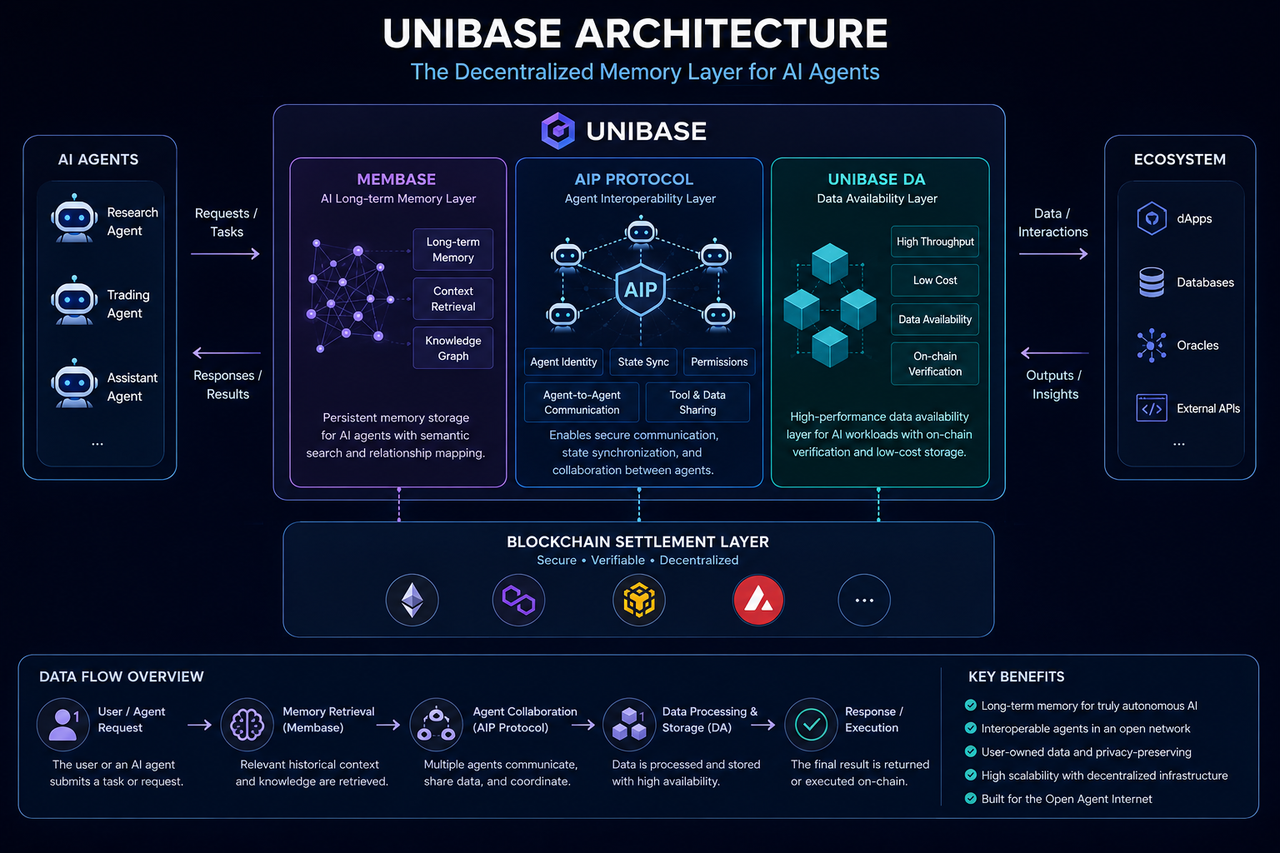
Membase handles long-term memory management for AI Agents, storing historical context, task states, and knowledge data. AIP Protocol (Agent Interoperability Protocol) establishes communication standards between Agents, enabling different AIs to exchange states and collaborate on tasks. Unibase DA (Data Availability) manages the storage, synchronization, and accessibility of high-frequency AI data.
Traditional AI systems typically rely on centralized databases and short-term context windows, whereas Unibase prioritizes long-term state synchronization and open Agent networks. Its goal is not just to enhance model capabilities, but to provide the infrastructure for AI Agents to persist and collaborate over time.
| Module |
Core Function |
Main Features |
| Membase |
AI Long-Term Memory Layer |
Stores context, historical states, and knowledge data |
| AIP Protocol |
Agent Communication Protocol |
Identity management, state sync, and multi-agent collaboration |
| Unibase DA |
Data Availability Layer |
AI data storage, sync, and on-chain verification |
How Do AI Agents Generate and Store Memories?
In traditional large language models, conversation context is typically limited in length, and most states are not preserved long-term after a session ends. This means AI struggles to continuously accumulate experience or remember user preferences and historical tasks over time.
Unibase’s Membase module is designed to address this issue.
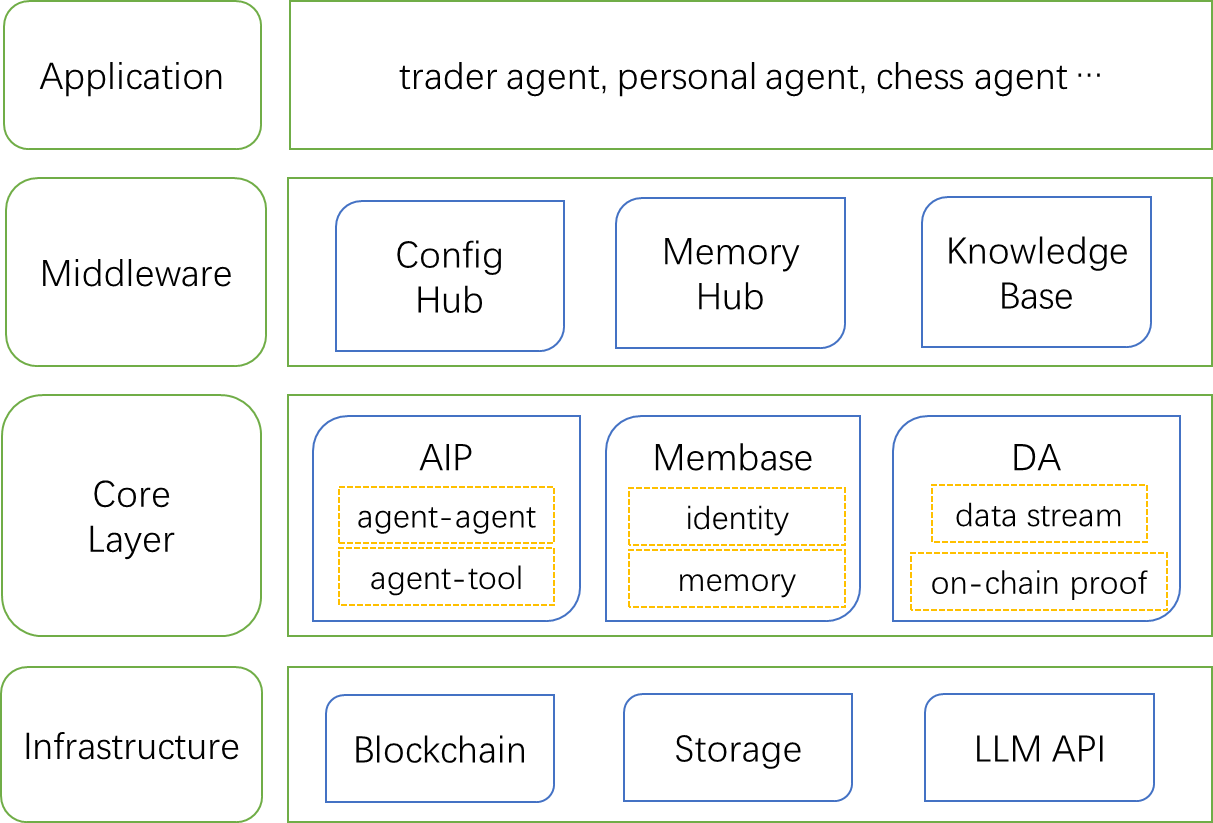
When an AI Agent interacts with users, executes tasks, or invokes tools, the relevant states are converted into structured memory data. This data may include historical conversations, task outcomes, environmental information, or knowledge fragments. Membase then writes this content into the long-term memory system and creates searchable indexes.
In subsequent tasks, the AI Agent can retrieve these historical states, enabling continuous learning and context persistence. This architecture makes the AI more like a persistent digital entity rather than a one-time Q&A system.
| AI Memory Type |
Characteristics |
Limitations |
| Short-Term Context Window |
Fast response speed |
Cannot retain states long-term |
| Centralized Database Memory |
Can store long-term |
Data is dependent on platform control |
| Unibase Membase |
Decentralized long-term memory |
Supports multi-agent collaboration and state sharing |
How Does Membase Achieve Long-Term Context Management?
Membase’s core logic goes beyond simply “storing data”—it enables AI to continuously access and manage historical states.
During operation, AI Agents filter, update, and retrieve long-term memories based on task requirements. For example, when a user submits a new request, the Agent can first search relevant historical information and then generate a response based on the current context.
Unlike traditional databases, Membase focuses on semantic-level memory management. This means the AI doesn't just read text—it understands user relationships, task goals, and environmental changes based on historical states.
In multi-agent collaboration scenarios, different Agents can also share partial memory states. For instance, a research Agent can sync its results to an execution Agent, which then proceeds with the next steps.
This structure transforms long-term memory from a single-model asset into a shared infrastructure within an open Agent network.
How Does the AIP Protocol Enable Agent Communication?
The AIP Protocol is Unibase’s Agent interoperability protocol, functioning as a communication standard in the AI Agent ecosystem.
In an open Agent internet, Agents may come from different models, platforms, or applications. Without a unified protocol, exchanging states and collaborating would be challenging.
The AIP Protocol’s core features include identity management, state synchronization, permission control, and Agent-to-Agent communication. For example, one Agent can request data analysis results from another, or delegate specific tasks to it.
This structure bears some resemblance to smart contract interactions in Web3. By providing a unified standard, different AI Agents can form collaborative relationships within an open network rather than being locked into a single platform.
| Function |
Role of AIP Protocol |
| Agent Identity |
Manages Agent identities and permissions |
| State Sync |
Synchronizes Agent states |
| Communication |
Establishes Agent-to-Agent communication |
| Task Coordination |
Supports multi-agent collaborative tasks |
| Tool Invocation |
Cross-platform Agent tool calls |
How Does Unibase DA Support AI Data Operations?
AI Agents generate large volumes of high-frequency data during continuous operation, including memory updates, task states, tool call records, and collaboration information.
Traditional blockchains struggle to handle this high-throughput AI data directly, so Unibase introduces a dedicated Data Availability Layer.
Unibase DA’s core functions include boosting AI data throughput, reducing long-term storage costs, ensuring state accessibility, and supporting on-chain verification and synchronization.
For AI Agent networks, the Data Availability Layer serves as the underlying infrastructure for long-term memory and state synchronization. Without stable data availability, AI Agents would struggle to operate continuously and share states.
| Data Type |
Role in Unibase DA |
| Dialogue State |
Saves the Agent’s current context |
| Memory Updates |
Synchronizes long-term memory updates |
| Tool Records |
Stores tool call results |
| Agent Collaboration Data |
Records multi-agent collaboration states |
| Verification Data |
Supports on-chain verification and traceability |
How Is a Typical AI Agent Collaboration Process Completed?
In Unibase’s architecture, a standard multi-agent collaboration process involves several stages.
First, a user issues a task request to an AI Agent—such as data research, market analysis, or automated execution. The Agent then calls Membase to retrieve long-term historical states, including user preferences, past tasks, and relevant knowledge data.
If the task involves multiple Agents, the AIP Protocol establishes communication links between them. For example, a research Agent might gather information while an execution Agent handles subsequent processing.
During task execution, all state changes and data updates are synchronized to Unibase DA to ensure data accessibility and state consistency. After the task completes, newly generated data is written back to Membase, becoming long-term context for future tasks.
| Stage |
System Module |
Main Role |
| User Request |
AI Agent |
Receives the task |
| Memory Retrieval |
Membase |
Retrieves historical context |
| Agent Collaboration |
AIP Protocol |
Establishes communication and state sync |
| Data Sync |
Unibase DA |
Saves running state |
| Memory Update |
Membase |
Writes to long-term memory |
How Does Unibase Differ From Traditional AI Systems?
Traditional AI systems typically use a centralized architecture, with memory and states stored inside platform databases. Users have limited control over their data and cannot achieve cross-platform Agent collaboration.
In contrast, Unibase emphasizes long-term memory systems, open Agent communication protocols, decentralized data structures, and multi-agent collaboration capabilities.
Traditional AI is more like one-time model calls, while Unibase focuses on the long-term autonomy and persistence of AI Agents.
| Dimension |
Traditional AI Systems |
Unibase |
| Memory |
Short-term context |
Long-term memory system |
| Data Structure |
Centralized database |
Decentralized storage |
| Agent Collaboration |
Limited |
Supports open network collaboration |
| State Sync |
Within platform |
Cross-platform Agent sync |
| Data Ownership |
Platform-controlled |
Emphasizes openness and verifiability |
Why Does the Open Agent Internet Need a Memory Layer?
The core goal of the Open Agent Internet is to enable AI Agents to exist persistently, interact continuously, and form collaborative networks—much like users on the internet.
If AI Agents cannot preserve long-term states, every task would require rebuilding context, severely limiting collaboration efficiency. The Memory Layer exists to give AI Agents a “persistent identity” and “long-term experience.”
Under this structure, AI is no longer just a model that generates temporary content but more like a digital agent capable of long-term growth.
Therefore, long-term memory systems are considered a critical infrastructure for the Open Agent Internet, and Unibase stands out as a representative project in this direction.
Summary
Unibase’s core operational logic revolves around long-term memory, open protocols, and data availability.
Through Membase, AIP Protocol, and Unibase DA, AI Agents can preserve long-term context, collaborate across platforms, and continuously synchronize states within an open network. This architecture transforms AI Agents from short-term tools into autonomous digital entities that can exist and evolve over time.
FAQs
What is the role of Membase?
Membase stores AI Agents’ long-term context, historical tasks, and knowledge data, enabling AI to continuously learn and access historical information.
How does the AIP Protocol work?
The AIP Protocol is an Agent communication protocol that enables Agent identity management, state synchronization, and multi-agent collaboration.
What is Unibase DA?
Unibase DA is the Data Availability layer that supports high-frequency data storage, synchronization, and accessibility for AI Agents.
Why do AI Agents need long-term memory?
Long-term memory helps AI preserve historical states, accumulate experience over time, and improve collaboration on complex tasks.
What is the Open Agent Internet?
The Open Agent Internet is an open network where AI Agents can interconnect and interoperate, allowing multiple Agents to collaborate under a unified protocol.







