How to Buy Bitcoin with PayPal?

Beginner
Quick Reads
Last Updated 2026-03-27 23:48:54
Reading Time: 1m
This article provides a formal overview of whether you can purchase Bitcoin using PayPal, detailing current PayPal policies, the transaction process, and associated costs and risks to help newcomers understand how to securely access the Bitcoin market via PayPal.

What Is PayPal and How Does It Relate to Buying Bitcoin

PayPal is a leading global online payment platform used by hundreds of millions for managing accounts, transferring funds, and making payments. As digital assets have surged in popularity, PayPal has progressively added crypto functionality to its offerings. Many newcomers ask, “Can I buy bitcoin with PayPal?”—in other words, can you use PayPal to purchase Bitcoin?

The answer depends on your location and the specific methods available. Not all features are universally accessible, and platform capabilities vary by region.

2025 Update: PayPal’s Bitcoin Support

Source: https://www.paypal.com/us/digital-wallet/manage-money/crypto

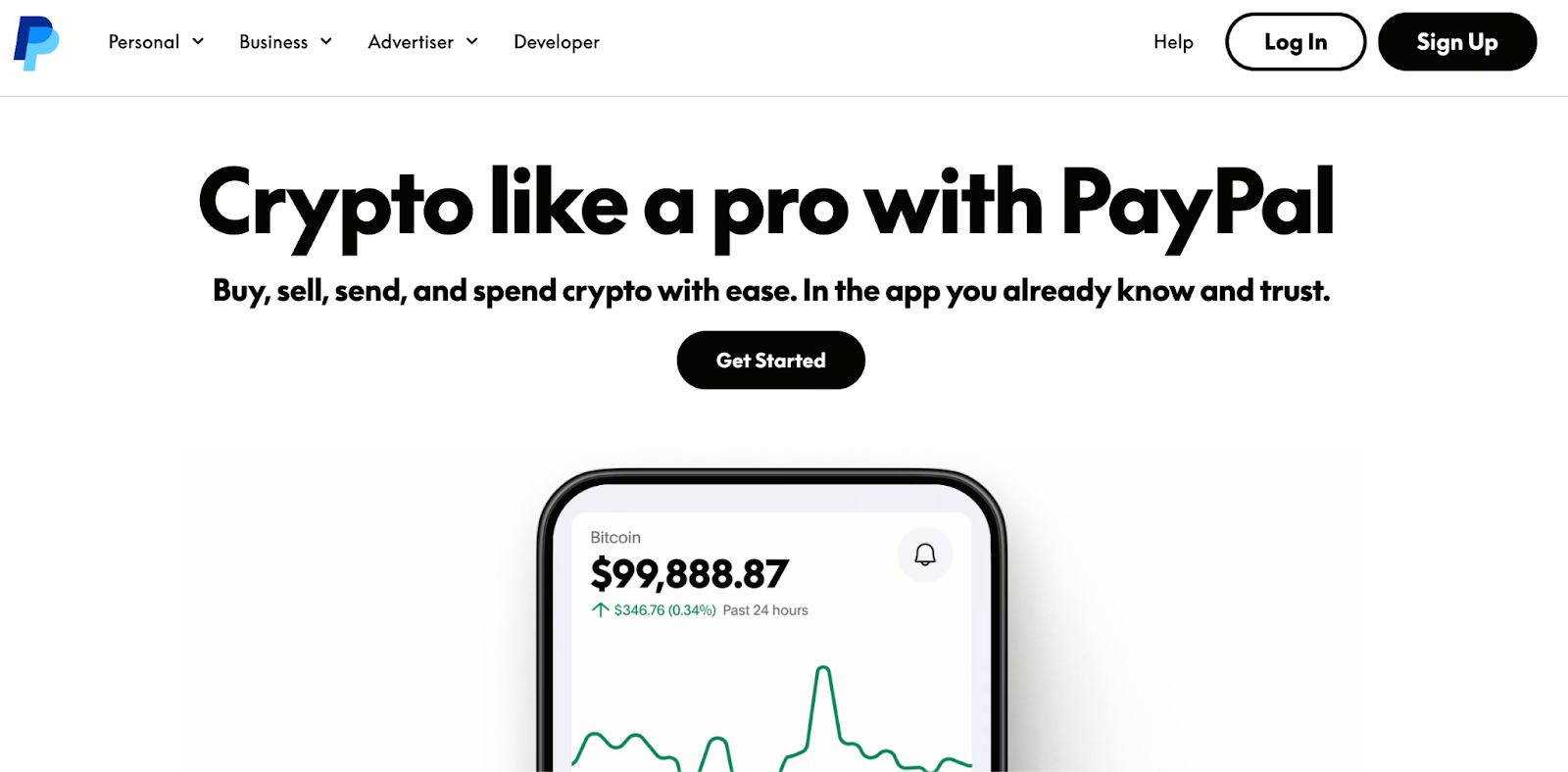
In 2025, PayPal enables U.S. users to buy, hold, and transfer Bitcoin. For example, U.S. account holders can use the “Buy Crypto” feature in the PayPal app to purchase and retain Bitcoin. PayPal is also expanding peer-to-peer (P2P) cryptocurrency transfers, allowing users to send Bitcoin or other cryptocurrencies from one PayPal account to another. Users should verify whether their location is supported before proceeding, as features such as external wallet withdrawals may not be available in all countries or for all users.

Beginner’s Guide: Step-by-Step Instructions for Buying Bitcoin with PayPal

Below is a general process using the United States as an example. Procedures may vary by country or region:

  • Register or log in to your PayPal account
  • Go to the “Buy Crypto” or crypto assets section in the app and select Bitcoin
  • Enter the purchase amount, review the current exchange rate and PayPal’s quoted price
  • Confirm your payment method (bank, credit card, PayPal balance, etc.) and complete the transaction
  • After purchase, Bitcoin will appear in your PayPal Crypto Hub or similar dashboard

If you want to transfer Bitcoin to an external wallet (non-custodial), check whether this feature is enabled, as it may be restricted in certain regions or for specific accounts.

Fees, Risks, and Key Considerations: Three Essential Facts

Fees: While PayPal offers convenience, each transaction may involve a spread and additional fees. According to PayPal’s official terms, buying crypto assets (including Bitcoin) may incur both a “spread” and service fees, in addition to exchange rate changes.

Transfer and Holding Restrictions: In some locations, you may be unable to withdraw Bitcoin directly from PayPal to an external wallet, limiting you to internal PayPal trades. These restrictions affect your ability to fully control your crypto holdings.

Market Volatility and Security Risks: Crypto prices are notoriously volatile, with sharp swings possible over short periods. PayPal’s terms highlight that crypto asset values can be “extremely unstable and unpredictable.”

Moreover, purchasing Bitcoin via PayPal does not eliminate risks such as hacking, account theft, or wallet errors. It is recommended to enable two-factor authentication and use robust security practices.

Conclusion: Is Buying Bitcoin via PayPal Worth It?

For newcomers, PayPal’s main advantages are its familiar interface, user-friendly experience, and streamlined process—making it ideal for those seeking a quick and easy way to get started. However, if your goal is to hold Bitcoin long-term and have full control, including external transfers, you must weigh the associated fees and platform limitations. If your region is supported, you can buy bitcoin with PayPal. Still, it’s wise to start with a small amount, fully understand the costs, restrictions, and risks, and then decide if you want to increase your investment.

Author: Max
Disclaimer
* The information is not intended to be and does not constitute financial advice or any other recommendation of any sort offered or endorsed by Gate.
* This article may not be reproduced, transmitted or copied without referencing Gate. Contravention is an infringement of Copyright Act and may be subject to legal action.

Related Articles

AI-Native Settlement Layers: How United Stables Is Building the Next Financial Rail
Beginner

AI-Native Settlement Layers: How United Stables Is Building the Next Financial Rail

Stablecoins were originally designed as dollar substitutes within exchanges, primarily used for asset pricing and trade settlement. As on-chain financial ecosystems have matured, their role has expanded beyond simple payments to include collateral assets, cross-chain liquidity mediums, and unified settlement units. In particular, as AI systems and automated agents begin to participate directly in economic activity, demand has risen sharply for programmable value units capable of instant settlement. This shift is pushing stablecoins toward the role of foundational financial infrastructure.
2026-03-25 03:16:17
The ve(3,3) Flywheel Explained: How AERO Tokenomics Powers Aerodrome’s DeFi Economy
Beginner

The ve(3,3) Flywheel Explained: How AERO Tokenomics Powers Aerodrome’s DeFi Economy

In the competition for DeFi liquidity, high-inflation mining alone is no longer enough to build lasting advantages. Aerodrome applies the ve(3,3) economic model to redesign token emissions, voting mechanisms, and revenue distribution, creating a liquidity flywheel centered on governance and cash flow. This article examines AERO tokenomics, the veAERO locking mechanism, and protocol revenue models to explain how Aerodrome builds a sustainable DeFi economic system.
2026-03-25 06:41:58
Aerodrome Tokenomics: How ve(3,3) Powers Base's Most Profitable DEX
Beginner

Aerodrome Tokenomics: How ve(3,3) Powers Base's Most Profitable DEX

AERO is the native token of Aerodrome Finance, a core decentralized exchange and liquidity protocol in the Base ecosystem. It is primarily used for liquidity incentives and ecosystem operations. veAERO is a governance NFT that users receive by locking AERO, representing both voting power and the right to share protocol revenue. Through a dual track structure of AERO as a utility token and veAERO as a governance credential, Aerodrome separates liquidity usage value from long term governance power, allowing participants to act as liquidity providers, governance decision makers, and revenue sharers within the same system.
2026-03-25 06:40:31
How Does PAXG Work? In-Depth Overview of the Physical Gold Tokenization Mechanism
Beginner

How Does PAXG Work? In-Depth Overview of the Physical Gold Tokenization Mechanism

PAXG (Pax Gold) is a tokenized asset backed by physical gold, issued by the fintech company Paxos and traded on the Ethereum blockchain as an ERC-20 token. The core concept is to tokenize physical gold on-chain, with each PAXG token representing ownership of a certain amount of gold. This structure enables investors to hold and trade gold in the form of a digital asset.
2026-03-24 19:12:51
How is the price of PAXG determined? Pegging mechanism, trading depth, and influencing factors
Beginner

How is the price of PAXG determined? Pegging mechanism, trading depth, and influencing factors

PAXG (Pax Gold) is a tokenized asset backed by physical gold reserves, launched by fintech firm Paxos and issued as an ERC-20 token on the Ethereum blockchain. The core concept is to digitally represent real-world gold assets, allowing investors to hold and trade gold via the blockchain network. Because each PAXG token corresponds to a specific quantity of physical gold, its price is theoretically expected to closely track the global gold market.
2026-03-24 19:11:40
DePIN Identity Network and Real World Applications: How Humanity Protocol Brings on-chain Identity Into the Physical World
Beginner

DePIN Identity Network and Real World Applications: How Humanity Protocol Brings on-chain Identity Into the Physical World

Most Web3 identity systems remain confined to on-chain environments and struggle to achieve meaningful adoption in real world settings. Through a DePIN architecture and physical verification hardware, Humanity Protocol aims to bring decentralized identity into access control systems, hospitality, public services, and offline events, allowing on-chain identity to function not just as a digital credential, but as foundational infrastructure for real world access.
2026-03-25 07:40:53





