Training large AI models requires not only GPU computing power, but also massive high speed data exchange capacity. If GPUs cannot continuously access training data, the overall efficiency of the AI system drops sharply. For this reason, high performance memory has gradually become essential infrastructure in the AI supply chain.
As AI data centers continue to scale, demand for HBM, server DRAM, and enterprise SSDs is growing rapidly. Micron is therefore not only a traditional memory chip company, but also an important participant in AI infrastructure.
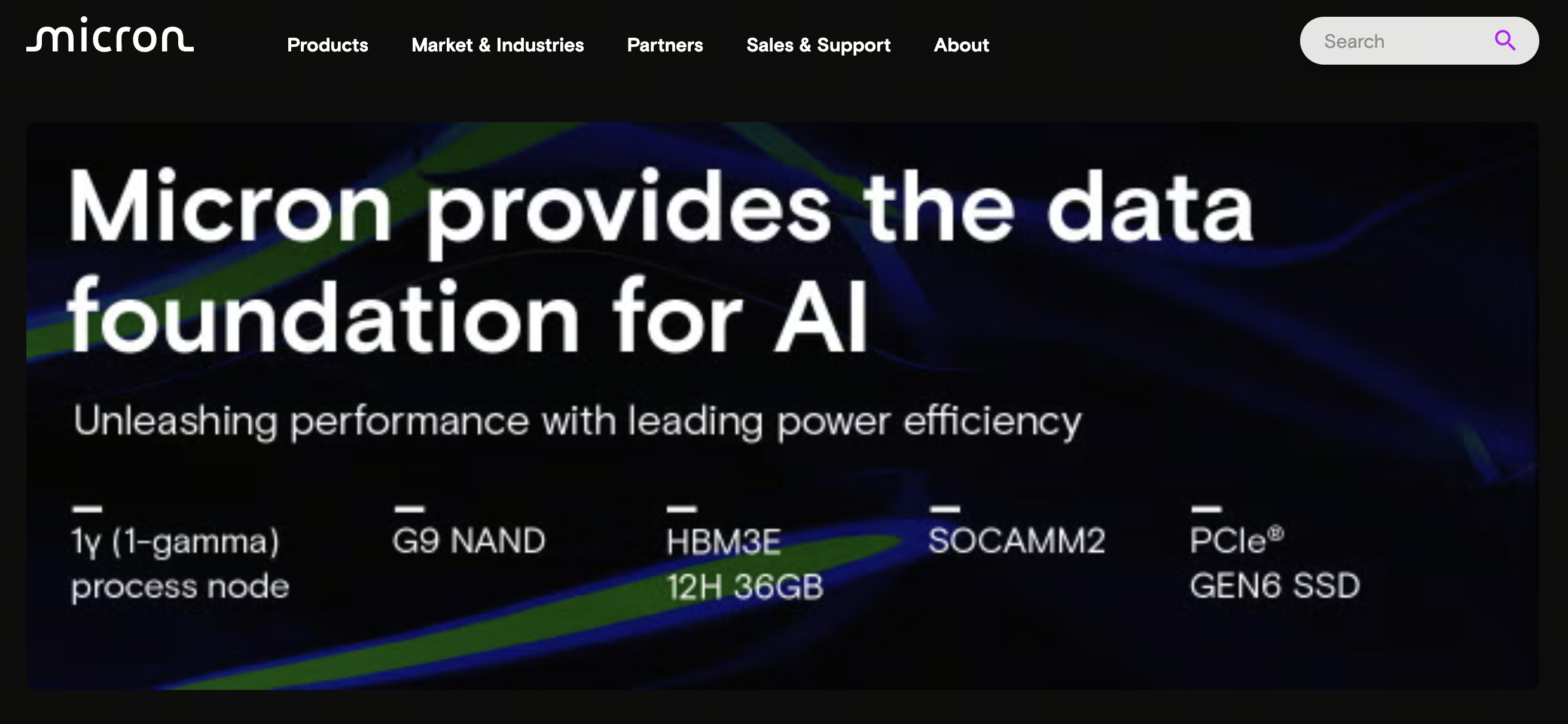
Source: micron.com
Micron’s Relationship with the AI Supply Chain
Micron’s main role in the AI supply chain is to help AI systems complete high speed data transmission and storage. AI GPUs handle computation, while DRAM, HBM, and enterprise SSDs handle data caching, reading, and long term storage. In practice, the entire AI system depends on the coordination of computing power and storage.
From an industry structure perspective, AI infrastructure usually includes GPUs, CPUs, networking systems, servers, and storage systems. Companies such as NVIDIA focus more on the GPU computing layer, while Micron is mainly responsible for high performance memory and data flow efficiency.
During AI model training, GPUs continuously access large amounts of parameters and data. If data reading speed is insufficient, even a powerful GPU cannot operate efficiently. As a result, demand for HBM and server DRAM in the AI market is growing rapidly.
This structure means the expansion of AI infrastructure usually drives not only growth in the GPU market, but also demand for high performance storage.
Why AI Model Training Needs High Bandwidth Memory
AI model training has extremely high data throughput requirements, so traditional storage systems struggle to meet the needs of large scale AI computing. During large language model training in particular, GPUs need to read large amounts of parameters, weights, and training data at the same time.
Traditional DRAM can provide high speed caching, but AI GPUs require far more data bandwidth than ordinary computing tasks. If a GPU cannot access data in time, computing resources may sit idle, reducing training efficiency.
The core purpose of HBM high bandwidth memory is to improve data exchange between GPUs and memory. Compared with ordinary DRAM, HBM can provide higher bandwidth and lower latency, making it better suited to AI data centers and high performance computing systems.
This mechanism means the AI era needs not only stronger GPUs, but also stronger data transmission systems. High performance memory is therefore becoming an important part of AI infrastructure.
How HBM Memory Enters AI Chip Systems
HBM high bandwidth memory usually forms a highly coordinated structure with AI GPUs. Compared with traditional memory modules, which are installed separately, HBM emphasizes tight packaging and high speed data connections.
First, the GPU continuously processes AI model computing tasks. HBM then quickly provides the GPU with training data and parameter caching. Next, high speed interconnect structures help the GPU and HBM maintain low latency data exchange. Finally, the AI system can maintain efficient large scale model training.
Structurally, HBM is usually deployed together with GPUs through advanced packaging technology. This approach shortens data transmission distance and reduces power consumption and latency.
The table below shows how AI GPUs and HBM work together:
| Module |
Main Role |
| GPU |
AI computation |
| HBM |
High speed data exchange |
| DRAM |
System cache |
| SSD |
Long term data storage |
This collaborative system means AI chip performance depends not only on the GPU itself, but also on HBM data bandwidth.
How Micron Supports GPU and Data Center Operations
Micron mainly supports AI GPU and data center operations through HBM, server DRAM, and enterprise SSDs. Compared with the consumer electronics market, AI data centers have higher requirements for stability, bandwidth, and continuous operation.
When an AI server is running, the GPU continuously accesses large amounts of training data. First, DRAM handles real time data caching. Then, HBM helps the GPU complete high speed data exchange. Finally, enterprise SSDs handle long term data storage and database management.
This process means AI data centers need a multi layer storage system working in coordination. If a system has GPUs but lacks high speed memory, AI model training efficiency usually drops significantly.
As AI models continue to grow in scale, demand for HBM and server DRAM from individual AI data centers is also continuing to rise.
AI servers depend on high performance storage mainly because of the need to process data at massive scale. Compared with traditional enterprise servers, AI systems need to handle more parameters, model weights, and training data at the same time.
In operation, AI model training continuously reads enormous amounts of data. GPUs perform computation, while DRAM and HBM handle high speed caching and data transmission. If the storage system cannot keep up with GPU computing speed, AI training efficiency is limited.
At the same time, large model training usually requires long periods of continuous operation, so server storage systems need not only speed, but also stability and the ability to handle sustained workloads.
This structure means competition in AI infrastructure is not only about GPUs, but also about high performance memory and data center storage systems.
How AI Infrastructure Expansion Affects Micron’s Business
The expansion of AI infrastructure is driving rapid growth in Micron’s high performance memory business. In the HBM and server DRAM markets especially, demand from AI data centers has gradually become an important industry driver.
Traditional consumer electronics markets are usually affected by smartphone and PC cycles. The AI data center market, however, focuses more on long term computing power expansion and enterprise server construction, so its demand structure is clearly different.
As AI GPU shipments increase, demand for HBM usually grows at the same time. This is because GPUs need large amounts of high bandwidth memory, and AI chip performance is closely tied to HBM data exchange efficiency.
At the same time, cloud computing companies and large technology firms are continuing to expand AI data centers, which also supports demand growth in server DRAM and enterprise SSD markets.
Main Application Scenarios for Micron’s AI Storage Products
Micron’s AI storage products are mainly used in AI data centers, cloud computing, high performance servers, and large model training. As AI systems continue to scale, high performance memory has gradually become an important part of modern AI infrastructure.
AI data centers are usually the most important application scenario for HBM and server DRAM. When GPUs train AI models, they need to continuously read massive amounts of data, so high speed memory directly affects training efficiency.
Cloud computing platforms also rely heavily on enterprise SSDs and server storage systems. Large AI platforms need not only to train models, but also to store data over long periods and support online inference services.
In addition, autonomous driving, edge AI, and high performance computing markets are also increasing demand for high performance storage products. Modern AI systems continue to require more data bandwidth and storage capacity.
Conclusion
Micron (MU)’s core role in the AI supply chain is to provide high performance memory and storage support for GPUs, data centers, and AI servers. HBM, DRAM, and enterprise SSDs are therefore becoming important parts of AI infrastructure.
Large AI model training depends not only on GPU computing power, but also on high speed data exchange. HBM high bandwidth memory helps GPUs improve data throughput efficiency, so demand for high performance memory in the AI market is growing rapidly.
As AI data centers continue to expand, memory chip companies such as Micron are becoming increasingly important in AI infrastructure.
FAQs
What Is HBM High Bandwidth Memory?
HBM is a high performance memory technology mainly used in AI GPUs and high performance computing systems. It can provide higher data bandwidth and lower latency.
Why Is Micron Part of the AI Supply Chain?
Micron mainly provides DRAM, HBM, and enterprise SSD products, so AI data centers and GPU systems usually need storage support from companies such as Micron.
Why Do AI GPUs Need HBM?
AI GPUs need to continuously read large amounts of data during model training, so HBM helps improve data exchange efficiency and training speed.
What Is the Relationship Between Micron and NVIDIA?
NVIDIA mainly provides AI GPU computing power, while Micron mainly provides HBM and server memory. Together, they form important parts of AI infrastructure.
AI data centers need to continuously process massive amounts of model parameters and training data, so they must rely on high speed DRAM, HBM, and enterprise SSDs to support data exchange and long term storage.