Los inversores compran y venden acciones de ETF en bolsa, mientras que los participantes autorizados gestionan la creación y el rescate en el mercado primario. Este sistema aporta alta liquidez y establece la base para la formación de precios y el arbitraje. Comprender cómo interactúan ambos mercados permite explicar cómo los ETF mantienen la eficiencia de precios y la estabilidad de los activos a nivel estructural.
¿Por qué los ETF utilizan una estructura dual de mercado primario y secundario?
Los fondos abiertos tradicionales operan solo en el mercado primario, donde los inversores suscriben o rescatan participaciones directamente con la gestora. Los ETF, en cambio, adoptan una estructura de doble mercado. Su objetivo principal es preservar la flexibilidad de los fondos abiertos y añadir liquidez negociada en bolsa.
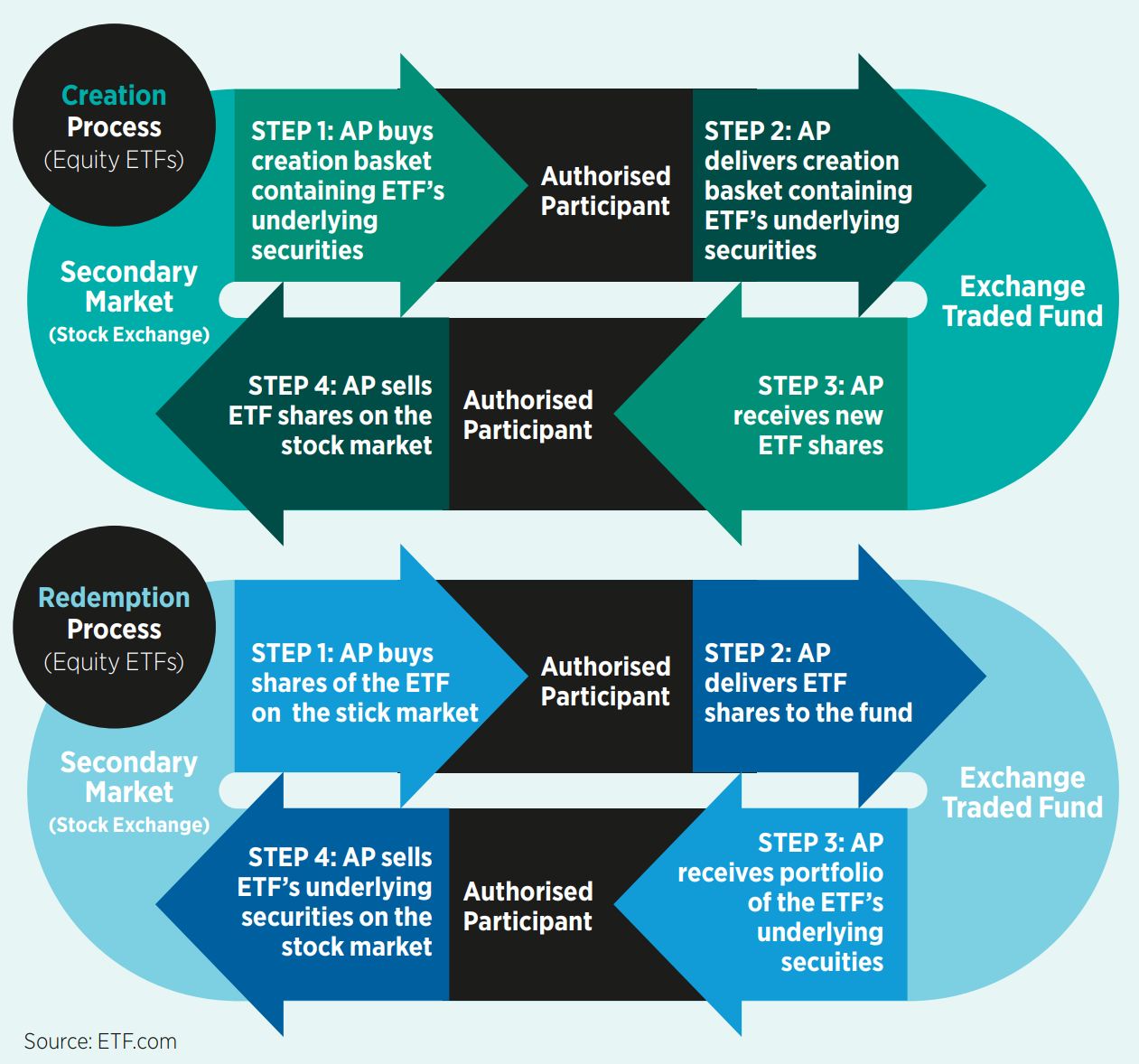
El mercado secundario permite a los inversores negociar acciones de ETF en tiempo real durante el horario bursátil, como con las acciones. El mercado primario, mediante el proceso de creación y rescate en especie entre los participantes autorizados (AP) y la gestora, garantiza que el número de acciones de ETF pueda aumentar o disminuir según la demanda del mercado.
Esta estructura de dos niveles aporta dos ventajas clave:
¿Qué es el mecanismo de Participante Autorizado (AP) en el mercado primario de ETF?
Los Participantes Autorizados (AP) suelen ser grandes intermediarios bursátiles o instituciones financieras. Solo los AP pueden crear o rescatar acciones de ETF directamente con la gestora.
Los AP no son inversores ordinarios. Actúan como proveedores profesionales de liquidez. Cuando aumenta la demanda, un AP entrega una cesta de valores a la gestora a cambio de acciones de ETF recién emitidas. Cuando la demanda disminuye, el AP devuelve acciones de ETF a la gestora y recibe la cesta de valores correspondiente.
Este mecanismo permite que la oferta de acciones de ETF se amplíe o reduzca según las condiciones del mercado, evitando distorsiones de precios que podrían surgir de una estructura de participaciones fija.
¿Cómo funciona el proceso de creación y rescate en el mercado primario?
El mercado primario de ETF suele operar mediante un modelo de “suscripción y rescate físico”.
En el proceso de creación, el AP prepara la “cesta de suscripción” de valores según la lista publicada por la gestora y la entrega al fondo. A cambio, el fondo emite acciones de ETF al AP según una proporción especificada.
En el proceso de rescate, el AP devuelve acciones de ETF a la gestora y recibe la cesta de valores correspondiente.
Esta estructura es relevante porque reduce la necesidad de que las gestoras compren o vendan activos frecuentemente en el mercado abierto. Los ajustes de participaciones se gestionan mediante intercambios físicos con los AP, lo que disminuye los costes de transacción y mejora la eficiencia operativa.
¿Cómo funciona la negociación en el mercado secundario de ETF?
En el mercado secundario, los inversores individuales negocian acciones de ETF en bolsa. Los precios fluctúan en tiempo real según la oferta y la demanda.
Los creadores de mercado ofrecen continuamente precios de compra y venta, lo que reduce los diferenciales y aumenta la liquidez.
Los inversores no necesitan participar en el proceso de creación o rescate. Simplemente compran o venden acciones de ETF en la bolsa.
Como los precios en el mercado secundario dependen de la oferta y la demanda, las acciones de ETF pueden cotizar temporalmente por encima o por debajo del NAV, generando oportunidades de arbitraje.
El valor financiero de la coordinación dual de mercados
La interacción entre los mercados primario y secundario otorga a los ETF ventajas únicas.
El mercado primario garantiza una oferta flexible de participaciones, reduciendo el riesgo de distorsión de precios por un número fijo de acciones.
El mercado secundario proporciona liquidez y facilidad de negociación, haciendo de los ETF herramientas eficientes para la asignación de activos.
Mediante el arbitraje, ambos mercados se influyen mutuamente. Cuando los precios se desvían del NAV, los AP intervienen para crear o rescatar participaciones, ayudando a que los precios se acerquen al valor justo.
Este diseño institucional mejora la eficiencia general del mercado y refuerza la confianza de los inversores.
¿Cómo se forman las primas y descuentos de ETF?
La prima o descuento de un ETF es la diferencia entre su precio de mercado y su NAV. Cuando el precio de mercado supera el NAV, el ETF cotiza con prima. Cuando es inferior, cotiza con descuento.
Las primas y descuentos suelen surgir de variaciones en la oferta y demanda, liquidez limitada o volatilidad a corto plazo. Por ejemplo, si los inversores compran un ETF de forma agresiva, su precio en el mercado secundario puede subir temporalmente por encima del NAV.
En condiciones normales, estas desviaciones son pequeñas porque los mecanismos de arbitraje las corrigen rápidamente.
¿Cómo corrige el mecanismo de arbitraje las primas y descuentos?
El arbitraje es el núcleo de la coordinación entre ambos mercados.
Cuando un ETF cotiza con prima, un AP puede crear nuevas participaciones en el mercado primario y venderlas en el secundario, capturando la diferencia de precios. El aumento de la oferta ayuda a que el precio vuelva a bajar.
Cuando un ETF cotiza con descuento, un AP puede comprar participaciones en el mercado secundario y rescatarlas en el primario. Esto reduce la oferta en el mercado y favorece la recuperación del precio.
Gracias a este proceso, los precios de mercado de los ETF permanecen relativamente cerca del NAV.
Riesgos en la coordinación entre mercados primario y secundario
Aunque la estructura dual de mercado mejora la eficiencia, puede enfrentar desafíos en condiciones extremas.
Si la liquidez disminuye o la negociación de los activos subyacentes se restringe, los AP pueden tener dificultades para ejecutar el arbitraje a tiempo, lo que genera primas o descuentos más amplios.
Si el mercado de activos subyacentes está cerrado o experimenta una fuerte volatilidad, la función de formación de precios del ETF puede debilitarse temporalmente.
Reconocer estos riesgos permite evaluar mejor los límites estructurales de los ETF.
| Dimensión | Mercado primario | Mercado secundario |
| Participantes | Participantes autorizados (AP) | Inversores ordinarios |
| Función | Creación y rescate | Negociación y formación de precios |
| Base de precios | Valor neto de los activos (NAV) | Oferta y demanda del mercado |
| Rol | Ajusta el número de participaciones en circulación | Proporciona liquidez |
| Relación con primas y descuentos | Corrige desviaciones mediante arbitraje | Origen de la formación de primas y descuentos |
En conjunto, el mercado primario gestiona la oferta de participaciones, mientras que el mercado secundario aporta liquidez y facilita la formación de precios. Ambos permiten que los ETF ofrezcan facilidad de negociación y mantengan precios próximos al NAV. Esta estructura constituye la base institucional para la adopción global de los ETF.
Resumen
Los ETF operan mediante una estructura coordinada que combina la creación y rescate en el mercado primario con la negociación en tiempo real en el mercado secundario. Los participantes autorizados ajustan la oferta y demanda mediante arbitraje, lo que ayuda a mantener los precios de mercado alineados con el NAV. Este diseño dual mejora la liquidez y la eficiencia de precios, aunque puede enfrentar riesgos de liquidez y de primas/descuentos en condiciones extremas. Comprender esta estructura es fundamental para entender cómo funcionan los ETF y las ventajas institucionales que ofrecen.
Preguntas frecuentes
¿Por qué los inversores ordinarios no pueden participar directamente en el mercado primario?
El mercado primario está reservado para los participantes autorizados, lo que mejora la eficiencia y reduce los costes de transacción.
¿Las primas y descuentos de ETF se mantienen a largo plazo?
En condiciones normales, los mecanismos de arbitraje suelen reducir rápidamente las primas y descuentos.
¿Se exige a los AP participar en el arbitraje?
Los AP actúan solo cuando existen oportunidades de arbitraje suficientes.
¿La creación en el mercado primario afecta al NAV del fondo?
La creación en especie normalmente no altera directamente la estructura del NAV.
¿Qué ocurre en condiciones extremas de mercado?
Una liquidez insuficiente puede provocar un aumento de los diferenciales entre precios de compra y venta.