Over the past few years, stablecoins have gradually expanded from being a trading medium within the crypto market to becoming part of global payments and cross border capital flows. More companies are beginning to use stablecoins such as USDC and USDT for international settlement, while payment platforms and fintech companies are also exploring ways to use stablecoins to reduce the costs and time delays found in traditional cross border payments.
However, stablecoins alone are not enough to solve global payment problems. International payments in the real world often involve conversion between different currencies, which means foreign exchange, or FX, remains a core part of the cross border financial system. The “stablecoin native foreign exchange network” model represented by Codex FX is helping global payments move gradually from traditional bank clearing toward real time on-chain settlement.
What Is Codex FX?
Codex FX is the on-chain foreign exchange, or on-chain FX, system within the Codex network. It is mainly used to enable fund conversion and payment settlement between stablecoins, as well as between stablecoins and fiat currencies. Its core goal is to improve the efficiency of global capital flows through on-chain liquidity and real time settlement mechanisms.
The traditional foreign exchange system usually relies on multiple banks and clearing institutions to complete a payment process. Codex FX, by contrast, focuses on using stablecoins to transfer value directly. In this structure, stablecoins are not only a payment medium, but also a core settlement asset for global capital flows.
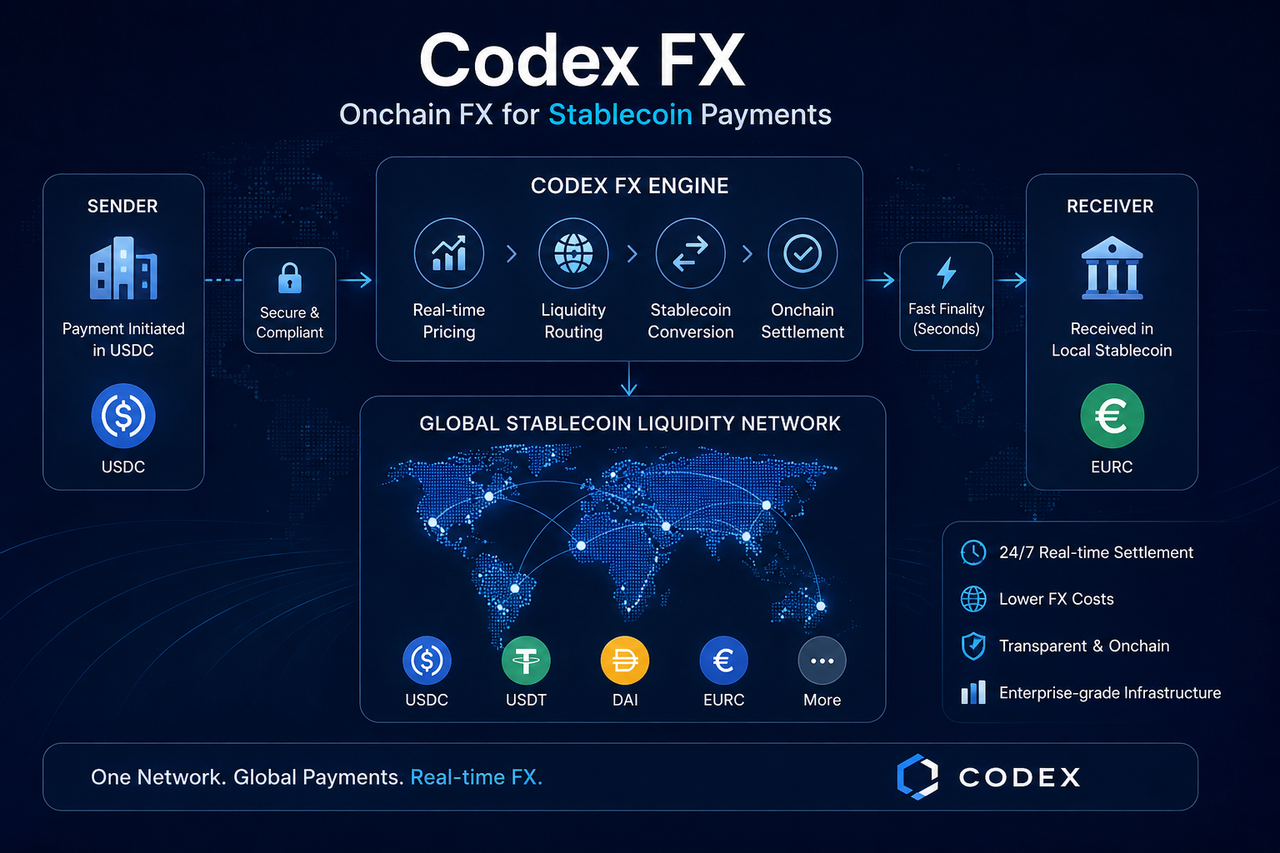
Compared with traditional foreign exchange networks, Codex FX focuses more on the following areas:
-
Real time cross border settlement
-
Stablecoin liquidity routing
-
Lower FX spreads
-
Around the clock payment capability
-
Global payment support for emerging markets
This structure also makes Codex FX closer to a “stablecoin native foreign exchange network.”
What Is the Stablecoin Exchange Process in Codex FX?
Codex FX mainly operates around stablecoin liquidity and payment routing. When a user or payment platform initiates an international payment, the system searches through the on-chain liquidity network for the most suitable exchange path.
For example, if a company wants to exchange a USD stablecoin for a stablecoin asset that can be used in the European market, the system first obtains a real time quote through on-chain liquidity pools, then completes the value conversion between stablecoins, and finally routes the funds into the payment network of the target market.
During this process, Codex FX aims to reduce the number of intermediaries found in traditional payment systems, thereby lowering issues such as:
-
Exchange rate losses
-
Payment delays
-
Intermediary fees
-
Fragmented liquidity
Because the entire process runs on-chain, fund movement and settlement paths also have greater transparency.
How Does Codex FX Enable on-chain Liquidity Routing?
Liquidity is one of the most important components of an on-chain FX system. The traditional banking system usually relies on large financial institutions to maintain global foreign exchange liquidity, while Codex FX places greater emphasis on using stablecoin networks to allocate capital globally.
In practice, Codex FX routes funds according to stablecoin supply and demand across different markets. For example, when a regional market has higher demand for stablecoins, the system can quickly allocate funds through on-chain liquidity pools, improving payment efficiency.
Compared with the traditional foreign exchange system, on-chain liquidity routing offers stronger real time performance and broader global accessibility. Because blockchain networks can operate around the clock, stablecoin liquidity can also support continuous global settlement without being limited by bank business hours.
Why Does Codex FX Emphasize Emerging Markets?
Emerging markets have long faced low efficiency in international payments. In some regions, cross border remittances not only involve higher fees, but also suffer from insufficient liquidity and long arrival times.
Stablecoin payment networks can, to some extent, bypass the complex intermediary structure of the traditional banking system, making it easier to improve the efficiency of international capital flows. For emerging markets, this means the barriers to international payments may be lowered further.
Codex FX places particular emphasis on building a global payment network and stablecoin liquidity because emerging markets often have a stronger need for low cost, around the clock, and highly transparent international settlement systems. This also makes on-chain FX networks an important development direction for the stablecoin financial system.
How Is Codex FX Different from the Traditional Foreign Exchange System?
The traditional foreign exchange system is mainly built on banks and correspondent clearing networks, while Codex FX focuses more on stablecoins and on-chain settlement mechanisms.
| Comparison Dimension |
Codex FX |
Traditional Foreign Exchange System |
| Settlement method |
on-chain stablecoin settlement |
Bank clearing |
| Operating hours |
24/7 around the clock |
Mainly business days |
| Intermediaries |
Fewer |
Multiple banking layers |
| Fund transparency |
Higher |
Relatively limited |
| Settlement speed |
Minutes |
Hours to days |
| Global accessibility |
Stronger |
Limited by region |
This difference is also why on-chain FX is regarded as an important part of future stablecoin payment networks.
Conclusion
Codex FX is a core infrastructure component within the Codex stablecoin payment network. Its goal is to optimize the efficiency of global capital flows through on-chain liquidity and stablecoin settlement mechanisms. Compared with the traditional foreign exchange system, which relies on banks and correspondent clearing networks, Codex FX places greater emphasis on real time settlement, around the clock operation, and stablecoin native payment capabilities.
FAQs
How Is Codex FX Different from Traditional Foreign Exchange Systems?
Traditional foreign exchange systems mainly rely on bank clearing, while Codex FX focuses on completing real time payments and settlement through stablecoins and on-chain liquidity.
Does Codex FX Support Cross Border Payments?
One of the core uses of Codex FX is stablecoin based cross border payments and international capital flows.
Why Are Stablecoins Suitable for FX Settlement?
Stablecoins can enable around the clock, low cost, and fast settlement, making them well suited as a settlement medium in on-chain foreign exchange networks.
Does Codex FX Depend on Traditional Banks?
The on-chain settlement component is mainly completed through the stablecoin network, but fiat on ramps and off ramps in real world payment systems still require support from banks and payment channels.
How Is Codex FX Different from a Regular DEX?
A regular DEX focuses more on on-chain asset trading, while Codex FX places greater emphasis on stablecoin payments, global liquidity routing, and international settlement capabilities.