The significance of Amazon's business model lies in its diversified revenue structure. Its different businesses create synergies that allow Amazon to serve both consumers and enterprise clients, establishing strong competitive moats.
Amazon's evolution shows that relying solely on e-commerce cannot sustain long-term growth. AWS, advertising, and subscription services have become key profit drivers.
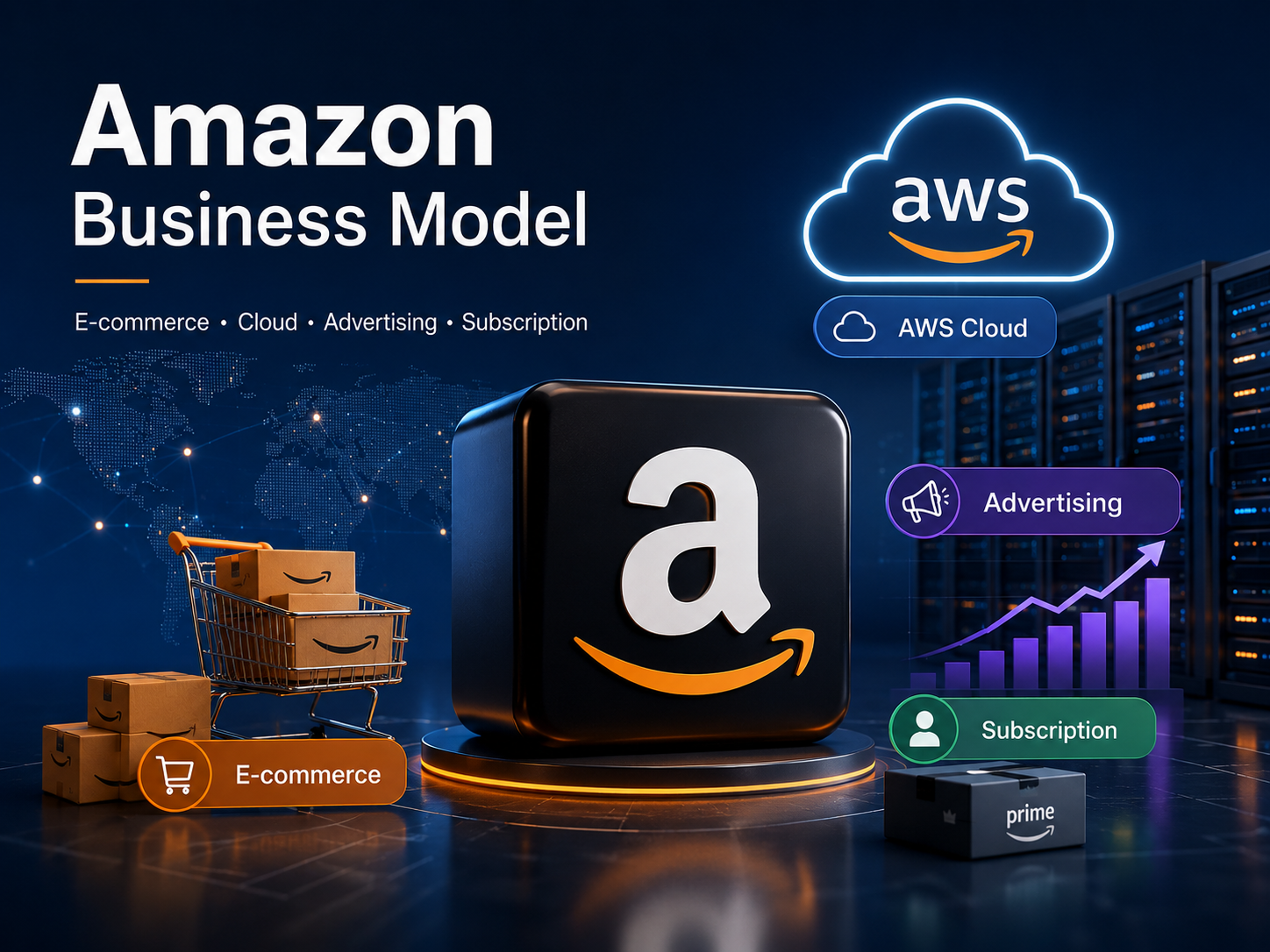
What Are Amazon's Core Businesses?
Amazon has built a comprehensive business system that spans both consumer and enterprise markets. Each segment plays a distinct role, collectively forming the Amazon ecosystem.
Amazon's core businesses currently include:
| Business Segment |
Main Content |
| E-commerce |
Online retail and third-party seller marketplace |
| AWS |
Cloud computing and enterprise services |
| Advertising |
Search and display advertising |
| Prime Membership |
Subscription service |
| Digital Content |
Video, music, e-books |
E-commerce generates the bulk of revenue, while AWS consistently delivers high profit margins. Advertising and subscription services further enhance overall business efficiency.
What sets Amazon's business model apart is its ability to share users, data, and infrastructure across multiple businesses.
How E-commerce Generates Revenue
E-commerce was Amazon's first revenue stream. Amazon sells its own products and also provides a marketplace for third-party merchants.
Amazon's e-commerce revenue primarily comes from product sales. When consumers buy through Amazon, the company earns sales revenue or transaction commissions.
Third-party sellers are now a vital part of the Amazon ecosystem. A vast number of products are sold by third parties, and Amazon earns fees from these marketplace services.
Key e-commerce revenue sources include:
- Product sales revenue
- Marketplace commission revenue
- Fulfillment service revenue
- Shipping and delivery revenue
Amazon's logistics network further strengthens its e-commerce advantage. The warehousing and delivery system not only improves user experience but also boosts the platform's competitiveness.
How AWS Became the Core Profit Engine
AWS (Amazon Web Services) is one of Amazon's most critical enterprise businesses. It provides cloud servers, databases, storage, and AI services that help companies build digital infrastructure.
AWS operates on a pay-as-you-go model. Businesses only pay for the computing resources they use, without needing to build their own data centers.
AWS's core services include:
| Service Category |
Use Case |
| Compute |
Cloud servers |
| Storage |
Data management |
| Database |
Enterprise applications |
| AI |
Model training and inference |
| Networking |
Cloud infrastructure |
AWS is a core profit engine largely because cloud computing typically enjoys high gross margins.
As demand for AI grows, more enterprises are increasing their cloud usage, further elevating AWS's strategic value.
How Advertising Drives Growth
Advertising has become one of Amazon's fastest-growing segments. With access to vast shopping data, Amazon offers merchants precise advertising targeting.
Merchants want to increase product visibility and are willing to buy ad space on the platform. Advertising revenue is now a significant profit source.
Amazon's advertising covers:
- Search ads
- Product recommendation ads
- Brand promotion ads
- Video ads
Amazon's ad system differs from traditional internet advertising. It is closer to actual purchase behavior, resulting in higher conversion efficiency.
As the number of sellers on the platform increases, so does the importance of advertising.
The Role of Subscription Services in the Business Model
Prime membership is the core of Amazon's subscription business. Prime users get faster shipping, video content, and other digital service benefits.
Subscription services provide stable cash flow. Unlike one-time product sales, membership revenue is more recurring.
Prime's key value includes:
- Boosting user retention
- Increasing purchase frequency
- Strengthening ecosystem lock-in
- Providing steady revenue
The membership system not only drives revenue but also fuels e-commerce growth.
Prime users tend to shop more frequently, creating a virtuous cycle between subscriptions and e-commerce.
How the Amazon Ecosystem Creates Network Effects
The Amazon ecosystem thrives on interactions among users, merchants, and enterprise clients. As participant numbers grow, the platform's value increases.
More consumers attract more merchants. More merchants offer more product choices, which in turn draws more consumers.
Amazon's network effects are evident:
| Participant |
Value Received |
| Consumers |
Greater product selection |
| Merchants |
Larger sales market |
| Enterprise clients |
Cloud computing services |
| Advertisers |
Targeted traffic |
AWS also benefits from network effects. As more developers and enterprises adopt AWS, more applications are built on its platform.
Network effects are a key reason Amazon maintains a long-term competitive edge.
Advantages and Challenges of Amazon's Business Model
Amazon's greatest strength is its diversified revenue base. E-commerce, cloud computing, advertising, and subscriptions form a stable growth system.
Main advantages of Amazon's business model:
- Diversified revenue structure
- Global user base
- Complete logistics network
- Powerful cloud business
Amazon also faces challenges.
Key challenges include:
- Intensifying e-commerce competition
- Fierce cloud computing rivalry
- High AI infrastructure investment costs
- Evolving global regulatory landscape
As the tech industry enters the AI era, Amazon must continue investing in infrastructure and R&D to stay competitive.
Summary
Amazon's business model has evolved from a pure e-commerce platform into a multi-business ecosystem. E-commerce provides traffic and users, AWS delivers high-margin enterprise services, advertising boosts commercial value, and Prime strengthens retention.
AWS has become Amazon's key profit driver, and growing demand for AI and cloud computing further solidifies its strategic importance.
Diversified operations and network effects are why Amazon remains a global tech giant.
FAQ
What is Amazon's main source of revenue?
Amazon's revenue comes primarily from e-commerce, AWS cloud computing, advertising, and Prime membership subscriptions.
Why is AWS so important to Amazon?
AWS is one of Amazon's highest-margin businesses, providing cloud and AI infrastructure to enterprise clients.
How does Amazon's advertising business make money?
Amazon earns revenue by selling search ads, product recommendation ads, and brand promotion ads to merchants.
What is the purpose of Prime membership?
Prime membership improves user retention, increases shopping frequency, and provides Amazon with recurring subscription revenue.
How is Amazon's business model different from traditional retail?
Amazon sells products but also runs cloud computing, advertising, and digital content businesses, making its revenue far more diversified.
What challenges does Amazon's business model face?
Amazon faces challenges including e-commerce competition, cloud computing rivalry, AI infrastructure costs, and a changing global regulatory environment.