As the crypto market continues to mature, traders’ needs are expanding far beyond single-product solutions. Increasingly, users are focusing on Spot allocation, Derivative hedging, trend trading, and cross-market capital flows. The market structure is evolving from “single-product trading platforms” to comprehensive asset trading systems.
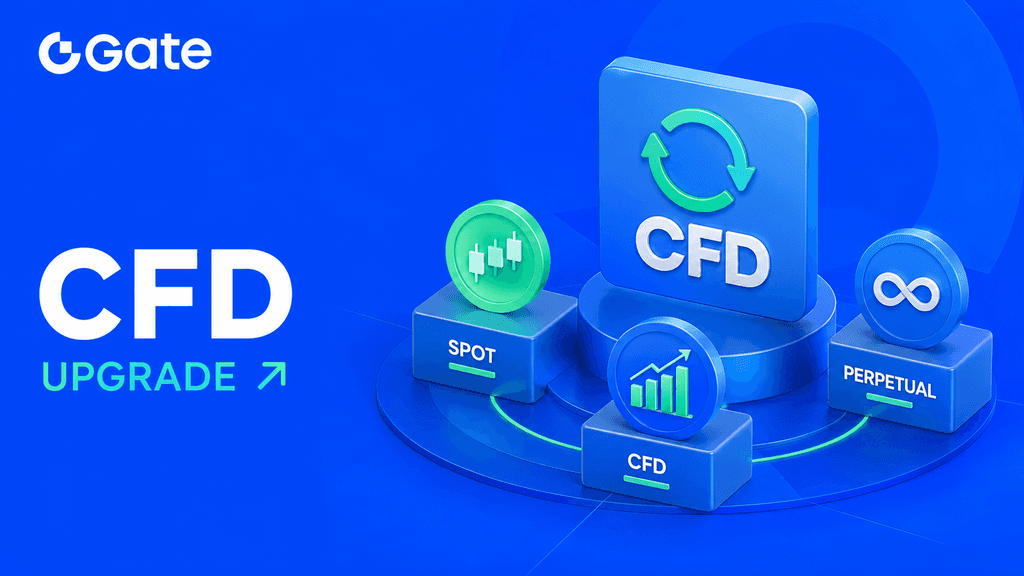
Within this new landscape, CFD contracts enable leveraged exposure and active trading on price movements, Perpetual Futures cater to crypto trend strategies, and Spot tokens serve long-term holders and ecosystem participants. As a result, Gate TradFi is transforming from a single Derivative entry point into a multi-asset, integrated trading platform.
What Is Gate TradFi?
Gate TradFi is Gate’s comprehensive trading Zone, designed to unify different trading products within a single system—spanning Spot, Derivatives, and price-trading tools to create a multi-asset market structure. Unlike earlier TradFi models focused solely on Contracts for Difference, the upgraded framework now provides a complete gateway to CFD contracts, Perpetual Futures, and Spot tokens.
This upgrade reflects shifting market logic. As crypto and traditional finance converge, traders increasingly deploy multiple products to execute diverse strategies. For example, some funds may be allocated to long-term Spot holdings, while others are used for trend trading or risk hedging via Derivatives.
Structurally, Gate TradFi resembles an “integrated broker model,” enabling users to trade across multiple markets within a single ecosystem—no need to switch platforms. This boosts trading efficiency and strengthens connections between asset classes.
In summary, Gate TradFi’s positioning has evolved from a single trading product to a comprehensive market system integrating price trading, trend strategies, and asset allocation.
CFD Contracts: Understanding the Spread Settlement Mechanism
A CFD (Contract for Difference) is a financial Derivative settled on price differentials. Users can speculate on price movements without owning the underlying asset. Thus, the essence of a CFD is trading price volatility, not asset ownership.
With CFDs, traders use Margin and leverage to amplify market exposure. Gains accrue to the long Side in rising markets and to the short Side when prices fall. This “Two-Way trading” flexibility is a key distinction from traditional Spot markets.
CFDs are widely used across equities, Indices, Forex, Commodities, and crypto. In the crypto sector, CFDs are primarily “price trading tools,” letting users trade volatility without on-chain Asset management or token ownership.
CFDs also involve Spread, overnight fees, and Liquidation mechanisms. Their structure is inherently high-volatility and high-leverage—distinct from long-term asset holding.
How Gate CFD Contracts Work
Gate CFD contracts settle Profit/Loss (PnL) based on price differentials. Users don’t buy the underlying asset; instead, they trade on price direction. The system calculates final PnL based on the difference between open and closed positions.
Margin is fundamental to this structure. By committing only a portion of funds, users gain amplified market exposure. While this increases potential Returns, it also heightens risk from market swings. Key factors in CFD trading include leverage ratio, Margin Ratio, and Risk Control.
Compared with traditional Futures, CFDs are more flexible. Many lack fixed settlement structures, focusing instead on short-term price action. This makes CFDs ideal for multi-market strategies and Short-term trading.
Ultimately, Gate CFD contracts are price volatility trading tools—delivering fast, flexible, Two-Way market access.
The Crypto Derivatives Market Structure
Perpetual Futures are Derivative instruments based on crypto Assets, distinguished by having “no Expiration Date.” Unlike traditional Futures, Perpetual Futures rely on a Funding Rate mechanism to stay anchored to the Spot Price.
Traders can take long or short positions with leverage, amplifying exposure. Perpetual Futures have thus become core tools for trend trading in crypto markets.
The Funding Rate mechanism keeps contract prices in line with Spot Prices. When contracts trade above Spot, longs pay the Funding Rate; when below, shorts may pay. This dynamic narrows the gap between contract and Spot prices.
Compared with CFDs, Perpetual Futures emphasize crypto-native market structure and high-frequency trend trading. They are foundational to the crypto Derivatives ecosystem.
The Role of Spot Token Trading in Gate TradFi
Spot Trading is the foundation of crypto markets. Users buy and hold Assets, directly participating in price changes and retaining ownership.
Relative to CFDs and Perpetual Futures, Spot is best suited for long-term allocation and value investing. Holders can also engage in on-chain activities such as Stake, governance, or DeFi.
Within Gate TradFi, Spot markets form the “underlying asset layer.” Many users maintain long-term Spot positions while using Derivatives for risk management or hedging.
Spot, CFD, and Perpetual Futures are complementary—not substitutes—serving different risk appetites and trading horizons.
Key Differences: CFD Contracts, Perpetual Futures, and Spot Tokens
CFDs, Perpetual Futures, and Spot tokens differ fundamentally in asset structure and trading objectives. Spot Trading is about actual asset ownership; CFDs and Perpetual Futures focus on price volatility.
CFDs mirror traditional finance Derivatives, enabling exposure without asset ownership. Perpetual Futures are crypto-native, pegged to Spot via Funding Rate.
Strategically, Spot fits long-term holding and asset allocation; Perpetual Futures suit trend and High Frequency trading; CFDs enable multi-market, flexible leveraged strategies.
Together, these products meet diverse market needs, forming Gate TradFi’s multi-asset trading framework.
Why Gate TradFi Focuses on “All-Scenario Trading”
As liquidity shifts among Spot, ETF, Stablecoins, and Derivatives, traders favor “portfolio strategies” over reliance on single-leverage products. Unified multi-asset access is now essential for trading platforms.
Gate TradFi’s “all-scenario trading” enables users to allocate capital flexibly across markets within a single system. One user might hold Spot long-term, trade Perpetual trends, and arbitrage volatility with CFDs—all at once.
This structure enhances trading continuity and cross-market linkage. Platform competition is moving from single-product strength to comprehensive trading capability.
This approach echoes the integrated broker model in TradFi—serving multi-asset, multi-strategy needs on one platform.
Gate TradFi: Product Upgrade and Naming Changes
In 2026, Gate officially upgraded TradFi, integrating CFD contracts, Perpetual Futures, and Spot tokens into a unified trading system. The former Contract for Difference product is now officially called “CFD contract.”
This naming aligns with industry standards and improves user clarity. “CFD contract” directly expresses the product’s trading nature, unlike the broader “TradFi.”
Gate assures users that existing positions, historical orders, and trading records remain unaffected, with rules and fees unchanged. The upgrade restructures the product system and market framework, not the underlying trading logic.
Industry-wide, this shift marks crypto’s adoption of more standardized, professional product classifications.
Gate TradFi: Advantages, Limitations, and Potential Risks
Gate TradFi’s main advantage is its coverage of Spot, CFD, and Perpetual Futures, letting users switch strategies based on market cycles, risk tolerance, and trading goals.
Unified multi-asset access reduces the friction of switching between markets. Unlike single-product platforms, this comprehensive system supports robust capital flows and strategic linkage.
However, CFDs and Perpetual Futures are inherently high-volatility Derivatives. Leverage can magnify profits—as well as risks, including Liquidation. Risk Control is critical in multi-asset trading.
As product systems grow more complex, users must understand the trading logic and risk profiles of each market. While comprehensive trading increases flexibility, it also demands higher strategy management skills.
Summary
Gate TradFi has evolved from a single Contract for Difference product into a unified trading system encompassing CFD contracts, Perpetual Futures, and Spot tokens.
CFDs focus on price volatility and leverage, Perpetual Futures serve trend trading, and Spot markets facilitate long-term asset allocation. This multi-asset structure enables Gate TradFi to address a range of risk preferences and trading timelines.
As crypto moves toward holistic financial models, platform competition is shifting from single-product offerings to building integrated trading ecosystems. Gate TradFi’s upgrade exemplifies this industry trajectory.
FAQ
What is Gate TradFi?
Gate TradFi is Gate’s comprehensive trading Zone, integrating CFD contracts, Perpetual Futures, and Spot tokens into a unified multi-asset trading system.
What does CFD contract mean?
A CFD (Contract for Difference) is a financial Derivative settled on price differences, allowing users to trade price movements without holding the underlying asset.
What is the difference between CFD contracts and Perpetual Futures?
CFDs function as traditional financial price-trading tools, while Perpetual Futures are crypto-native Derivatives pegged to Spot via Funding Rate.
Why do Perpetual Futures have no Expiration Date?
Perpetual Futures use Funding Rate mechanisms to maintain price stability, eliminating the need for fixed settlement dates.
What is the difference between Spot Trading and CFD trading?
Spot Trading requires actual asset ownership; CFDs settle only on price changes and do not involve asset transfers.
Why did Gate rename TradFi to CFD contract?
To standardize industry terminology and clarify user understanding, making product positioning more explicit.
Do CFD contracts require asset ownership?
No. CFDs are price Derivatives—users trade on price volatility, not asset ownership.
What types of traders is Gate TradFi suitable for?
Gate TradFi is ideal for users seeking Spot allocation, trend trading, leveraged trades, and multi-market strategy execution.







