Gate Launches GUSD Minting Newcomer Rewards Season 8

Beginner
Quick Reads
Last Updated 2026-03-23 08:08:39
Reading Time: 1m
Gate introduces the eighth round of the GUSD Minting New User Rewards program, providing extra incentives for users participating for the first time. By using USDT or USDC to mint GUSD, users can hold GUSD and start earning returns, while also accessing multiple sources of income through products like Launchpool and Launchpad. This article outlines the event timeline, participation process, reward structure, and GUSD’s operational mechanism.

Gate Announces GUSD Minting New User Rewards Program
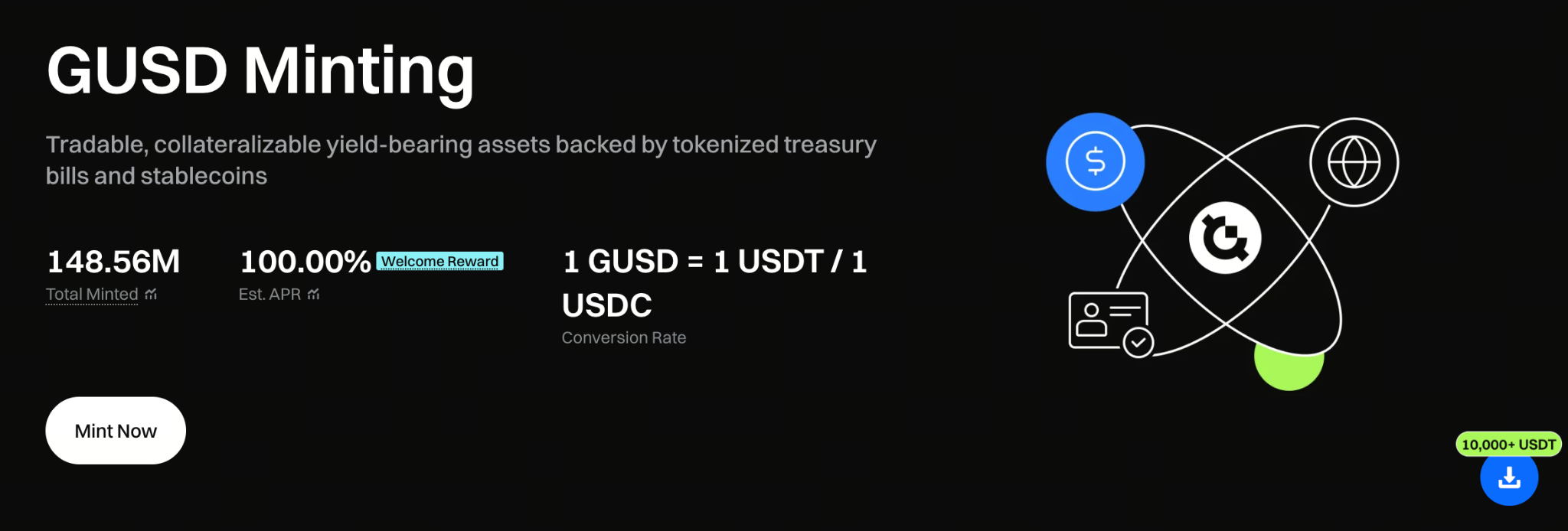
Gate Announces GUSD Minting New User Rewards Program

Gate has launched the eighth phase of its GUSD Minting New User Rewards program, offering limited-time yield incentives to eligible new users. During the campaign period, first-time GUSD minters can earn additional platform incentives on top of standard yields, with the referenced comprehensive annualized return reaching up to 100%.

Unlike some financial products that require complex procedures, GUSD offers a straightforward participation process. Users simply use stablecoins to mint GUSD, immediately begin accruing yields, and benefit from an intuitive workflow with a lower entry barrier.

Start earning with Gate’s GUSD Minting New User Limited-Time Rewards Phase 8—one-click minting and instant yield: https://www.gate.com/staking/USDT?pid=33&isDebtType=1

Campaign Period

This new user incentive program runs:

2026-03-12 16:00 — 2026-03-26 16:00 (UTC+8)

Mint GUSD during the event and satisfy new user criteria to qualify for rewards and yield accrual.

Program Details

How to Mint GUSD

Users can access the GUSD minting page through Gate’s Finance portal:

  • Web: Finance → GUSD Minting

  • App: Finance → GUSD Minting

Once minting is complete, GUSD holdings are credited and yield calculation begins.

Minting Rules and Subscription Process

GUSD minting follows these rules:

  • Supports USDT or USDC for minting

  • GUSD is issued at a 1:1 ratio

  • Daily minting window: 00:00 — 23:59 (UTC)

Subscribe within the open window to acquire GUSD holdings and participate in yield accumulation.

Yield Calculation and Distribution

After GUSD subscription, yields begin accruing as follows:

  • Yield calculation starts the day after subscription

  • Yields are distributed by 18:00 on the day following yield accrual

  • All yields are credited in GUSD to user accounts

Gate calculates yields based on GUSD holdings in:

  • Spot Account

  • Unified Account

  • Fund Account

Users can track daily yield records and accumulation in their Spot or Unified Accounts.

GUSD Redemption Options

GUSD can be redeemed at any time for USDT or USDC at a 1:1 ratio. Two redemption options are available:

  • Fast Redemption: Funds typically credited within about 5 minutes after request

  • Standard Redemption: Assets returned on D+3

Redemption fees are dynamically adjusted based on market conditions; actual rates are displayed on the redemption page.

Comprehensive Annualized Yield Structure

The campaign’s comprehensive annualized yield consists of:

Reference Comprehensive Annualized Yield = Reference Annualized Yield + Additional Rewards

Details:

  • Reference Annualized Yield: Adjusted dynamically based on market and product performance

  • Additional Rewards: Platform incentive yields

Additional rewards are distributed daily in GT tokens and vary by subscription amount tier.

The reward pool is limited; once depleted, distributions cease. Actual rates are as shown on the subscription page.

GUSD Minting Mechanism Overview

GUSD is a flexible, principal-guaranteed financial product. Yields originate from multiple asset channels, including:

  • Gate ecosystem revenues

  • Sovereign bond-type RWAs (Real World Assets)

  • Stablecoin yield assets

When users mint GUSD with USDT or USDC, they receive a certificate representing yields from on-chain or real-world assets—not direct ownership of real-world assets.

Upon redemption, GUSD is exchanged for USDT or USDC at a 1:1 ratio, minus applicable fees.

Factors Influencing GUSD Yield

GUSD yields are variable, adjusted based on several market factors:

  • Gate ecosystem total revenues

  • Sovereign bond RWA yield performance

  • Stablecoin asset yields

  • Market returns from tokenized US Treasuries and other real-world assets

These factors collectively determine the final annualized yield.

New User Eligibility Criteria

The new user rewards program is open only to qualified users. Requirements:

  • No GUSD spot holdings before 2026-03-12 08:00 (UTC+8)

  • Never received GUSD minting yields

  • Never participated in on-chain earning products

If the subscription page displays an additional rewards prompt after login, the user is eligible.

Risk Disclosure

Crypto asset markets are subject to market conditions, policies, and macro factors, resulting in significant price volatility and uncertain future trends. Before participating, users should fully understand product mechanisms and potential risks and make prudent decisions based on their circumstances. Users in certain regions (including the UK and other restricted areas) currently cannot access these services; restrictions are governed by the platform user agreement.

Summary

Gate’s eighth GUSD Minting New User Rewards phase offers a simple entry point for first-time users. By minting with USDT or USDC, users can hold GUSD and accumulate yields, while also earning additional returns from products like Launchpool and Launchpad. For those seeking to optimize asset utilization and explore diversified yield sources, GUSD minting provides a financial solution that integrates on-chain and real-world asset yield mechanisms.

Author:  Allen
Disclaimer
* The information is not intended to be and does not constitute financial advice or any other recommendation of any sort offered or endorsed by Gate.
* This article may not be reproduced, transmitted or copied without referencing Gate. Contravention is an infringement of Copyright Act and may be subject to legal action.

Related Articles

AI-Native Settlement Layers: How United Stables Is Building the Next Financial Rail
Beginner

AI-Native Settlement Layers: How United Stables Is Building the Next Financial Rail

Stablecoins were originally designed as dollar substitutes within exchanges, primarily used for asset pricing and trade settlement. As on-chain financial ecosystems have matured, their role has expanded beyond simple payments to include collateral assets, cross-chain liquidity mediums, and unified settlement units. In particular, as AI systems and automated agents begin to participate directly in economic activity, demand has risen sharply for programmable value units capable of instant settlement. This shift is pushing stablecoins toward the role of foundational financial infrastructure.
2026-03-25 03:16:17
The ve(3,3) Flywheel Explained: How AERO Tokenomics Powers Aerodrome’s DeFi Economy
Beginner

The ve(3,3) Flywheel Explained: How AERO Tokenomics Powers Aerodrome’s DeFi Economy

In the competition for DeFi liquidity, high-inflation mining alone is no longer enough to build lasting advantages. Aerodrome applies the ve(3,3) economic model to redesign token emissions, voting mechanisms, and revenue distribution, creating a liquidity flywheel centered on governance and cash flow. This article examines AERO tokenomics, the veAERO locking mechanism, and protocol revenue models to explain how Aerodrome builds a sustainable DeFi economic system.
2026-03-25 06:41:58
How Does PAXG Work? In-Depth Overview of the Physical Gold Tokenization Mechanism
Beginner

How Does PAXG Work? In-Depth Overview of the Physical Gold Tokenization Mechanism

PAXG (Pax Gold) is a tokenized asset backed by physical gold, issued by the fintech company Paxos and traded on the Ethereum blockchain as an ERC-20 token. The core concept is to tokenize physical gold on-chain, with each PAXG token representing ownership of a certain amount of gold. This structure enables investors to hold and trade gold in the form of a digital asset.
2026-03-24 19:12:51
Aerodrome Tokenomics: How ve(3,3) Powers Base's Most Profitable DEX
Beginner

Aerodrome Tokenomics: How ve(3,3) Powers Base's Most Profitable DEX

AERO is the native token of Aerodrome Finance, a core decentralized exchange and liquidity protocol in the Base ecosystem. It is primarily used for liquidity incentives and ecosystem operations. veAERO is a governance NFT that users receive by locking AERO, representing both voting power and the right to share protocol revenue. Through a dual track structure of AERO as a utility token and veAERO as a governance credential, Aerodrome separates liquidity usage value from long term governance power, allowing participants to act as liquidity providers, governance decision makers, and revenue sharers within the same system.
2026-03-25 06:40:31
How is the price of PAXG determined? Pegging mechanism, trading depth, and influencing factors
Beginner

How is the price of PAXG determined? Pegging mechanism, trading depth, and influencing factors

PAXG (Pax Gold) is a tokenized asset backed by physical gold reserves, launched by fintech firm Paxos and issued as an ERC-20 token on the Ethereum blockchain. The core concept is to digitally represent real-world gold assets, allowing investors to hold and trade gold via the blockchain network. Because each PAXG token corresponds to a specific quantity of physical gold, its price is theoretically expected to closely track the global gold market.
2026-03-24 19:11:40
Hybrid Collateral Stablecoins: Inside United Stables' Stability and Yield Architecture
Beginner

Hybrid Collateral Stablecoins: Inside United Stables' Stability and Yield Architecture

In the early stages of the crypto market, traditional stablecoins mainly relied on single-reserve or single-collateral models. Their primary focus was price stability and payment convenience, which allowed them to become foundational tools for on-chain trading and capital flows. As the market has entered a more mature financial phase, however, this structure has begun to reveal limitations, including high concentration risk and the difficulty of balancing liquidity with yield. These constraints have driven the evolution toward multi-layer collateral and portfolio-based designs, such as the dual-layer hybrid collateral architecture proposed by United Stables, which seeks to redefine the underlying logic of stable assets.
2026-03-25 03:17:39





