Ethereum Open Interest Drops 50% as $6.4B in Positions Vanish — Where Is ETH’s Next Major Turning Point?

Last Updated 2026-03-27 03:04:25
Reading Time: 1m
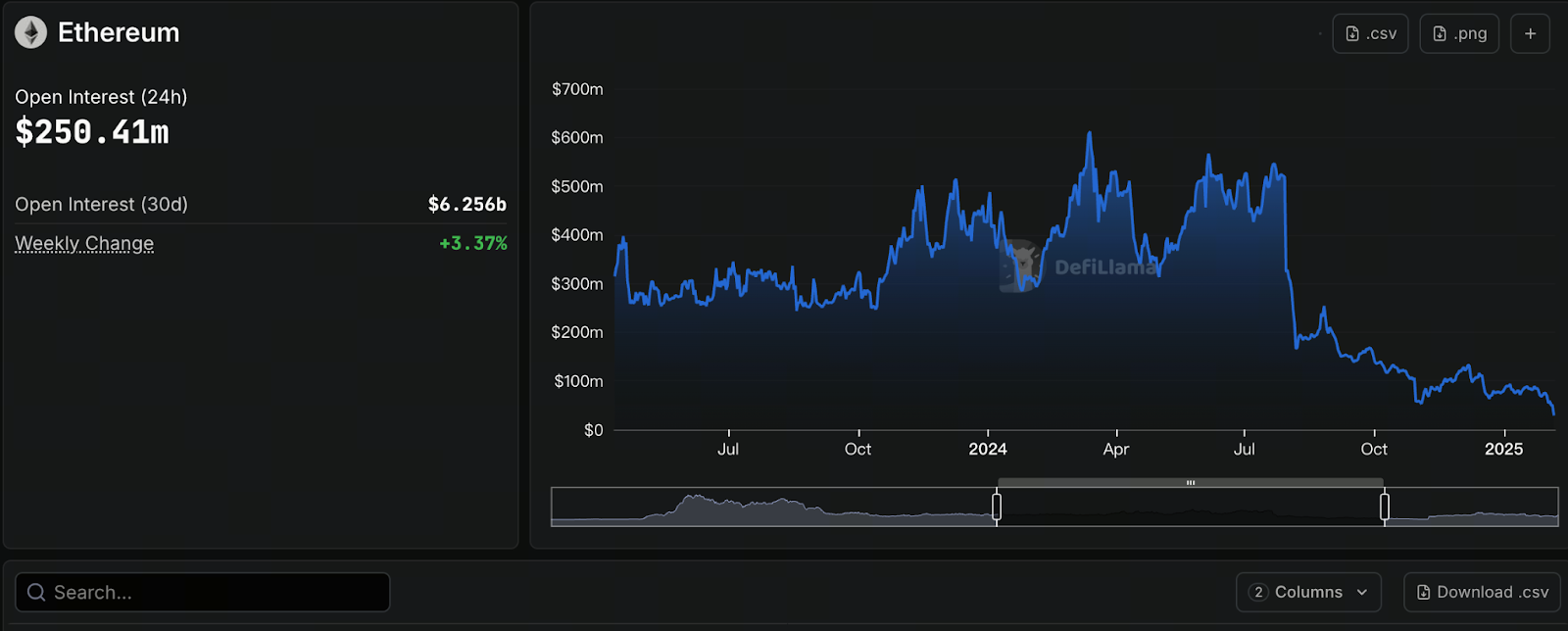
Ethereum Open Interest dropped sharply by 50% within a short timeframe, resulting in the liquidation of about $6.4 billion in contracts and causing significant market volatility. This article offers a comprehensive analysis of the drivers behind the capital exodus, recent changes in short-term price structure, and possible future movements for ETH.


Chart: https://defillama.com/open-interest/chain/ethereum

Open Interest is a core indicator for gauging the activity level and capital structure of the crypto derivatives market. It measures the total number of open long and short contracts that remain unsettled, providing insights into:

  • Market speculation intensity
  • Scale of leveraged positions
  • Potential for price volatility
  • Strength of buyer-seller dynamics

A rapid increase in Open Interest typically signals a flood of capital entering the market, rising leverage, and heightened volatility.

On the other hand, when Open Interest drops sharply in a short span—such as the recent halving—it indicates:

  • Rapid unwinding of leveraged positions
  • Mass withdrawal of short-term speculative capital
  • Sudden decline in market activity
  • Investors broadly shifting to the sidelines

Such shifts often disrupt price structures, halting or even reversing ongoing trends.

The Real Reason Behind the $6.4 Billion Contract Disappearance

The recent sharp drop in Ethereum Open Interest, based on a range of data and market behavior, can be attributed to several main factors:

Profit-Takers Exiting in Unison

Over the past few weeks, ETH has seen a pronounced rally, prompting many early long holders to lock in profits at the top, triggering a wave of long liquidations. This reflects a natural market cycle.

Market Expectations Turn Unstable

Entering a new cycle, the market has grown wary of several factors:

  • Uncertainty around the Federal Reserve’s interest rate path
  • Slowing pace of crypto capital inflows
  • Unpredictable regulatory developments
  • Lack of short-term accumulation by major institutions

These uncertainties may drive leveraged capital to adopt more conservative strategies.

High-Leverage Positions Forced Out or Voluntarily Exiting

Traders with high leverage are the most reactive—minor price swings can prompt large-scale exits. This time, capital left the derivatives market swiftly, driven by both voluntary withdrawals and forced liquidations.

Capital Rotates to More Stable Sectors

Institutional capital flows indicate:

  • Rotation from ETH contracts to BTC
  • Shift from derivatives to spot markets
  • Movement from crypto markets to traditional financial assets

As capital moves into less volatile markets, derivatives contract volumes naturally shrink.

In summary, this is not mere “panic,” but the result of a comprehensive capital structure reshuffle.

How Does Market Sentiment Get Amplified?

Sharp fluctuations in Open Interest often serve as amplifiers of market sentiment.

Retail Investors:

When retail participants see headlines like “$6.4 billion in contracts evaporated,” panic can quickly set in, accelerating selling pressure across the market. This emotional contagion spreads far faster than in traditional markets.

Institutions:

Institutional investors focus on liquidity changes. When they observe such a steep drop in OI, they may adjust short-term strategies:

  • Reducing ETH leveraged exposure
  • Hedging early against potential downside
  • Waiting for new entry opportunities

Market Makers:

Market makers scale back liquidity provision in thin markets, making prices more susceptible to “lightweight orders” and amplifying volatility.

This leads to a chain reaction: small volatility → liquidations → panic → larger volatility.

ETH Short-Term and Mid-Term Price Analysis

Short Term (1–2 Weeks)

After a sharp drop in OI, ETH typically exhibits:

  • Tighter trading ranges
  • Sideways and choppy price action
  • Greater reliance on spot market inflows for price movement

Major breakouts are unlikely in the short run, as most of the leveraged capital that drives price swings has exited.

Mid Term (1–3 Months)

The key factor is whether capital returns:

  • If capital flows back into derivatives and OI rebounds → ETH could resume its uptrend
  • If liquidity remains tight → ETH faces continued downward pressure

Currently, ETH’s market structure suggests a “wait-and-see” phase, awaiting new macro signals or on-chain narratives.

How Should Investors Respond?

1. Long-Term Investors (HODL)

Periods of low leverage and low OI are generally healthier and less volatile environments.

If you’re a long-term holder, this period is better suited for systematic dollar-cost averaging, not chasing rallies.

2. Leverage Traders

Recommendations:

  • Pause high-leverage trading
  • Monitor for OI recovery signals
  • Manage position sizes and avoid chasing breakouts

The current market still has the potential to retest lower levels.

3. Beginners or Observers

This is not an ideal time for aggressive entries. Instead:

  • Watch for capital inflows
  • Wait for OI stabilization and clear price structure
  • Avoid FOMO

Patience is key—opportunities often emerge as capital returns to the market.

Author: Max
Disclaimer
* The information is not intended to be and does not constitute financial advice or any other recommendation of any sort offered or endorsed by Gate.
* This article may not be reproduced, transmitted or copied without referencing Gate. Contravention is an infringement of Copyright Act and may be subject to legal action.

Related Articles

AI-Native Settlement Layers: How United Stables Is Building the Next Financial Rail
Beginner

AI-Native Settlement Layers: How United Stables Is Building the Next Financial Rail

Stablecoins were originally designed as dollar substitutes within exchanges, primarily used for asset pricing and trade settlement. As on-chain financial ecosystems have matured, their role has expanded beyond simple payments to include collateral assets, cross-chain liquidity mediums, and unified settlement units. In particular, as AI systems and automated agents begin to participate directly in economic activity, demand has risen sharply for programmable value units capable of instant settlement. This shift is pushing stablecoins toward the role of foundational financial infrastructure.
2026-03-25 03:16:17
DePIN Identity Network and Real World Applications: How Humanity Protocol Brings on-chain Identity Into the Physical World
Beginner

DePIN Identity Network and Real World Applications: How Humanity Protocol Brings on-chain Identity Into the Physical World

Most Web3 identity systems remain confined to on-chain environments and struggle to achieve meaningful adoption in real world settings. Through a DePIN architecture and physical verification hardware, Humanity Protocol aims to bring decentralized identity into access control systems, hospitality, public services, and offline events, allowing on-chain identity to function not just as a digital credential, but as foundational infrastructure for real world access.
2026-03-25 07:40:53
The ve(3,3) Flywheel Explained: How AERO Tokenomics Powers Aerodrome’s DeFi Economy
Beginner

The ve(3,3) Flywheel Explained: How AERO Tokenomics Powers Aerodrome’s DeFi Economy

In the competition for DeFi liquidity, high-inflation mining alone is no longer enough to build lasting advantages. Aerodrome applies the ve(3,3) economic model to redesign token emissions, voting mechanisms, and revenue distribution, creating a liquidity flywheel centered on governance and cash flow. This article examines AERO tokenomics, the veAERO locking mechanism, and protocol revenue models to explain how Aerodrome builds a sustainable DeFi economic system.
2026-03-25 06:41:58
Aerodrome Tokenomics: How ve(3,3) Powers Base's Most Profitable DEX
Beginner

Aerodrome Tokenomics: How ve(3,3) Powers Base's Most Profitable DEX

AERO is the native token of Aerodrome Finance, a core decentralized exchange and liquidity protocol in the Base ecosystem. It is primarily used for liquidity incentives and ecosystem operations. veAERO is a governance NFT that users receive by locking AERO, representing both voting power and the right to share protocol revenue. Through a dual track structure of AERO as a utility token and veAERO as a governance credential, Aerodrome separates liquidity usage value from long term governance power, allowing participants to act as liquidity providers, governance decision makers, and revenue sharers within the same system.
2026-03-25 06:40:31
Aster vs Hyperliquid: Which Perp DEX Will Prevail?
Beginner

Aster vs Hyperliquid: Which Perp DEX Will Prevail?

Aster and Hyperliquid are the two representative protocols of the "purpose-built L1 path" within the current decentralized perpetual exchange (Perp DEX) sector. As a pioneer in the field, Hyperliquid has built a deep liquidity moat through its highly mature order book architecture and strong community consensus. Conversely, Aster, as a rising challenger, seeks to leapfrog the competition in high-performance trading through more aggressive multi-chain aggregation logic, private transaction modules, and an underlying execution environment optimized for 2026 market demands.
2026-03-24 11:58:33
Gold Price Forecast for the Next Five Years: 2026–2030 Trend Outlook and Investment Implications, Could It Reach $6,000?
Beginner

Gold Price Forecast for the Next Five Years: 2026–2030 Trend Outlook and Investment Implications, Could It Reach $6,000?

Analyze current gold price trends alongside authoritative five-year forecasts, integrating an evaluation of market risks and opportunities. This gives investors insight into the potential trajectory of gold prices and the main drivers expected to shape the market over the next five years.
2026-03-25 18:13:30





