As Meme coins have become a key segment of the crypto asset market, digital assets rooted in internet culture and community consensus are drawing increasing attention. Among these, Dogecoin, Shiba Inu, and dogwifhat stand out as the most representative projects—each emerging at a distinct stage and illustrating the evolution of Meme coin structures.
While all three derive their value from community-driven cultural influence, they differ significantly in underlying network architecture, token positioning, ecosystem scalability, and community organization. Understanding these distinctions not only clarifies the operational logic of various Meme coins, but also helps establish a clearer framework for Meme coin classification.
What Are the Key Differences Among Dogecoin, Shiba Inu, and dogwifhat?
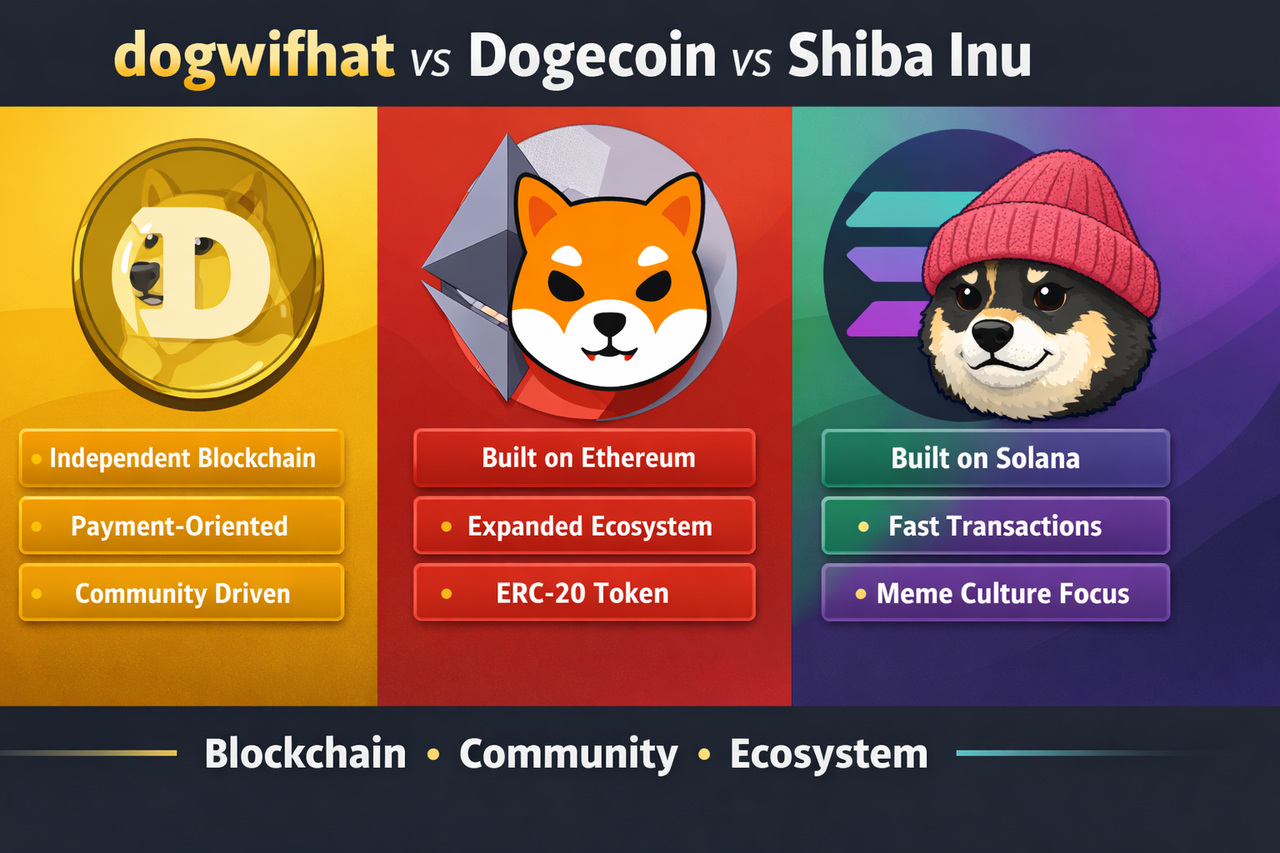
Dogecoin, Shiba Inu, and dogwifhat differ primarily in their blockchain infrastructure and methods of value realization. Dogecoin is a cryptocurrency with its own independent blockchain network; Shiba Inu is an ERC-20 token on Ethereum, featuring an expanding ecosystem; dogwifhat is an SPL Token built on Solana, prioritizing lightweight dissemination and community momentum.
| Comparison Dimension |
Dogecoin |
Shiba Inu |
dogwifhat |
| Underlying Network |
Independent Blockchain |
Ethereum |
Solana |
| Token Standard |
Native Chain Asset |
ERC-20 |
SPL Token |
| Transaction Efficiency |
Medium |
Low |
High |
| Ecosystem Expansion |
Limited |
Strong |
Weak |
| Core Driver |
Community + Payments |
Community + Ecosystem |
Community + Cultural Propagation |
| Structural Positioning |
Standalone Meme Coin |
Ecosystem Meme Coin |
Dissemination Meme Coin |
These characteristics shape their transaction efficiency, ecosystem reach, and market positioning: Dogecoin is geared toward payments, Shiba Inu is an ecosystem-oriented Meme project, and dogwifhat excels in cultural propagation.
What Are Dogecoin’s Structural Features?
Dogecoin, as one of the earliest Meme coins, operates on its own blockchain, with code originally forked from Litecoin. As a native chain asset, Dogecoin features a complete on-chain consensus mechanism and block production process, making its structure similar to traditional cryptocurrencies.
This independent design gives Dogecoin robust asset fundamentals, as its token operation is not dependent on any other public chain. Meanwhile, its vibrant community culture imparts Meme coin characteristics, giving it dual roles as both a payment asset and a cultural icon.
What Are Shiba Inu’s Structural Features?
Shiba Inu is built on Ethereum and follows the ERC-20 token standard. Unlike Dogecoin, Shiba Inu does not have its own blockchain; instead, it relies on Ethereum for transactions and asset management.
Shiba Inu is notable for its strong ecosystem scalability. Beyond its base token, the project has expanded into decentralized trading, NFTs, Layer2 solutions, and more—making it both a Meme coin and an ecosystem project.
What Are dogwifhat’s Structural Features?
dogwifhat is an SPL Token on the Solana network, designed for lightweight operation. Unlike Shiba Inu, dogwifhat has not developed a complex ecosystem, focusing instead on community-driven dissemination and Meme culture.
Built on Solana, dogwifhat benefits from fast transaction speeds and low trading fees, making it well-suited for high-frequency trading and viral community growth. Its minimalist branding further enhances its recognition as a Meme asset.
How Do Their Underlying Networks Differ?
Dogecoin operates on its own blockchain with a dedicated node network and consensus mechanism; Shiba Inu relies on Ethereum; dogwifhat runs on Solana. These differences in infrastructure impact transaction speed, cost, and scalability.
Solana offers the fastest confirmations and lowest fees; Ethereum provides robust developer capabilities; Dogecoin’s independent chain offers the highest network autonomy. These distinctions define their unique on-chain environments.
Dogecoin’s community boasts deep roots and broad recognition, with a stable culture. Shiba Inu’s community is organized around ecosystem growth, resulting in a more complex structure. dogwifhat’s community is lightweight and relies on social virality for growth.
Structurally, Dogecoin emphasizes long-term consensus, Shiba Inu focuses on ecosystem participation, and dogwifhat values dissemination efficiency. These differences shape each project’s role in the Meme coin landscape.
How Do Their Value Propositions Differ?
Dogecoin’s value is rooted in “independent chain + community consensus”; Shiba Inu’s value comes from “ecosystem expansion + community culture”; dogwifhat’s value is driven by “cultural propagation + social consensus.”
In essence, Dogecoin is a culturally-charged cryptocurrency, Shiba Inu is an ecosystem-driven Meme asset, and dogwifhat is a purely community-powered cultural token. These value structures reflect the evolving stages of the Meme coin ecosystem.
Summary
dogwifhat, Dogecoin, and Shiba Inu are all Meme coins, but each represents a distinct structural model. Dogecoin exemplifies the standalone-chain Meme coin, Shiba Inu is the ecosystem expansion model, and dogwifhat represents the lightweight dissemination model.
Comparing their underlying networks, community structures, and value propositions provides a comprehensive view of the diverse development paths within the Meme coin ecosystem and deepens our understanding of how community culture drives digital asset value across different technical frameworks.
FAQs
What Is the Biggest Difference Among dogwifhat, Dogecoin, and Shiba Inu?
The primary difference lies in their underlying networks and ecosystem structures: Dogecoin has its own blockchain, Shiba Inu is based on Ethereum, and dogwifhat is built on Solana.
Why Is Dogecoin Seen as More Like a Traditional Cryptocurrency?
Because Dogecoin runs on an independent blockchain with its own consensus mechanism and network architecture.
Why Is the Shiba Inu Ecosystem More Complex?
Because it is built on Ethereum and has expanded to include DEX, NFT, Layer2, and other ecosystem features.
Why Is dogwifhat’s Dissemination Faster?
Because it operates on Solana, offering higher transaction efficiency, and leverages simple, recognizable Meme branding for viral spread.
Are All Three Considered Meme Coins?
Yes, all three are Meme coins, but each exemplifies a different structural type and developmental model within the Meme coin category.