Coral Finance (CORL): Beginner’s Guide to Pre-Listing Insights and Airdrop Strategy

Beginner
Quick Reads
Last Updated 2026-03-28 15:30:27
Reading Time: 1m
Stay up to date on Coral Finance (CORL) with the latest news, token listing timeline, airdrop guidelines, and price forecasts. Even newcomers can easily master the key fundamentals.


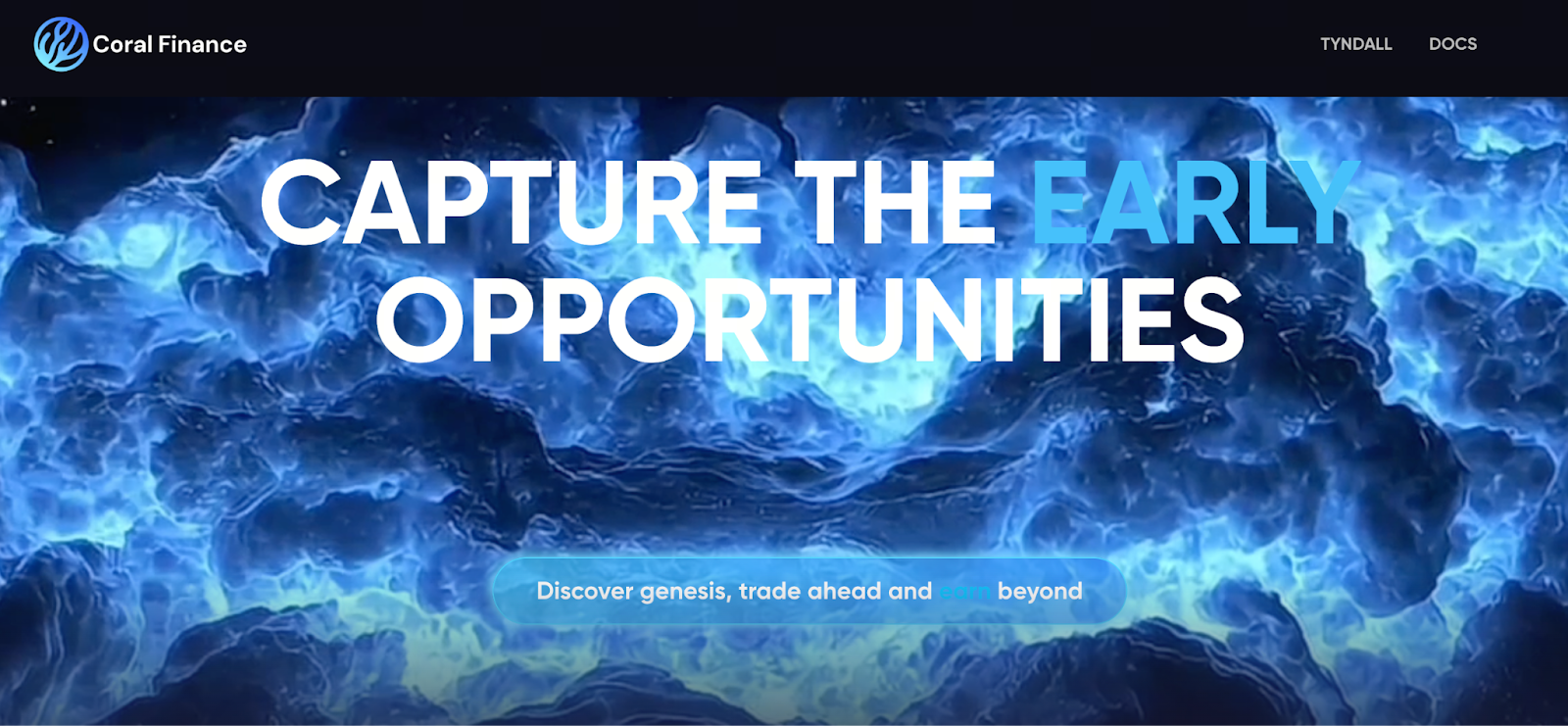
Image: https://www.coraldex.finance/

Coral Finance is a decentralized finance (DeFi) platform dedicated to pre-market asset trading. Its mission is to offer a secure, highly liquid, and equitable early-stage trading environment for crypto projects that have yet to officially launch or be listed on major exchanges.

Traditionally, many promising projects struggle with low liquidity and high participation thresholds prior to their Token Generation Event (TGE). Coral Finance seeks to eliminate these barriers, enabling everyday users to invest and participate in governance from the earliest stages.

The Coral ecosystem encompasses project discovery, liquidity provision, risk hedging, and multi-chain asset management.

CORL Token Utility and Economic Model

CORL, the native token of Coral Finance, has a fixed total supply of 1 billion tokens. Within the ecosystem, it fulfills three primary roles:

  • Incentive Mechanism: Coral Finance distributes rewards in CORL to liquidity providers, early investors, and ecosystem developers;
  • Governance Rights: Future community voting will determine the project’s direction and fee allocation;
  • Platform Transactions: CORL can be used to pay trading fees, participate in presale events, or stake to earn yield.

The team emphasizes that as the ecosystem expands, CORL will evolve from a platform token into a vital bridge for value transfer within Coral’s ecosystem.

Gate Listing and HODLer Airdrop Campaign

Gate has announced the listing of CORL spot trading, coupled with a HODLer airdrop campaign distributing a total of 200,000 CORL tokens. For official details, refer to the announcement at: https://www.gate.com/announcements/article/47559

By holding GT (Gate’s platform token) during the designated period, users can participate in the airdrop based on their GT holdings. This “hold-to-earn” model boosts user engagement and provides retail investors affordable access to new projects.

The listing offers Coral Finance more than a token launch; it provides an opportunity for user education and community growth.

Price Outlook and Market Reaction

Analysts widely anticipate CORL to debut in the $0.10–$0.15 range, with active trading possibly driving short-term spikes above $0.20. New listings are often volatile, so short-term traders should be mindful of correction risks. If Coral Finance establishes a robust pre-market ecosystem, CORL may become a notable player in the DeFi sector.

Beginner Participation Guide and Risk Advisory

Recommended steps:

  • Create and verify an account on Gate;
  • Hold GT or USDT to join trading or airdrop events;
  • Track CORL’s listing schedule and make sure you have sufficient balance before the listing;
  • On launch day, place buy or sell orders in batches according to market trends;
  • Store your assets securely using Gate Wallet or a private wallet.

Risk advisory:

  • Expect high volatility after new token launches; pursuing short-term gains involves higher risk;
  • Airdropped tokens may be subject to lock-up periods or delayed release;
  • Liquidity may decrease as market enthusiasm wanes;
  • Invest responsibly and avoid concentrating your investments in a single asset.

Conclusion

Coral Finance (CORL) introduces an innovative pre-market trading approach, creating new access points for investors. The Gate listing and airdrop campaign represent pivotal stages in Coral Finance’s market expansion.

For newcomers, CORL presents a compelling opportunity for learning and participation. However, prudent entry and balanced capital allocation are essential. If the platform’s ecosystem develops as intended, CORL may emerge as a standout token in the DeFi landscape.

Author: Max
Disclaimer
* The information is not intended to be and does not constitute financial advice or any other recommendation of any sort offered or endorsed by Gate.
* This article may not be reproduced, transmitted or copied without referencing Gate. Contravention is an infringement of Copyright Act and may be subject to legal action.

Related Articles

AI-Native Settlement Layers: How United Stables Is Building the Next Financial Rail
Beginner

AI-Native Settlement Layers: How United Stables Is Building the Next Financial Rail

Stablecoins were originally designed as dollar substitutes within exchanges, primarily used for asset pricing and trade settlement. As on-chain financial ecosystems have matured, their role has expanded beyond simple payments to include collateral assets, cross-chain liquidity mediums, and unified settlement units. In particular, as AI systems and automated agents begin to participate directly in economic activity, demand has risen sharply for programmable value units capable of instant settlement. This shift is pushing stablecoins toward the role of foundational financial infrastructure.
2026-03-25 03:16:17
DePIN Identity Network and Real World Applications: How Humanity Protocol Brings on-chain Identity Into the Physical World
Beginner

DePIN Identity Network and Real World Applications: How Humanity Protocol Brings on-chain Identity Into the Physical World

Most Web3 identity systems remain confined to on-chain environments and struggle to achieve meaningful adoption in real world settings. Through a DePIN architecture and physical verification hardware, Humanity Protocol aims to bring decentralized identity into access control systems, hospitality, public services, and offline events, allowing on-chain identity to function not just as a digital credential, but as foundational infrastructure for real world access.
2026-03-25 07:40:53
The ve(3,3) Flywheel Explained: How AERO Tokenomics Powers Aerodrome’s DeFi Economy
Beginner

The ve(3,3) Flywheel Explained: How AERO Tokenomics Powers Aerodrome’s DeFi Economy

In the competition for DeFi liquidity, high-inflation mining alone is no longer enough to build lasting advantages. Aerodrome applies the ve(3,3) economic model to redesign token emissions, voting mechanisms, and revenue distribution, creating a liquidity flywheel centered on governance and cash flow. This article examines AERO tokenomics, the veAERO locking mechanism, and protocol revenue models to explain how Aerodrome builds a sustainable DeFi economic system.
2026-03-25 06:41:58
Aerodrome Tokenomics: How ve(3,3) Powers Base's Most Profitable DEX
Beginner

Aerodrome Tokenomics: How ve(3,3) Powers Base's Most Profitable DEX

AERO is the native token of Aerodrome Finance, a core decentralized exchange and liquidity protocol in the Base ecosystem. It is primarily used for liquidity incentives and ecosystem operations. veAERO is a governance NFT that users receive by locking AERO, representing both voting power and the right to share protocol revenue. Through a dual track structure of AERO as a utility token and veAERO as a governance credential, Aerodrome separates liquidity usage value from long term governance power, allowing participants to act as liquidity providers, governance decision makers, and revenue sharers within the same system.
2026-03-25 06:40:31
Aster vs Hyperliquid: Which Perp DEX Will Prevail?
Beginner

Aster vs Hyperliquid: Which Perp DEX Will Prevail?

Aster and Hyperliquid are the two representative protocols of the "purpose-built L1 path" within the current decentralized perpetual exchange (Perp DEX) sector. As a pioneer in the field, Hyperliquid has built a deep liquidity moat through its highly mature order book architecture and strong community consensus. Conversely, Aster, as a rising challenger, seeks to leapfrog the competition in high-performance trading through more aggressive multi-chain aggregation logic, private transaction modules, and an underlying execution environment optimized for 2026 market demands.
2026-03-24 11:58:33
Gold Price Forecast for the Next Five Years: 2026–2030 Trend Outlook and Investment Implications, Could It Reach $6,000?
Beginner

Gold Price Forecast for the Next Five Years: 2026–2030 Trend Outlook and Investment Implications, Could It Reach $6,000?

Analyze current gold price trends alongside authoritative five-year forecasts, integrating an evaluation of market risks and opportunities. This gives investors insight into the potential trajectory of gold prices and the main drivers expected to shape the market over the next five years.
2026-03-25 18:13:30