BlackRock Files for “Staked Ethereum ETF” — A New Era of Yield for ETH Investors

Last Updated 2026-03-27 02:33:38
Reading Time: 1m
BlackRock recently filed an S-1 registration statement for the iShares Staked Ethereum Trust (ETHB) with the U.S. Securities and Exchange Commission (SEC), marking a pivotal shift as institutional investors enter the era of Ethereum staking returns. The combined prospects of ETH price growth and staking rewards are attracting intense market interest.

Background: BlackRock and the Evolution of Ethereum ETFs

BlackRock, one of the world’s largest asset managers, has a deep foundation in both traditional finance and the ETF market. In the crypto sector, BlackRock previously launched a spot Bitcoin ETF and filed for a spot Ethereum ETF. However, while a spot Ethereum ETF allows investors to gain indirect exposure to ETH, it does not enable participation in network staking. As a result, investors miss out on potential staking rewards—estimated at around 3% annually.

What Is a Staked Ethereum ETF? How It Differs from Traditional Spot ETFs

A staked Ethereum ETF is an exchange-traded fund that not only holds ETH but also stakes these assets through approved validators. This allows the ETF to participate in Ethereum’s network validation process and earn staking rewards. In effect, the ETF tracks ETH’s price movements while also generating interest-like, annualized returns for investors.

Compared to traditional spot ETFs, staked ETFs offer several key advantages:

  • Dual return streams: capital appreciation plus staking rewards;
  • Regulatory compliance: invest in crypto assets within a traditional ETF structure, eliminating the need for investors to manage private keys or staking nodes;
  • Appealing to institutions and conservative investors: lower holding costs, less operational complexity, and a clearer path to compliance.

Key Elements of BlackRock’s Filing and Market Implications

On December 8, 2025, BlackRock submitted an S-1 registration statement to the SEC for the iShares Staked Ethereum Trust (ETHB), marking its fourth crypto-related ETF. According to the filing, ETHB intends to allocate about 70%–90% of its ETH holdings to third-party staking service providers under normal market conditions. BlackRock will not operate validator nodes directly; instead, it will delegate staking through a custodian to professional providers. This filing signals an accelerating trend toward the institutionalization and financialization of crypto assets. Historically, ETFs have tracked spot prices. Now, with the addition of staking yield, crypto assets are evolving from purely volatile instruments to yield-generating assets. Multiple research firms predict this will become a defining trend in the crypto ETF market.

Potential Impact on the ETH Market and Price
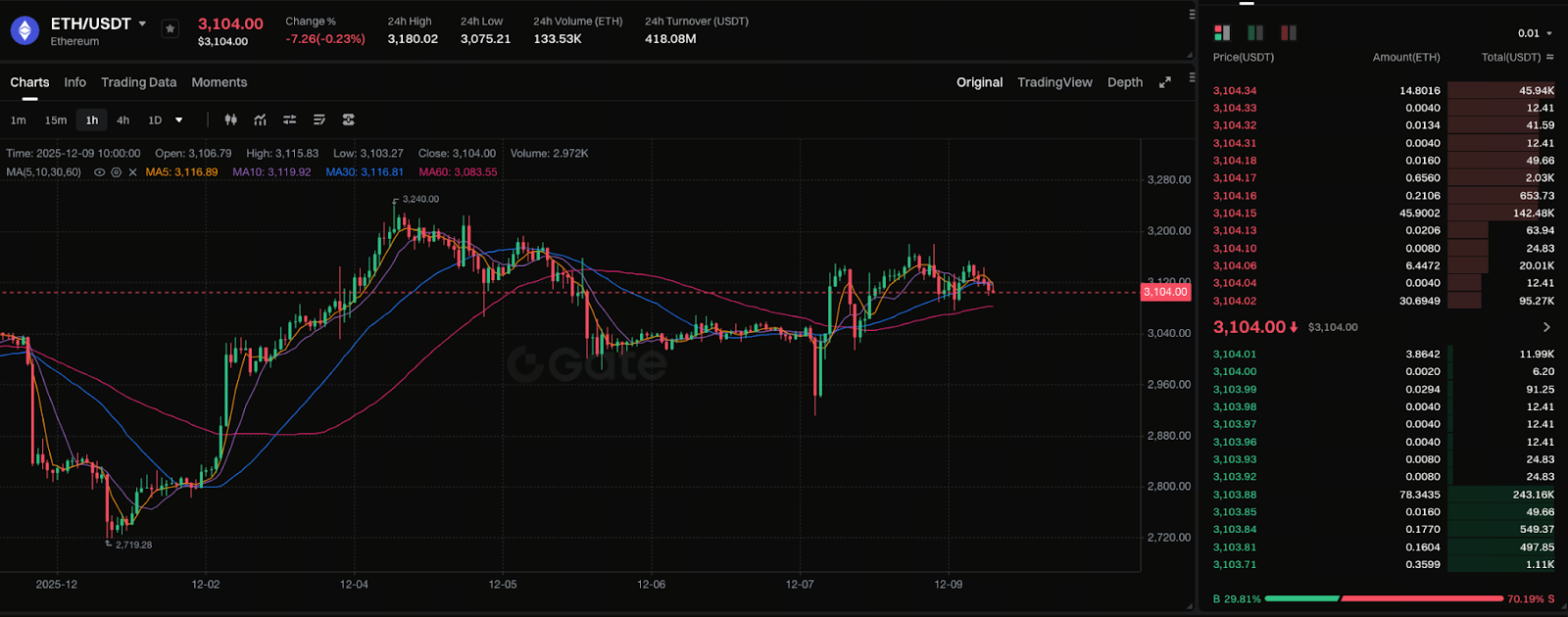

Chart: https://www.gate.com/trade/ETH_USDT

  • Boosts interest in ETH from both institutional and retail investors — for those seeking steady returns without the hassle of direct staking, a staked ETF offers a streamlined option;
  • Increases demand for and locked supply of ETH — if the ETF gains approval and attracts significant capital, it will drive ETH purchases and lockups;
  • Helps stabilize price volatility — staking generates cash flow, reducing speculation-driven swings and supporting long-term allocations;
  • Combines yield and liquidity — the ETF trades like a stock, offering both regular yield and flexible trading, making it more convenient than direct staking.

Additionally, expectations for ETH could rise, giving its price further room to appreciate.

How Should Investors View This Filing? Balancing Risks and Opportunities

Opportunities:

  • Access ETH staking through regulated, compliant channels;
  • No need for self-custody or node operation, simplifying the process;
  • Well-suited for investors seeking passive income and long-term holding.

Risks / Uncertainties:

  • The application is still under SEC review, and approval is not guaranteed;
  • Staking rewards, fees, tax treatment, and protocol changes could impact actual returns;
  • The ETF’s liquidity, redemption process, and lock-up provisions may present challenges;
  • The crypto market remains highly volatile, with persistent price and regulatory risks that require careful assessment.

Conclusion

BlackRock’s application for a staked Ethereum ETF is a pivotal step in the financialization of crypto assets. If approved, it would provide investors with a new avenue to capture both price appreciation and staking yield, potentially establishing itself as a mainstream entry point for ETH investment. For long-term Ethereum supporters seeking stable returns, this represents a significant opportunity. As with any investment, risks are inherent—investors should thoroughly understand staking mechanisms, tax implications, and liquidity conditions before making allocation decisions.

Author: Max
Disclaimer
* The information is not intended to be and does not constitute financial advice or any other recommendation of any sort offered or endorsed by Gate.
* This article may not be reproduced, transmitted or copied without referencing Gate. Contravention is an infringement of Copyright Act and may be subject to legal action.

Related Articles

AI-Native Settlement Layers: How United Stables Is Building the Next Financial Rail
Beginner

AI-Native Settlement Layers: How United Stables Is Building the Next Financial Rail

Stablecoins were originally designed as dollar substitutes within exchanges, primarily used for asset pricing and trade settlement. As on-chain financial ecosystems have matured, their role has expanded beyond simple payments to include collateral assets, cross-chain liquidity mediums, and unified settlement units. In particular, as AI systems and automated agents begin to participate directly in economic activity, demand has risen sharply for programmable value units capable of instant settlement. This shift is pushing stablecoins toward the role of foundational financial infrastructure.
2026-03-25 03:16:17
The ve(3,3) Flywheel Explained: How AERO Tokenomics Powers Aerodrome’s DeFi Economy
Beginner

The ve(3,3) Flywheel Explained: How AERO Tokenomics Powers Aerodrome’s DeFi Economy

In the competition for DeFi liquidity, high-inflation mining alone is no longer enough to build lasting advantages. Aerodrome applies the ve(3,3) economic model to redesign token emissions, voting mechanisms, and revenue distribution, creating a liquidity flywheel centered on governance and cash flow. This article examines AERO tokenomics, the veAERO locking mechanism, and protocol revenue models to explain how Aerodrome builds a sustainable DeFi economic system.
2026-03-25 06:41:58
Aerodrome Tokenomics: How ve(3,3) Powers Base's Most Profitable DEX
Beginner

Aerodrome Tokenomics: How ve(3,3) Powers Base's Most Profitable DEX

AERO is the native token of Aerodrome Finance, a core decentralized exchange and liquidity protocol in the Base ecosystem. It is primarily used for liquidity incentives and ecosystem operations. veAERO is a governance NFT that users receive by locking AERO, representing both voting power and the right to share protocol revenue. Through a dual track structure of AERO as a utility token and veAERO as a governance credential, Aerodrome separates liquidity usage value from long term governance power, allowing participants to act as liquidity providers, governance decision makers, and revenue sharers within the same system.
2026-03-25 06:40:31
DePIN Identity Network and Real World Applications: How Humanity Protocol Brings on-chain Identity Into the Physical World
Beginner

DePIN Identity Network and Real World Applications: How Humanity Protocol Brings on-chain Identity Into the Physical World

Most Web3 identity systems remain confined to on-chain environments and struggle to achieve meaningful adoption in real world settings. Through a DePIN architecture and physical verification hardware, Humanity Protocol aims to bring decentralized identity into access control systems, hospitality, public services, and offline events, allowing on-chain identity to function not just as a digital credential, but as foundational infrastructure for real world access.
2026-03-25 07:40:53
How is the price of PAXG determined? Pegging mechanism, trading depth, and influencing factors
Beginner

How is the price of PAXG determined? Pegging mechanism, trading depth, and influencing factors

PAXG (Pax Gold) is a tokenized asset backed by physical gold reserves, launched by fintech firm Paxos and issued as an ERC-20 token on the Ethereum blockchain. The core concept is to digitally represent real-world gold assets, allowing investors to hold and trade gold via the blockchain network. Because each PAXG token corresponds to a specific quantity of physical gold, its price is theoretically expected to closely track the global gold market.
2026-03-24 19:11:40
How Does PAXG Work? In-Depth Overview of the Physical Gold Tokenization Mechanism
Beginner

How Does PAXG Work? In-Depth Overview of the Physical Gold Tokenization Mechanism

PAXG (Pax Gold) is a tokenized asset backed by physical gold, issued by the fintech company Paxos and traded on the Ethereum blockchain as an ERC-20 token. The core concept is to tokenize physical gold on-chain, with each PAXG token representing ownership of a certain amount of gold. This structure enables investors to hold and trade gold in the form of a digital asset.
2026-03-24 19:12:51





