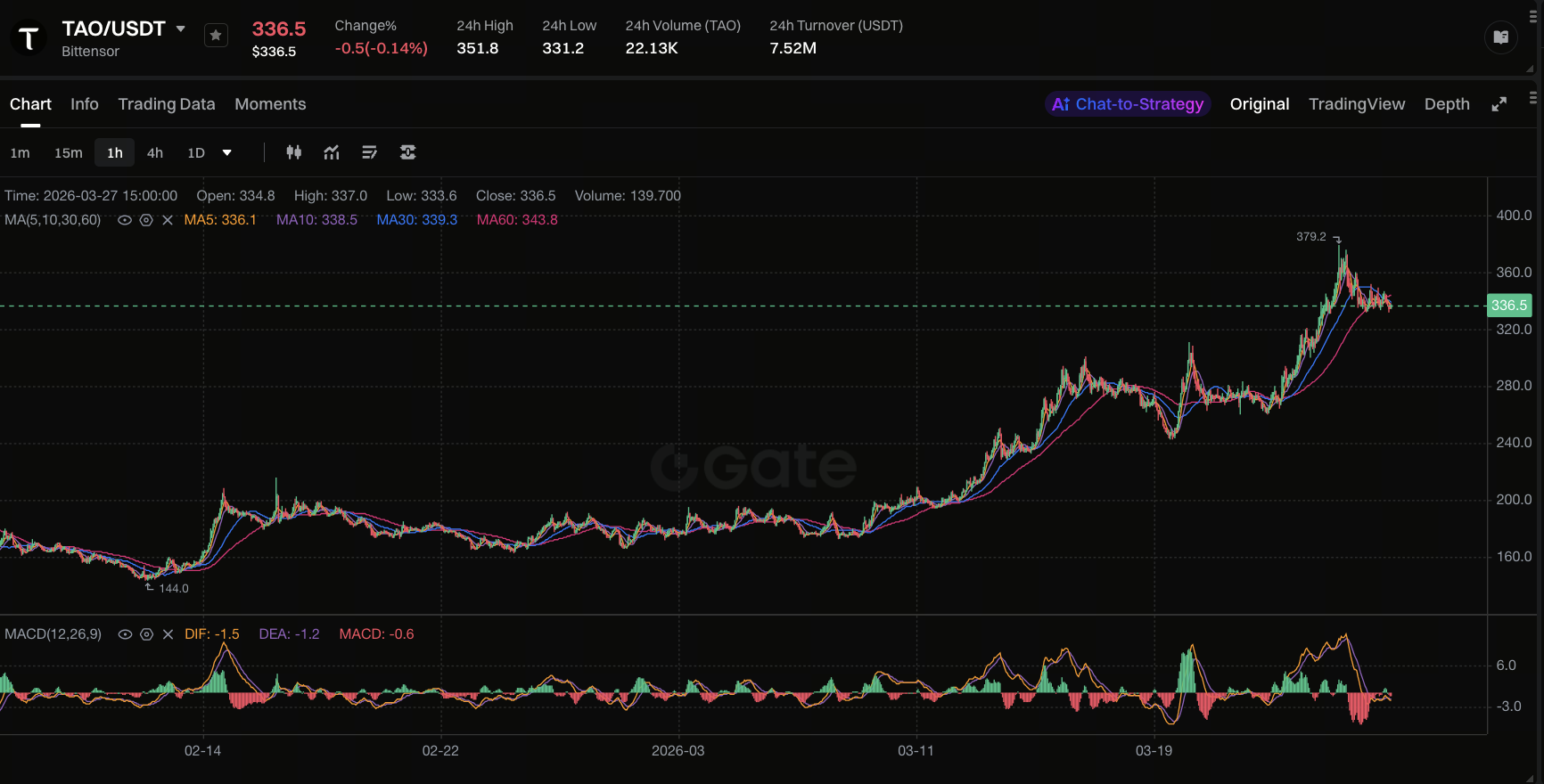
Image source: Gate Market Page
In today’s AI-driven market environment, Bittensor (TAO) has outperformed most comparable assets. Unlike short-term rallies fueled by speculative capital, the key question for TAO is whether its price movement is supported by a clear structural logic, rather than being driven solely by sentiment. From a market perspective, TAO’s rise meets at least three criteria: narrative consensus formation, concentrated capital inflows, and verifiability at the mechanism level. This positions it as a classic case for studying crypto “driving mechanisms.”
TAO’s rally can be broken down into four interlocking variables. These factors interact and reinforce each other in the marketplace:
AI has become a core theme in global capital markets
The scarcity of “AI + Crypto” assets is increasingly clear
Capital is seeking on-chain AI-mapped assets
Few projects offer foundational network structures
Bittensor operates active subnets
The market now views it as an “infrastructure candidate”
Funds are moving out of MEME and short-cycle assets
Shifting toward AI sectors with mid-term narratives
TAO serves as a high-beta asset in the AI zone
Increased industry attention
Improved exchange liquidity
Key opinion leaders are driving broader recognition
These variables create a typical progression: heightened awareness → capital inflow → price breakout → sentiment strengthening → repricing.
TAO’s core logic is not about short-term price swings, but the “open AI network” narrative it represents. The current AI industry is highly centralized, while Bittensor offers an alternative. Its core assumptions include:
AI models can compete and collaborate within open networks
Value can be distributed through algorithms and token incentives
Hashrate and data can form decentralized marketplaces
This narrative is a structural challenge to traditional AI models, similar to:
Bitcoin’s decentralized transformation of finance
Ethereum’s open approach to computing resources
If this hypothesis proves correct, TAO could transition from a “narrative asset” to an “infrastructure asset.”

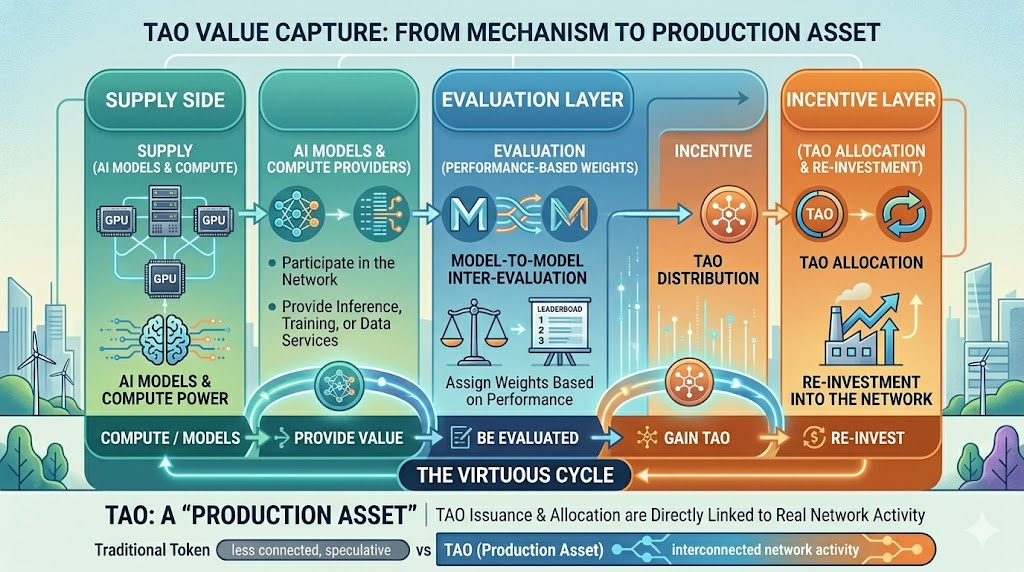
From a mechanism perspective, TAO’s potential hinges on whether it can establish a closed-loop value capture structure. Its operational logic breaks down into three layers:
Supply Side
AI models and hash power providers join the network
They offer inference, training, or data services
Evaluation Layer
Models evaluate each other’s performance
The network allocates weights based on these evaluations
Incentive Layer
TAO is distributed based on contributions
This incentivizes ongoing resource input
This creates a cycle: hash power/models → deliver value → are evaluated → earn TAO → reinvest in the network.
Unlike traditional tokens, TAO’s value logic is closer to that of a “productive asset”—its issuance and distribution are directly linked to real network activity.
Within the AI crypto ecosystem, projects occupy distinct layers. By function, the structure is as follows:
Hash Power Layer: provides GPU or rendering capabilities
Data Layer: offers training data or data marketplaces
Application Layer: AI Agents and tools
Network Layer: connects supply and demand, allocates value
TAO sits in the “network layer,” characterized by:
Integrating hash power and model supply above
Connecting to application demand below
Managing value distribution and incentive mechanisms
This position offers significant potential, but also makes TAO more dependent on network effects.
Despite strong narrative and structural support, TAO’s risks remain significant, mainly in the following areas:
Narrative Exhaustion Risk: Market expectations may outpace actual progress. If application growth lags, valuations could correct.
Technical Complexity Risk: The mechanism design is complex, subnet quality varies, and evaluation mechanisms are still evolving.
Competition Risk: Web2 AI giants still dominate, and new Web3 AI projects continue to emerge.
Price Volatility Risk: Its high-beta nature makes it sensitive to macro factors and sentiment swings.
These factors mean TAO’s price path is unlikely to be linear.
In summary, TAO’s rally is driven by the combined influence of three forces:
Macro-level AI narrative expansion
Market-level capital rotation
Micro-level mechanism design and network operation
However, TAO is still in the “narrative validation phase”—not yet the “value realization phase.” The key variables for the future are:
Can it generate real AI demand?
Can it build sustainable network effects?
Can it transition from an experimental network to true infrastructure?
From a research perspective, a more cautious view emerges: TAO is not yet a validated value asset, but a “potential infrastructure hypothesis” currently being priced by the market.