$ ZEC Leading Privacy Coin FOMO Market Analysis: Short-Term Opportunity or Bubble?

Beginner
Quick Reads
Last Updated 2026-03-28 16:15:02
Reading Time: 1m
ZEC (Zcash) has recently become a key focus in the market. Its sharp price surge has created a sense of fear of missing out among investors. This article explains the drivers behind the price rally, short-term trading signals, and essential risk management strategies. These insights are designed to help newcomers make more rational decisions in a highly volatile environment.

Price Overview

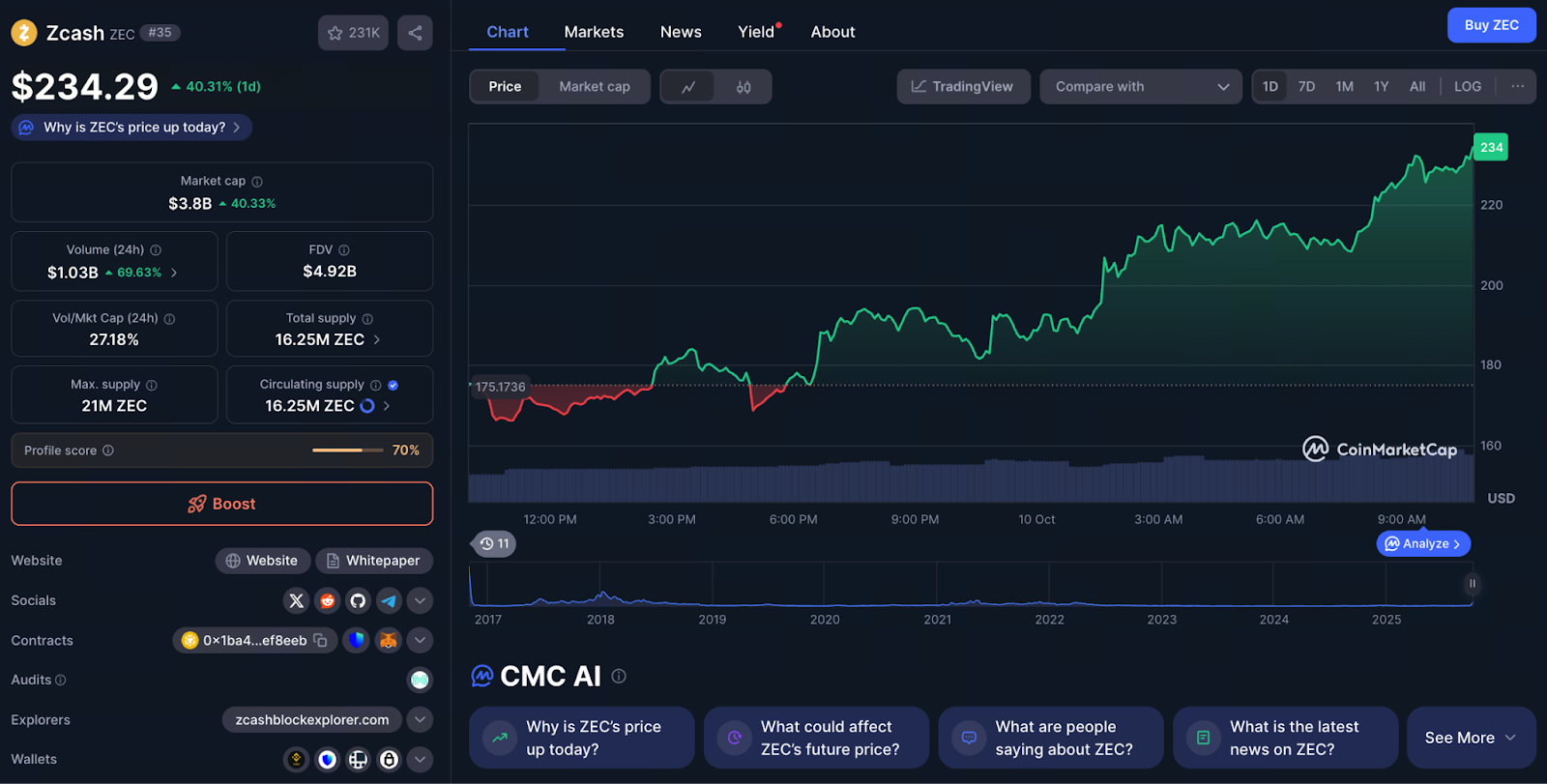
ZEC has seen a dramatic surge in recent weeks, posting substantial short-term gains that have captured significant market attention. The price rebounded sharply from multi-month lows, reaching relative highs not seen in years. Recent trading has been marked by heightened volatility, with frequent large intraday rallies and pullbacks, alongside a notable uptick in trading volume.

Rally Catalysts

This rally has been fueled by several converging factors: First, a recovery in market liquidity and renewed focus on the “privacy” narrative; second, reports of trust product launches and increased institutional interest, leading to capital inflows; third, the reinstatement or enhancement of privacy features by certain exchanges and wallets, which has broadened the perceived use cases for ZEC. Together, these factors have generated strong buying momentum.

FOMO Behavior and Short-Term Signals

Rapid price appreciation often triggers FOMO (fear of missing out) among retail traders chasing the rally. Short-term traders should watch for the following signals: daily RSI moving into overbought territory, trading volume surging near price peaks without sustained buying, and key resistance levels being quickly breached but followed by sharp pullbacks—all of which typically indicate a heightened risk of short-term correction. Additionally, when social media buzz spikes without corresponding fundamental improvements, this often signals sentiment-driven moves.

Risk Alerts and Stop-Loss Strategies

If you intend to trade this momentum short-term, set explicit stop-losses (for example, 8%–15% from your entry) and manage position sizing (each position should not exceed 3%–5% of your investable capital). Long-term investors need to consider the regulatory uncertainty and compliance risks associated with privacy coins, and should avoid using leverage to chase gains. Clearly define your risk-reward parameters before entering a trade, and execute stop-losses decisively if the market moves against your expectations. Remember: market trends shift rapidly—rationality must prevail over emotion.

Author: Max
Disclaimer
* The information is not intended to be and does not constitute financial advice or any other recommendation of any sort offered or endorsed by Gate.
* This article may not be reproduced, transmitted or copied without referencing Gate. Contravention is an infringement of Copyright Act and may be subject to legal action.

Related Articles

AI-Native Settlement Layers: How United Stables Is Building the Next Financial Rail
Beginner

AI-Native Settlement Layers: How United Stables Is Building the Next Financial Rail

Stablecoins were originally designed as dollar substitutes within exchanges, primarily used for asset pricing and trade settlement. As on-chain financial ecosystems have matured, their role has expanded beyond simple payments to include collateral assets, cross-chain liquidity mediums, and unified settlement units. In particular, as AI systems and automated agents begin to participate directly in economic activity, demand has risen sharply for programmable value units capable of instant settlement. This shift is pushing stablecoins toward the role of foundational financial infrastructure.
2026-03-25 03:16:17
DePIN Identity Network and Real World Applications: How Humanity Protocol Brings on-chain Identity Into the Physical World
Beginner

DePIN Identity Network and Real World Applications: How Humanity Protocol Brings on-chain Identity Into the Physical World

Most Web3 identity systems remain confined to on-chain environments and struggle to achieve meaningful adoption in real world settings. Through a DePIN architecture and physical verification hardware, Humanity Protocol aims to bring decentralized identity into access control systems, hospitality, public services, and offline events, allowing on-chain identity to function not just as a digital credential, but as foundational infrastructure for real world access.
2026-03-25 07:40:53
Gold Price Forecast for the Next Five Years: 2026–2030 Trend Outlook and Investment Implications, Could It Reach $6,000?
Beginner

Gold Price Forecast for the Next Five Years: 2026–2030 Trend Outlook and Investment Implications, Could It Reach $6,000?

Analyze current gold price trends alongside authoritative five-year forecasts, integrating an evaluation of market risks and opportunities. This gives investors insight into the potential trajectory of gold prices and the main drivers expected to shape the market over the next five years.
2026-03-25 18:13:30
Aster vs Hyperliquid: Which Perp DEX Will Prevail?
Beginner

Aster vs Hyperliquid: Which Perp DEX Will Prevail?

Aster and Hyperliquid are the two representative protocols of the "purpose-built L1 path" within the current decentralized perpetual exchange (Perp DEX) sector. As a pioneer in the field, Hyperliquid has built a deep liquidity moat through its highly mature order book architecture and strong community consensus. Conversely, Aster, as a rising challenger, seeks to leapfrog the competition in high-performance trading through more aggressive multi-chain aggregation logic, private transaction modules, and an underlying execution environment optimized for 2026 market demands.
2026-03-24 11:58:33
Aerodrome Tokenomics: How ve(3,3) Powers Base's Most Profitable DEX
Beginner

Aerodrome Tokenomics: How ve(3,3) Powers Base's Most Profitable DEX

AERO is the native token of Aerodrome Finance, a core decentralized exchange and liquidity protocol in the Base ecosystem. It is primarily used for liquidity incentives and ecosystem operations. veAERO is a governance NFT that users receive by locking AERO, representing both voting power and the right to share protocol revenue. Through a dual track structure of AERO as a utility token and veAERO as a governance credential, Aerodrome separates liquidity usage value from long term governance power, allowing participants to act as liquidity providers, governance decision makers, and revenue sharers within the same system.
2026-03-25 06:40:31
The ve(3,3) Flywheel Explained: How AERO Tokenomics Powers Aerodrome’s DeFi Economy
Beginner

The ve(3,3) Flywheel Explained: How AERO Tokenomics Powers Aerodrome’s DeFi Economy

In the competition for DeFi liquidity, high-inflation mining alone is no longer enough to build lasting advantages. Aerodrome applies the ve(3,3) economic model to redesign token emissions, voting mechanisms, and revenue distribution, creating a liquidity flywheel centered on governance and cash flow. This article examines AERO tokenomics, the veAERO locking mechanism, and protocol revenue models to explain how Aerodrome builds a sustainable DeFi economic system.
2026-03-25 06:41:58





