Why Now Might Be a Good Time to Buy BRK.B — Latest December 2025 Investment Analysis

Beginner
Quick Reads
Last Updated 2026-03-27 05:04:24
Reading Time: 1m
This report evaluates whether BRK.B (Berkshire Hathaway) represents a prudent investment at this time. BRK.B's investment prospects and potential risks are analyzed through examination of the latest 2025 financial report, analyst ratings, and current market trends.

BRK.B Recent Performance and Fundamentals

According to Berkshire Hathaway’s latest 2025 financial report, shareholder equity reached about $700.4 billion as of Q3, representing an annual increase of roughly 7.5%. The company’s cash and cash equivalents increased significantly, providing strong liquidity and flexibility for future capital initiatives. However, revenue growth remains modest, with a four-quarter annualized growth rate of just 0.6%, indicating steady short-term performance. Investors consider BRK.B’s current price-to-earnings (P/E) ratio of approximately 16–17 reasonable and comparatively low versus many high-growth stocks.

Institutional Ratings and Analyst Price Targets
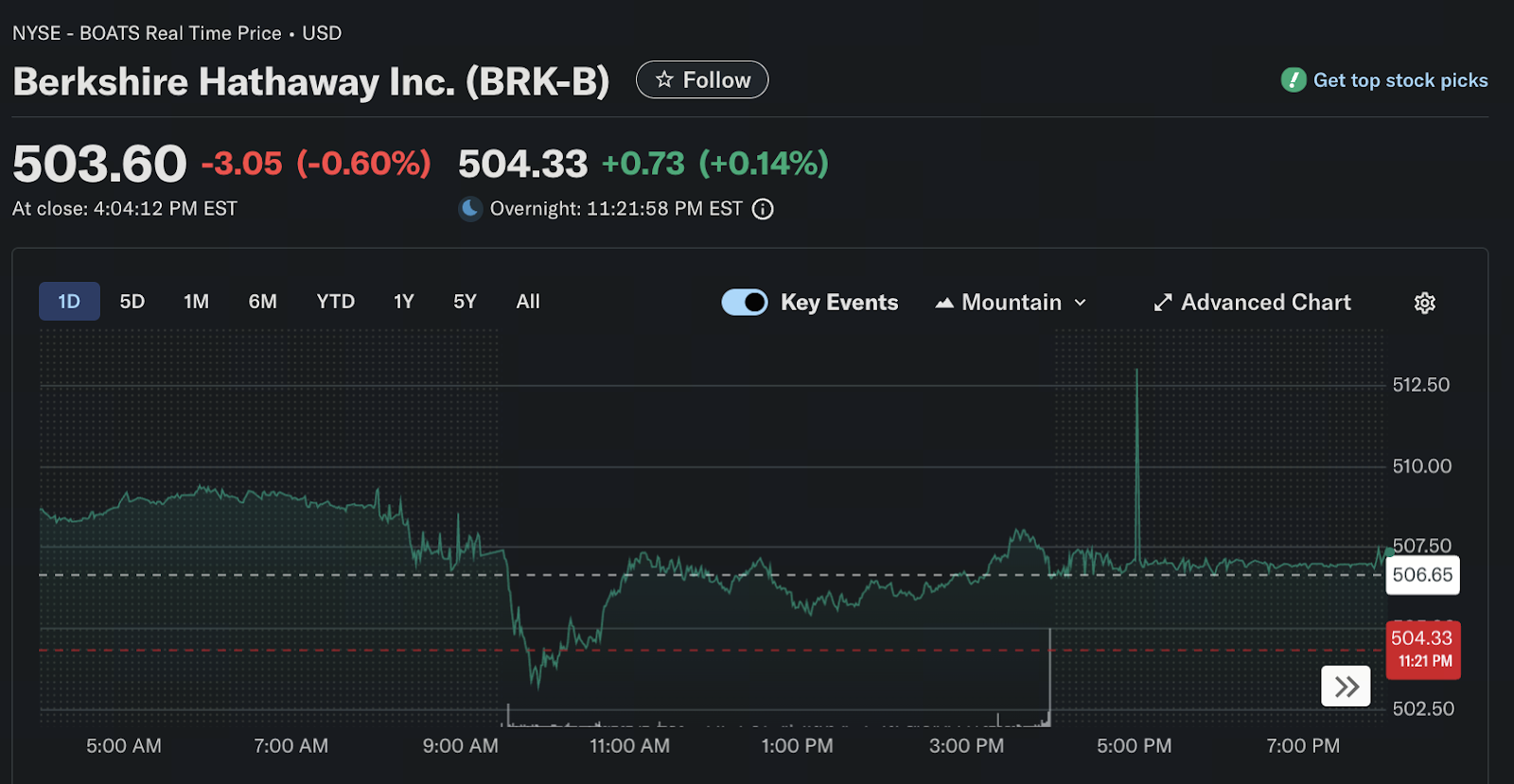

Chart: https://finance.yahoo.com/quote/BRK-B/

Recent analyst surveys set BRK.B’s average 12-month price target at $538, implying an upside of about 5–6% from current levels. Most institutions rate the stock as a Moderate Buy. This reflects market confidence in Berkshire’s solid asset structure and cash flow management, suggesting that, assuming stable market conditions, BRK.B will likely continue to perform well.

Investment Advantages: Cash Reserves, Asset Portfolio, and Diversified Businesses

Berkshire Hathaway is a highly diversified conglomerate, operating across insurance, railroads, energy, manufacturing, retail, and more. The company also holds shares in several prominent publicly traded firms, spanning technology and consumer sectors. This effectively allows one share to provide exposure to multiple industries. Its substantial cash reserves provide strong support for future acquisitions, buybacks, or navigating economic downturns. For investors seeking a stable, diversified, and long-term approach to reduce volatility, BRK.B delivers both a margin of safety and attractive potential returns.

Risk Factors: Interest Rate Environment and Operational Adjustments

Nonetheless, potential risks remain. If interest rates decline—given the Federal Reserve may cut rates—BRK.B’s advantage in earning interest rate spreads on cash and short-term bonds could weaken, and reinvestment returns from its insurance float may also decrease. The company has been a net seller of stocks for several consecutive quarters and has paused buybacks, suggesting management may see few reasonably valued opportunities in the market. In addition, with Greg Abel set to succeed as CEO, it remains to be seen if Greg Abel will match or surpass Warren Buffett’s track record in capital allocation and decision-making.

Implications for Long-Term Investors

Overall, BRK.B stands out as an attractive option for long-term investors who value diversification, stability, cash flow, and a mixed business portfolio. Its reasonable valuation, strong assets and cash flow, and medium-term upside make it well suited for building a core long-term position. Those seeking higher growth, volatility, and risk may consider pairing BRK.B with technology or growth stocks.

Ultimately, if you want stability without being overly conservative, BRK.B is a strong candidate for your core holdings.

Author: Max
Disclaimer
* The information is not intended to be and does not constitute financial advice or any other recommendation of any sort offered or endorsed by Gate.
* This article may not be reproduced, transmitted or copied without referencing Gate. Contravention is an infringement of Copyright Act and may be subject to legal action.

Related Articles

AI-Native Settlement Layers: How United Stables Is Building the Next Financial Rail
Beginner

AI-Native Settlement Layers: How United Stables Is Building the Next Financial Rail

Stablecoins were originally designed as dollar substitutes within exchanges, primarily used for asset pricing and trade settlement. As on-chain financial ecosystems have matured, their role has expanded beyond simple payments to include collateral assets, cross-chain liquidity mediums, and unified settlement units. In particular, as AI systems and automated agents begin to participate directly in economic activity, demand has risen sharply for programmable value units capable of instant settlement. This shift is pushing stablecoins toward the role of foundational financial infrastructure.
2026-03-25 03:16:17
The ve(3,3) Flywheel Explained: How AERO Tokenomics Powers Aerodrome’s DeFi Economy
Beginner

The ve(3,3) Flywheel Explained: How AERO Tokenomics Powers Aerodrome’s DeFi Economy

In the competition for DeFi liquidity, high-inflation mining alone is no longer enough to build lasting advantages. Aerodrome applies the ve(3,3) economic model to redesign token emissions, voting mechanisms, and revenue distribution, creating a liquidity flywheel centered on governance and cash flow. This article examines AERO tokenomics, the veAERO locking mechanism, and protocol revenue models to explain how Aerodrome builds a sustainable DeFi economic system.
2026-03-25 06:41:58
Aerodrome Tokenomics: How ve(3,3) Powers Base's Most Profitable DEX
Beginner

Aerodrome Tokenomics: How ve(3,3) Powers Base's Most Profitable DEX

AERO is the native token of Aerodrome Finance, a core decentralized exchange and liquidity protocol in the Base ecosystem. It is primarily used for liquidity incentives and ecosystem operations. veAERO is a governance NFT that users receive by locking AERO, representing both voting power and the right to share protocol revenue. Through a dual track structure of AERO as a utility token and veAERO as a governance credential, Aerodrome separates liquidity usage value from long term governance power, allowing participants to act as liquidity providers, governance decision makers, and revenue sharers within the same system.
2026-03-25 06:40:31
DePIN Identity Network and Real World Applications: How Humanity Protocol Brings on-chain Identity Into the Physical World
Beginner

DePIN Identity Network and Real World Applications: How Humanity Protocol Brings on-chain Identity Into the Physical World

Most Web3 identity systems remain confined to on-chain environments and struggle to achieve meaningful adoption in real world settings. Through a DePIN architecture and physical verification hardware, Humanity Protocol aims to bring decentralized identity into access control systems, hospitality, public services, and offline events, allowing on-chain identity to function not just as a digital credential, but as foundational infrastructure for real world access.
2026-03-25 07:40:53
How is the price of PAXG determined? Pegging mechanism, trading depth, and influencing factors
Beginner

How is the price of PAXG determined? Pegging mechanism, trading depth, and influencing factors

PAXG (Pax Gold) is a tokenized asset backed by physical gold reserves, launched by fintech firm Paxos and issued as an ERC-20 token on the Ethereum blockchain. The core concept is to digitally represent real-world gold assets, allowing investors to hold and trade gold via the blockchain network. Because each PAXG token corresponds to a specific quantity of physical gold, its price is theoretically expected to closely track the global gold market.
2026-03-24 19:11:40
How Does PAXG Work? In-Depth Overview of the Physical Gold Tokenization Mechanism
Beginner

How Does PAXG Work? In-Depth Overview of the Physical Gold Tokenization Mechanism

PAXG (Pax Gold) is a tokenized asset backed by physical gold, issued by the fintech company Paxos and traded on the Ethereum blockchain as an ERC-20 token. The core concept is to tokenize physical gold on-chain, with each PAXG token representing ownership of a certain amount of gold. This structure enables investors to hold and trade gold in the form of a digital asset.
2026-03-24 19:12:51





