There’s a big disconnect between what investors think is happening in crypto and what’s actually happening.
The largest sources of alpha in financial markets are behavioral. Investors make mistakes all the time, and if you can exploit those mistakes, you can do well.
My favorite behavioral bias to exploit is anchoring bias: the tendency to fixate on the first piece of information you encounter. It’s why retailers price things at $9.99 instead of $10.00. You hear the “9” first and your mind doesn’t let go.
Anchoring bias was one of the reasons I decided to get into crypto full-time in 2018. At the time, most people thought crypto was a joke. They’d first encountered it during the Silk Road scandal of 2013 or the Mt. Gox collapse of 2014, and they had watched it cycle through massive periods of volatility. I was fortunate enough to have a few people I trust tell me to take crypto seriously, and when I dug beneath the surface—looking at crypto for what it was, not what people thought it was—I was blown away. The technology was better and the opportunity far larger than most people realized. They were still anchored to 2014.
I’m having flashbacks to that moment right now.
The World Is Screaming at You
Everywhere I look, Wall Street is screaming that finance is moving onchain. Not a little of it; all of it.
Last July, SEC Chairman Paul Atkins launched “Project Crypto,” a commission-wide initiative to modernize securities regulation so that America’s financial markets can, in his words, “move onchain.” And move onchain they have:
- In October, BlackRock CEO Larry Fink declared that we are at “the beginning of the tokenization of all assets.” Two weeks ago, BlackRock launched its BUIDL tokenized Treasury fund—now with more than $2 billion in assets—on Uniswap, the largest decentralized exchange. As part of the deal, it invested in Uniswap’s native token (UNI) as well.
- Apollo, the $700 billion credit manager, tokenized its Diversified Credit Fund through a partnership with Securitize and launched it on six different blockchains. It has attracted over $100 million since January 2025. The firm recently announced plans to buy 9% of Morpho, one of the world’s leading decentralized lending protocols.
- JPMorgan, Bank of America, Citigroup, and Wells Fargo are in discussions to launch a joint stablecoin.
Meanwhile, JPMorgan launched a deposit token on Coinbase’s Base network. Fidelity is hiring a DeFi vaults manager. And so on.
The numbers in question are enormous. ETFs hold $30 trillion, stocks are $110 trillion, and bonds are $145 trillion. Compare that to the size of the entire tokenized market today: $20 billion. If Larry Fink is right that “every stock, every bond … will be tokenized,” it means the market can grow 10,000x and still have room to grow.
The Disconnect
And yet traditional investors can’t hear it.
They can’t hear it because of anchoring bias. They look at crypto and still see a punk skateboarder with tattoos. They don’t realize he’s shaved, put on a suit, and is deploying infrastructure that will underpin the next generation of capital markets.
The funny thing is, crypto investors don’t seem to hear it either. They’re suffering from “the boy who cried wolf” syndrome. They’ve heard the promises of institutional adoption for so long that they no longer register.
But the data is there. Look at this chart of how tokenized real-world assets have grown. It’s steeper than Everest.
Value of Tokenized Real-World Assets (RWAs)
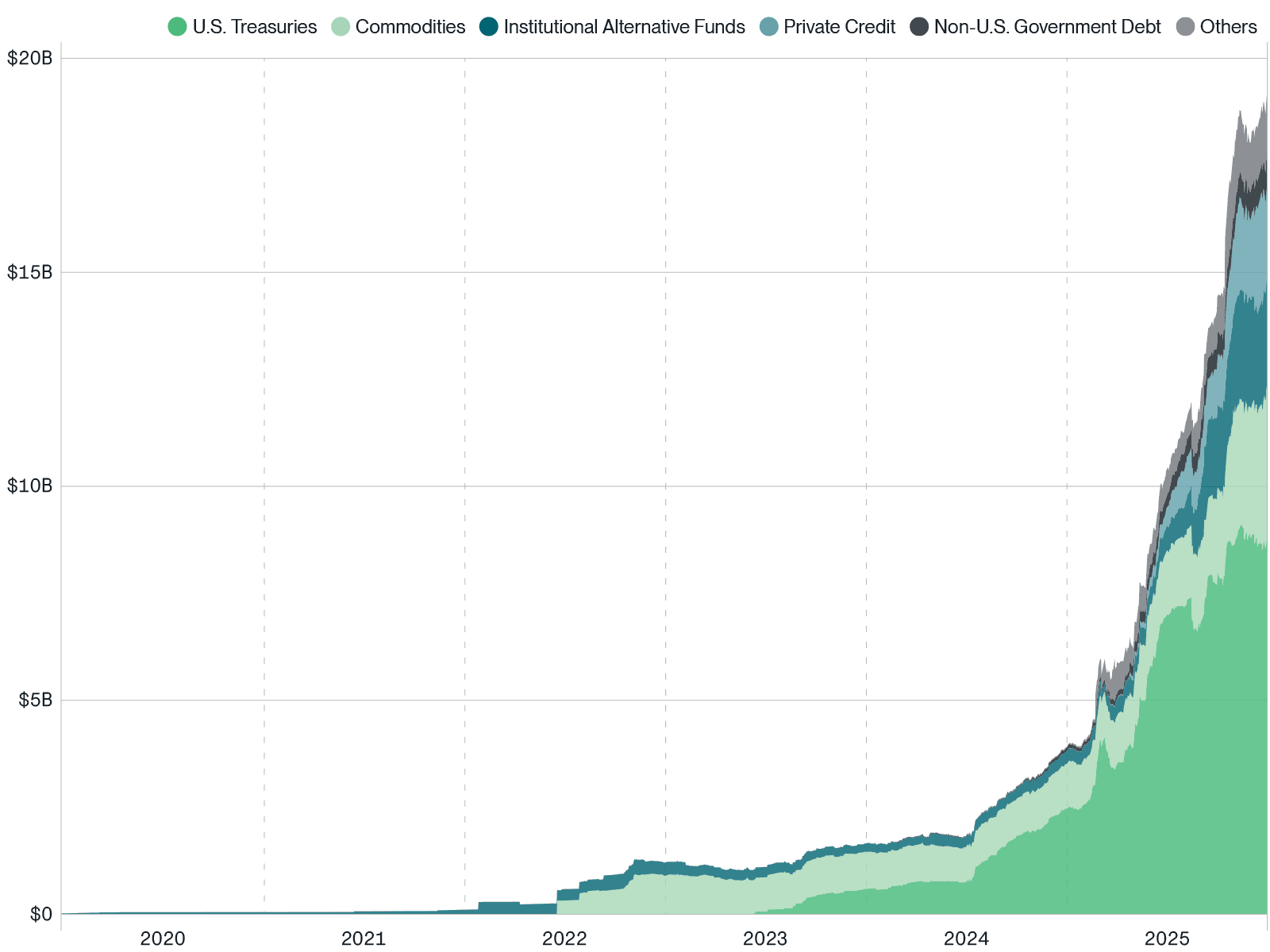
Source: Bitwise Asset Management with data from RWA.xyz. Data from January 1, 2020 to December 31, 2025.
Note: Stablecoin issuers such as Circle and Tether are intentionally omitted.
Capturing the Opportunity
The challenging thing about this realization is that it is difficult to know exactly how to profit from it. That’s because there are big questions in crypto right now that still need to be answered. Questions like:
- Will the value from tokenization accrue to public Layer 1 protocols like Ethereum and Solana, or is L1 blockspace being commoditized?
- If value accrues to L1 networks, will the new quasi-private blockchains like Canton Network and Tempo outperform public chains?
- Will DeFi tokens surge as firms like BlackRock and Apollo embrace the DeFi sector, or are the tokenomic challenges associated with DeFi tokens too large to overcome?
- If the value accrues to companies building in the space, and not to the blockchains, who will benefit more: incumbents like BlackRock and JPMorgan, or crypto-native firms?
I have views on all of these questions—and I’ll be writing about them in the coming months. But the honest answer to most of them is: No one knows yet. What I do know is that there is a large delta between what people think is happening in crypto and what is actually happening. From where I sit, that gap creates a significant opportunity—not to try to pick winners prematurely, but to build broad exposure to the space while the market is still mispricing the structural shift.
The biggest alpha opportunities come when the consensus narrative is stale and reality has moved on, but investors are still anchored on the old story. That’s exactly where we are with crypto today. If you can see it for what it is, there’s a lot of opportunity.
Risks and Important Information
No Advice on Investment; Risk of Loss: Prior to making any investment decision, each investor must undertake its own independent examination and investigation, including the merits and risks involved in an investment, and must base its investment decision—including a determination whether the investment would be a suitable investment for the investor—on such examination and investigation.
Crypto assets are digital representations of value that function as a medium of exchange, a unit of account, or a store of value, but they do not have legal tender status. Crypto assets are sometimes exchanged for U.S. dollars or other currencies around the world, but they are not currently backed nor supported by any government or central bank. Their value is completely derived by market forces of supply and demand, and they are more volatile than traditional currencies, stocks, or bonds.
Trading in crypto assets comes with significant risks, including volatile market price swings or flash crashes, market manipulation, and cybersecurity risks and risk of losing principal or all of your investment. In addition, crypto asset markets and exchanges are not regulated with the same controls or customer protections available in equity, option, futures, or foreign exchange investing.
Crypto asset trading requires knowledge of crypto asset markets. In attempting to profit through crypto asset trading, you must compete with traders worldwide. You should have appropriate knowledge and experience before engaging in substantial crypto asset trading. Crypto asset trading can lead to large and immediate financial losses. Under certain market conditions, you may find it difficult or impossible to liquidate a position quickly at a reasonable price.
The opinions expressed represent an assessment of the market environment at a specific time and are not intended to be a forecast of future events, or a guarantee of future results, and are subject to further discussion, completion and amendment. The information herein is not intended to provide, and should not be relied upon for, accounting, legal or tax advice, or investment recommendations. You should consult your accounting, legal, tax or other advisors about the matters discussed herein.
Disclaimer:
- This article is reprinted from Bitwise]. All copyrights belong to the original author [Matt Hougan]. If there are objections to this reprint, please contact the Gate Learn team, and they will handle it promptly.
- Liability Disclaimer: The views and opinions expressed in this article are solely those of the author and do not constitute any investment advice.
- Translations of the article into other languages are done by the Gate Learn team. Unless mentioned, copying, distributing, or plagiarizing the translated articles is prohibited.







