Image source: https://www.circle.com/
In the past year, Circle has emerged as one of the most notable “macro beneficiaries” in the crypto industry. Amid the Federal Reserve’s high interest rate environment, the interest income generated by reserve assets backing its flagship product, USD Coin (USDC), soared significantly—making Circle the most transparent and compliant stablecoin issuer in the sector for a time. USDC’s circulating supply returned above the $70 billion mark, with reserve yields peaking near 5%, theoretically producing billions of dollars in annualized interest income. At face value, this is a business with robust cash flow.
However, as expectations for rate cuts have grown, the market has begun to reassess the company: if profits are highly dependent on the interest rate cycle, is Circle truly a blockchain technology company, or is it a macro-sensitive financial institution? Stock price volatility and valuation compression have emerged as a direct result of these questions. At this crossroads, Circle has started to emphasize its positioning as a “payment network,” “cross-chain infrastructure,” and “on-chain asset service” provider, aiming to transform its identity from a single stablecoin issuer into a broader fintech platform.
This prompts a critical question: is this identity shift the result of genuine business transformation, or merely a narrative upgrade driven by valuation pressures?
I. Circle’s Core Profit Driver: Interest Rates, Not User Growth
Circle’s core product, USD Coin (USDC), is a dollar stablecoin backed by cash and short-term U.S. Treasuries.
According to public disclosures:
- USDC’s circulating supply is approximately $70–75 billion
- Reserve assets are primarily allocated to short-term Treasuries and cash equivalents
- During high-rate cycles, annualized reserve yields have exceeded 5%
A simple calculation: $70 billion × 5% annualized yield equals about $3.5 billion in theoretical annualized interest income, which underpins Circle’s significant profit expansion during rate hikes.
But if rates fall from 5% to 3%: $70 billion × 3% = $2.1 billion, a direct revenue decline of roughly 40%.
This underscores a key reality: Circle’s profit elasticity is primarily driven by interest rates, not by on-chain activity or user growth.
Capital markets are highly sensitive to this “macro variable-driven profit structure.”
II. Scale Expansion Has Not Changed the Profit Structure
Theoretically, a larger USDC circulating supply means a larger reserve base and higher profits for the company. In reality, the structure is more complex. As disclosed, Circle must share a portion of its reserve income with Coinbase. At certain times, Coinbase’s share of USDC-related revenue has reached hundreds of millions of dollars.
This means:
- Circulation increases
- Interest income grows
- But net profit margin does not necessarily rise in parallel
This is unlike the typical technology platform model.
Tech platforms rely on: user growth → lower marginal costs → expanding profit margins
Stablecoin issuance, however, is more akin to: asset scale expansion → income fluctuates with interest rates
It is more similar to a highly streamlined asset management company.
III. The Stablecoin Model’s Deeper Structure: Shadow Banking Logic
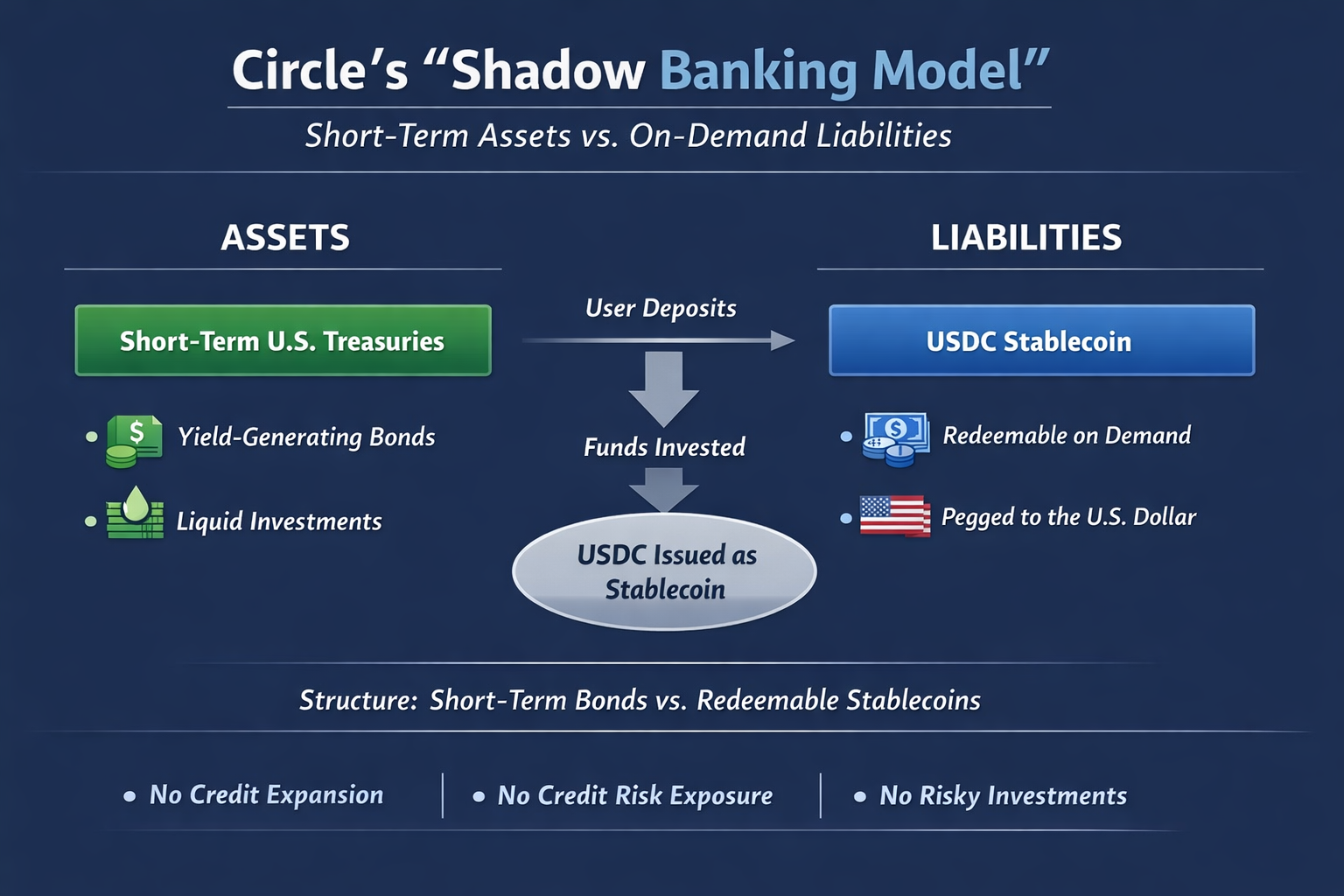
Many consider USDC a technology product. Yet from a balance sheet perspective, it closely resembles a “shadow banking model.”
The structure is straightforward:
- Users deposit dollars
- Circle allocates funds to short-term Treasuries
- Issues USDC as a liability certificate
Essentially:
- Asset side: yield-bearing short-term bonds
- Liability side: dollar stablecoins redeemable at any time
This is highly similar to a banking model, with a few key differences:
- No credit expansion
- No credit risk exposure
- No high-risk investments
But the economic structure remains the same: short-term liabilities backed by liquid assets.
IV. The Real Risk Is Not Credit, but “Maturity”
USDC’s reserve assets are mostly U.S. Treasuries, so credit risk is extremely low. The core issue, however, is the maturity structure.
USDC is redeemable T+0. Even short-term Treasuries face:
- Maturity dates
- Market price fluctuations
- Liquidity discounts
If redemptions surge, Circle must liquidate assets quickly. In a rising rate environment, bond prices fall, potentially resulting in mark-to-market losses. This structure led to market concerns during the 2023 regional banking crisis. While Circle differs from traditional banks, it carries liabilities similar to demand deposits, while assets have maturities—creating a maturity mismatch.
V. Rate Hikes and Cuts Both Create Pressure
When rates rise:
- Interest income increases
- Asset price volatility risk rises
When rates fall:
- Asset price risk decreases
- Income potential is compressed
No matter which direction rates move, Circle cannot fully escape the macro cycle. This creates a unique dilemma: its profit model is always exposed to macro variables. Capital markets typically apply a valuation discount to such companies.
VI. Industry Comparison: Why Does the Valuation Logic Differ?
| Comparison Dimension | Circle | Tether |
|---|
| Core Product | USDC | USDT |
| Company Type | Public Company | Private Company |
| Market Oversight | Capital markets + regulatory constraints | Mainly regulation and self-governance |
| Profit Source | Primarily reserve interest income | Primarily reserve interest income |
| Income Disclosure | Regular financial reports | Relatively limited disclosure |
| Valuation Pressure | Subject to P/E and growth expectations | No public valuation pressure |
| Cycle Sensitivity | Highly sensitive to U.S. rates | Also sensitive, but not reflected in valuation swings |
| Investor Expectations | Diversified income, growth logic, sustainability | Stable scale and profitability |
| Market Pricing Logic | Closer to “rate-sensitive financial company” | Closer to “cash flow machine” |
The global stablecoin market totals about $140–160 billion, with USDC holding a 25–30% share. Tether, the other major issuer, maintains a higher long-term scale with USDT. The crucial difference: Tether is private and does not face quarterly valuation or P/E pressures. As a public company, Circle must answer:
- Are profits sustainable?
- Is there cyclical volatility?
- Is income diversified?
- Will regulation compress profit margins?
Capital markets therefore classify Circle as a rate-sensitive financial income company, not a blockchain infrastructure growth company—driving the valuation gap.
VII. Potential Shifts in Regulatory Costs
Stablecoin regulation is gradually clarifying.
Future developments may include:
- Higher capital reserve requirements
- Limits on reserve asset maturities
- Stricter disclosure mandates
- Regulation of profit distribution
If the business remains highly concentrated on “stablecoin issuance income,” regulatory risk becomes a single-point vulnerability.
The more singular the business model, the more conservative the valuation.
VIII. Why Does Circle Emphasize “Network” and “Infrastructure”?
Over the past year, Circle has consistently highlighted:
- Cross-chain messaging protocols
- Payment network capabilities
- Asset tokenization services
The motivation is not just a brand refresh, but a structural shift. If future revenue splits 60% from reserve interest and 40% from payment fees and network services, the company would partially decouple from the interest rate cycle.
However, current public financials show reserve income is still dominant; the narrative has shifted, but the business structure has yet to catch up.
IX. What Truly Concerns Capital Markets?
Capital markets don’t object to stablecoins—they object to profit models reliant on a single variable. When profits are tied to a single macro factor (U.S. interest rates):
- Valuation multiples are compressed
- The market applies cyclical discounts
- Volatility is amplified
Only when revenue streams diversify and cash flow predictability improves will growth valuations be possible.
X. Key Metrics to Watch for the Future
To determine whether Circle is truly transforming, monitor three key indicators:
- Is the share of reserve income in total revenue declining?
- Are non-interest revenues providing stable profit contributions?
- Is USDC evolving into a network gateway rather than merely a profit pool?
If future profits still primarily derive from reserve scale × U.S. interest rates − profit-sharing costs, Circle will continue to be valued like a financial stock, not a tech stock.
Conclusion: A Financial Structure Overhaul
Circle’s desire to shed the “stablecoin company” label is not because stablecoins are unprofitable. Quite the opposite—in a high-rate environment, they are extremely lucrative.
The issue lies in an overreliance on the interest rate cycle for profits. If rates enter a sustained decline and new business lines have yet to scale, valuation pressure will persist. Only if cross-chain, payment, and tokenization services truly establish a “second curve” can Circle be reclassified as a fintech infrastructure company. Ultimately, what determines valuation is not whether USDC exists, but whether it remains the core of the profit structure.
Only when profits are no longer dictated primarily by interest rates will capital markets revalue the company.







