TON is a decentralized Layer 1 blockchain built on a high performance sharding architecture. It was designed to support large scale user adoption and complex on chain applications. The project was originally proposed by the Telegram team and later continued by an independent developer community, eventually evolving into a standalone public blockchain ecosystem.
As competition among public blockchains intensifies, scalability, transaction efficiency, and user experience have become critical benchmarks. TON addresses these challenges at the architectural level through dynamic sharding, while also exploring how blockchain technology can integrate with mainstream internet platforms through its close connection with Telegram.
This article walks through TON’s foundational definition, technical structure, performance design, ecosystem development, token economy, and potential risks, helping readers build a comprehensive understanding of the network.
What Is TON?
Source: TON official website
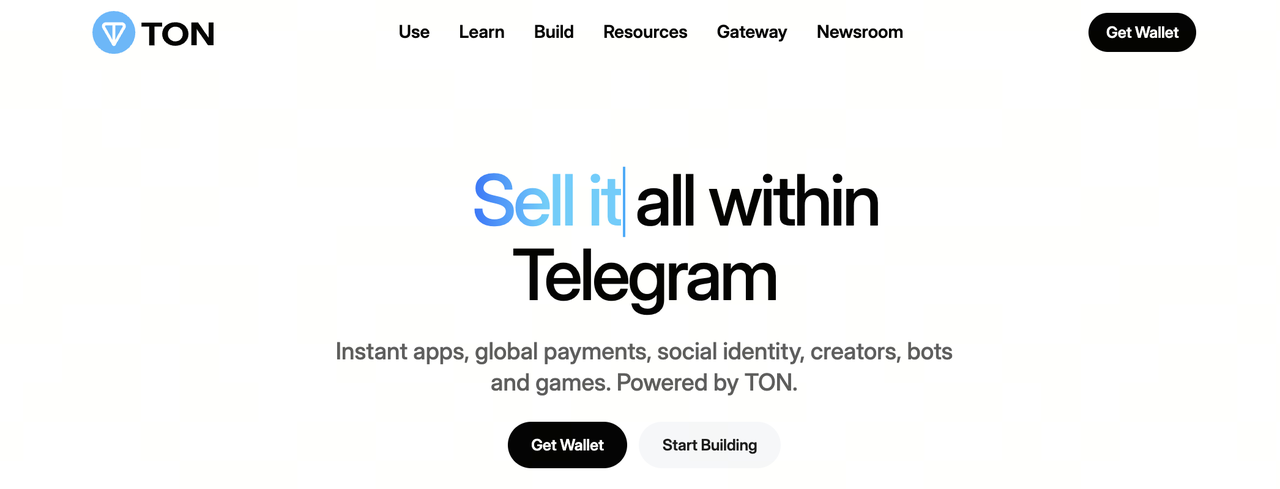
TON (The Open Network), is a decentralized Layer 1 blockchain. Its original name was Telegram Open Network, first introduced in 2018 by the founding team behind Telegram. The goal was to create a high performance blockchain infrastructure capable of serving a global user base.
In 2020, due to regulatory disputes, Telegram officially withdrew from the project. The open source community then assumed control of the codebase, continued development, and eventually renamed the project The Open Network. Today, TON operates under community governance, with a stable mainnet and a steadily expanding ecosystem.
Positioned beyond a simple public chain, TON aims to function as a comprehensive blockchain network that includes payments, storage, domain services, decentralized websites, and application platforms.
TON Technical Architecture and Performance Mechanisms
TON’s performance advantages do not rely on a single feature. Instead, they stem from a coordinated architectural design and multi layer optimization strategy.
1. Dynamic Sharding
TON uses a dynamic sharding architecture that divides the network into multiple shardchains. Unlike traditional static sharding models, TON’s shards can automatically split or merge based on network load. This allows the network to increase throughput when demand rises while maintaining efficient resource utilization.
In theory, this design supports extremely high transactions per second and reduces the risk of network congestion.
2. Multi Chain Structure, Masterchain and Workchains
The TON network consists of one masterchain and multiple workchains.
- The masterchain records the global state and validation information of the network.
- Workchains can operate under different virtual machines or rule sets depending on specific requirements.
This modular structure increases flexibility and enables TON to adapt to a wide range of use cases.
3. Consensus Mechanism, Proof of Stake (PoS)
TON uses a Proof of Stake consensus mechanism (PoS). Validators stake Toncoin to participate in block production and validation, earning rewards in return. This model reduces energy consumption and strengthens network security through economic incentives tied to staking.
4. TON Virtual Machine, TVM
TON operates its own virtual machine, known as TVM, for executing smart contracts. It supports an asynchronous message passing model, which improves efficiency in cross contract interactions and makes it well suited for complex application logic.
5. Core Network Services
TON also includes several foundational service modules:
- TON DNS, an on chain domain name system
- TON Storage, a decentralized storage solution
- TON Proxy, an anonymized access service
- TON Sites, decentralized web hosting
Together, these components form a more complete decentralized infrastructure layer.
How TON Differs from Other Public Blockchains
| Comparison Dimension |
TON |
Ethereum |
Solana |
BNB Chain |
| Public Chain Type |
Layer 1 |
Layer 1 |
Layer 1 |
Layer 1 |
| Scaling Approach |
Native dynamic sharding |
Relies on Layer 2 scaling |
High performance single chain architecture |
High performance single chain |
| Architecture Structure |
Multi chain structure, Masterchain + Workchains + Shardchains |
Single main chain + Rollups |
Single main chain |
Single main chain |
| Theoretical TPS |
Theoretically scalable to millions |
Approximately 15 to 30 TPS on mainnet at Layer 1 |
Thousands of TPS |
Hundreds of TPS |
| Consensus Mechanism |
PoS |
PoS |
PoS + Tower BFT |
PoSA |
| Smart Contract Virtual Machine |
TVM, TON Virtual Machine |
EVM |
Sealevel |
EVM |
| Native Social Entry |
Deep integration with Telegram |
No native social integration |
None |
None |
| Core Ecosystem Focus |
Payments + Social + Mini Apps |
DeFi + NFT + Layer 2 |
DeFi + High frequency trading |
DeFi + Trading |
| User Onboarding Barrier |
Accessible through Telegram embedded wallet |
Requires standalone wallet, such as MetaMask |
Requires standalone wallet |
Requires standalone wallet |
| Degree of Decentralization |
Community governance |
Highly decentralized |
Moderate |
Relatively high but with concentrated nodes |
| Network Positioning |
Web3 infrastructure for large scale user adoption |
Smart contract platform |
High performance trading chain |
Trading and DeFi ecosystem chain |
Key Differences at a Glance
- Architectural philosophy: TON was designed from the outset with a multi chain sharding structure focused on scalability, whereas Ethereum has primarily scaled through Layer 2 solutions over time.
- User entry point: TON’s most significant advantage lies in its deep integration with Telegram, giving it direct access to a massive built in user base, a feature most public blockchains do not have.
- Ecosystem positioning: Ethereum emphasizes infrastructure and DeFi as its core layer; Solana focuses on high frequency transaction performance; TON prioritizes social use cases and payment integration.
TON Ecosystem and Core Applications
In recent years, the TON ecosystem has expanded across several key areas:
- Decentralized exchanges, DEXs: Multiple DEX platforms have emerged on TON, offering token trading and liquidity services.
- DeFi protocols: Lending, staking, and liquidity mining applications support the financialization of Toncoin and other assets.
- Mini Apps: Mini Apps are a central component of the TON ecosystem. These applications are embedded directly within the Telegram chat interface, spanning gaming, payments, and social digital assets.
- NFTs and digital identity: TON DNS domains, digital usernames, and NFT assets together create a socially integrated digital asset system.
Deep Integration Between TON and Telegram
With hundreds of millions of users worldwide, Telegram serves as TON’s primary entry point. Through built in wallets, bot interfaces, and Mini Apps, TON integrates blockchain functionality directly into everyday messaging and social interactions.
This model offers three potential advantages:
- Lower user learning barriers
- Real world application scenarios
- A shorter transition path from Web2 to Web3
It is important to note, however, that TON is now governed independently by the community and is no longer operated by Telegram officially.
TON Token Economics
TON’s native token is Toncoin. Its primary uses include:
- Paying gas fees
- Participating in Proof of Stake validation (PoS Staking)
- Voting in network governance
- Paying for services within ecosystem applications
Toncoin follows an inflationary reward model, using validator incentives to maintain network security. The core economic challenge lies in balancing staking participation with circulating liquidity.
How to Participate in the TON Ecosystem
Users can get involved in several ways:
- Download a wallet that supports TON
- Purchase Toncoin on trading platform
- Participate in staking to earn rewards
- Use Mini Apps within Telegram
- Develop or deploy smart contracts
Developers can build decentralized applications using TVM and official development tools.
Risks and Future Outlook
Risk Factors
- Regulatory uncertainty
- Security risks arising from technical complexity
- Ecosystem maturity is still in development
- Token price volatility
Future Directions
- Expanding DeFi and payment scenarios
- Driving commercialization of more Mini Apps
- Strengthening the developer ecosystem
- Enhancing cross chain compatibility
If TON continues to leverage Telegram’s user base while maintaining technical stability, its ecosystem could grow significantly.
Conclusion
TON is a Layer 1 public blockchain focused on scalability and social integration. Its core strengths lie in its dynamic sharding architecture and its connection to Telegram-based use cases. Compared with traditional public chains, TON places greater emphasis on large scale user onboarding and real world application deployment.
From its technical design to its ecosystem strategy and token model, TON presents coherent development logic. Its long term value, however, will depend on application growth, developer engagement, and shifts in the regulatory environment.
FAQs
Q1: Is TON officially owned by Telegram?
TON is currently governed by the community and operates independently from Telegram, although ecosystem collaboration remains.
Q2: What is Toncoin used for?
It is used to pay transaction fees, stake for validation, participate in governance, and pay for ecosystem services.
Q3: What is the biggest difference between TON and Ethereum?
TON natively adopts a dynamic sharding structure and integrates deeply with a social platform entry point.
Q4: How can ordinary users use TON?
Users can manage assets and interact with applications through the Telegram wallet or other wallets that support TON.
Q5: Is TON suitable for long term investment?
Suitability depends on individual risk tolerance, as its price volatility is closely tied to broader market conditions.







