UK 100 is one of the most representative stock indices in the British market. It generally refers to the FTSE 100 Index, which consists of the 100 largest companies by market capitalization listed on the London Stock Exchange. It is widely regarded as a primary gauge of overall UK stock market performance.
In global capital markets, UK 100 attracts significant attention because many of its constituent companies are large multinational corporations. It also serves as the underlying asset for numerous index funds, Contracts for Difference, and other derivatives. This article explains the definition, structure, calculation method, influencing factors, and trading applications of UK 100, offering a professional and in depth understanding of how the index operates.
The article below explore the core concepts behind UK 100, including sector distribution, calculation methodology, price drivers, comparisons with other major indices, trading strategies, and investment risks. It is designed as a comprehensive reference for investors.
What Is UK 100? Its Relationship with the FTSE 100 Index
Source: Wiki Lingo
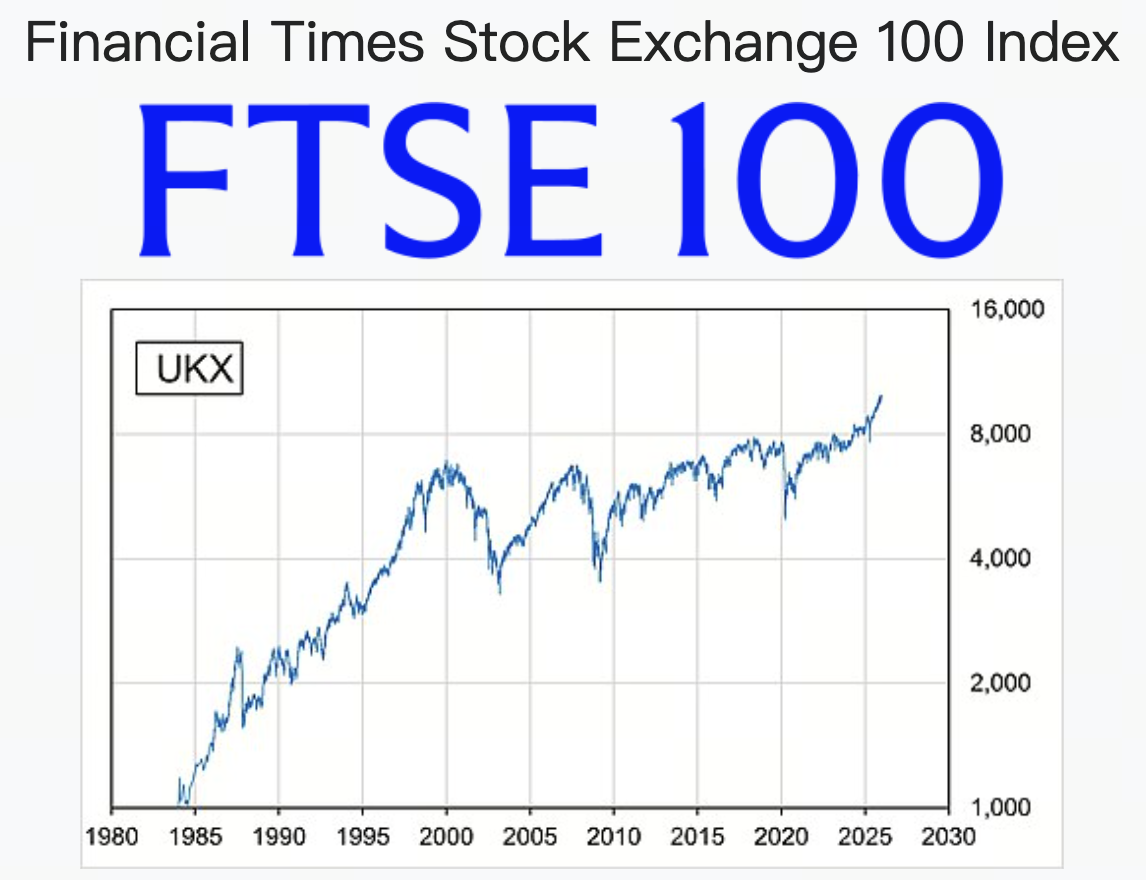
UK 100 is simply the market shorthand for the FTSE 100 Index. The full name, Financial Times Stock Exchange 100 Index, is maintained and published by FTSE Russell, a subsidiary of the London Stock Exchange Group.
Since its launch in 1984, the index has been regarded as a barometer of British blue chip performance. Its official trading symbol is typically UKX in professional financial markets, while retail and CFD platforms commonly use the simplified label “UK 100.”
Because many FTSE 100 companies operate globally, their revenues are not solely dependent on the UK economy. As a result, the index often reflects broader global economic conditions, not just domestic developments.
Composition and Sector Distribution of UK 100
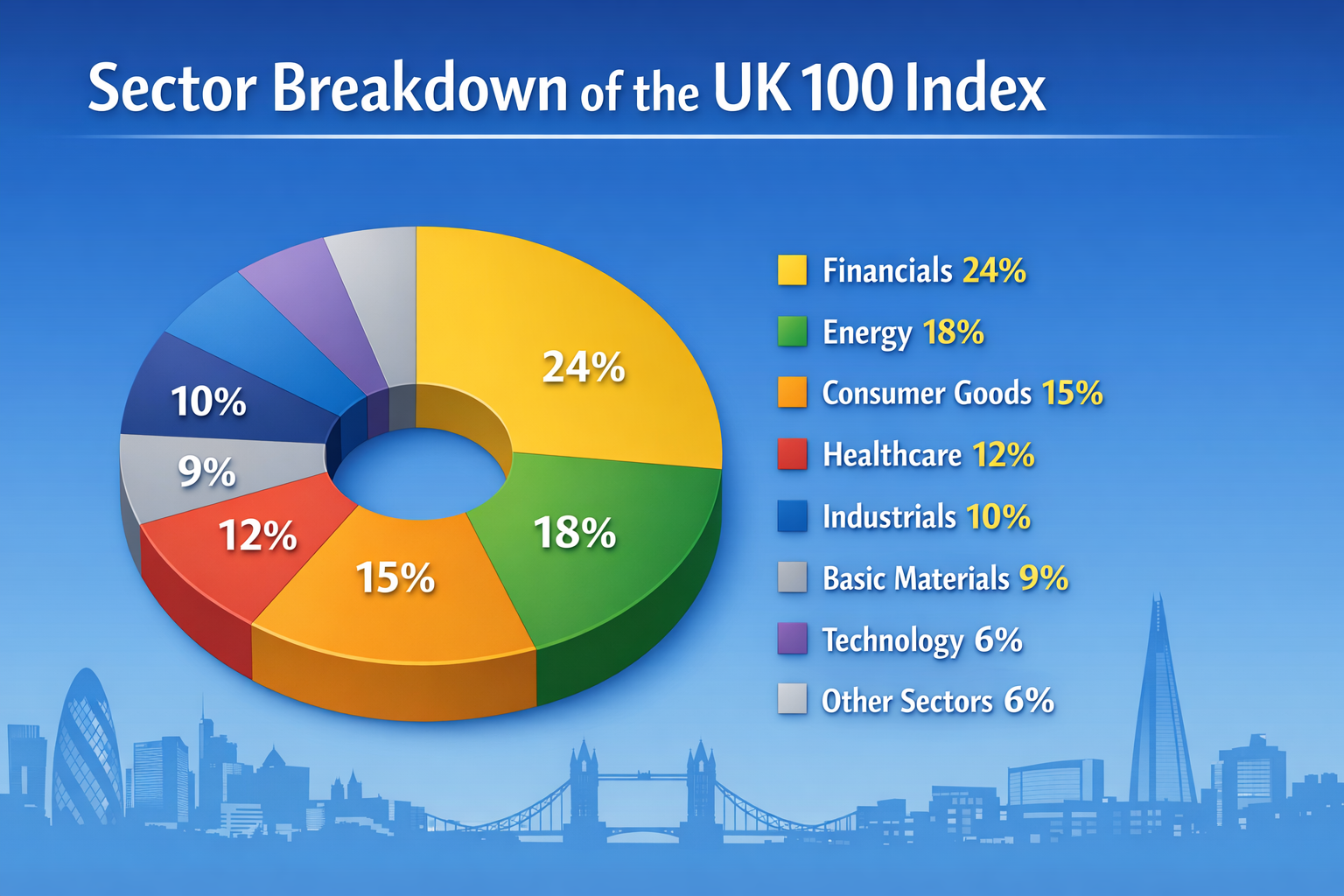
The FTSE 100 Index includes the 100 largest listed companies in the UK, selected and ranked by market capitalization. These firms represent the most established and influential businesses in the country.
Major Sector Distribution
- Financial Sector: Banks, insurance firms, and asset managers typically carry substantial weight and form a key pillar of the index.
- Energy and materials: Oil, gas, and mining companies hold significant positions due to their large market capitalizations.
- Consumer goods and healthcare: Pharmaceutical and consumer product companies account for a meaningful share of the index.
- Technology and industrials: Although smaller in proportion compared to the US market, technology and industrial service companies still contribute to sector diversity.
Because many of these businesses generate revenue internationally, their performance is not entirely tied to the UK domestic economy. This helps explain why the UK 100 does not always move in line with local economic trends of the United Kingdom.
How Is UK 100 Calculated? Understanding the Market Capitalization Weighting Method
UK 100 uses a market capitalization weighted methodology. This means each company’s weight in the index is determined by its total market value, calculated as share price multiplied by the number of outstanding shares, relative to the total market value of all constituents.
Core Logic of Market Capitalization Weighting
- Larger companies carry greater weight: Firms with higher market value exert a stronger influence on the index level. For example, a sharp move in a major bank can impact the index more than a similar move in a smaller company.
- Quarterly reviews: The list of constituents is reviewed every quarter and adjusted according to changes in market capitalization, ensuring the index continues to reflect the top 100 companies.
This approach allows the index to mirror price movements of the largest companies more accurately rather than relying on a simple average.
What Factors Influence UK 100’s Movements?
UK 100 is affected by a wide range of forces, including macroeconomic trends, sector dynamics, and overall market sentiment.
Macroeconomic Data
Indicators such as GDP growth, inflation rates, and interest rate decisions directly shape corporate earnings expectations and investor confidence. These shifts, in turn, influence stock prices and the overall direction of the index.
Political and Policy Developments
Events such as the Brexit process, international trade negotiations, and changes in fiscal or monetary policy can trigger market volatility. Policy uncertainty often increases risk premiums and may lead to index fluctuations.
Global Market Correlation
As many UK 100 constituents operate globally, the index is closely linked to international market movements. For example, significant volatility in the S&P 500 often spills over into global risk assets, including UK 100.
UK 100 Compared with Other Major Global Indices Such as the S&P 500 and DAX
Within the global index landscape, UK 100 differs in several key respects from indices like the S&P 500 and Germany’s DAX.
Comparison with the S&P 500
- Number of constituents: The S&P 500 includes 500 companies, offering broader diversification than the 100 company UK 100.
- Sector profile: The S&P 500 has a higher concentration of technology stocks, whereas UK 100 is more heavily weighted toward financials, energy, and materials.
Comparison with the DAX
- Market orientation: The DAX reflects the performance of Germany’s leading companies and has strong exposure to export driven manufacturing. UK 100, by contrast, features more internationally diversified firms and a higher weighting in financial services.
How Can Investors Trade or Invest in UK 100?
UK 100 is not only a benchmark index but also an investable asset through several channels:
Index funds and ETFs
Many passive funds track UK 100, offering a straightforward option for long term portfolio allocation.
Contracts for Difference
CFDs allow traders to speculate on price movements without owning the underlying assets, enabling both long and short positions.
Index options and futures
Certain exchanges offer UK 100 related derivatives for hedging or speculative purposes.
Stock basket strategies
Investors may replicate the index by constructing a portfolio of constituent stocks in similar weightings.
UK 100 in the CFD and Crypto Derivatives Markets
With the expansion of derivatives markets, many platforms now offer UK 100 CFD trading tools. In the CFD market:
- Leverage is widely available, which can amplify both gains and losses.
- Extended trading hours are often provided, with some platforms offering near 24 hour access.
- Crypto linked derivatives. On certain digital asset exchanges, UK 100 may be available as a derivative contract priced in stablecoins such as USDT.
These instruments are generally better suited to experienced traders due to the higher level of risk and the need for disciplined risk management.
What Risks Should Investors Consider When Trading UK 100?
Investing in UK 100 requires careful attention to several risk factors:
- Market volatility risk: The index is sensitive to global economic conditions, commodity prices, and policy changes.
- Leverage risk: Leveraged products such as CFDs can magnify losses.
- Sector concentration risk: Heavy exposure to financials and energy means sector specific shocks can significantly affect overall performance.
- Currency risk: As many companies generate revenue overseas, exchange rate fluctuations can influence earnings and valuations.
Long Term Performance and Market Significance of UK 100
In recent years, UK 100 has achieved several notable milestones in its long term trajectory. For example, in 2025 the index surpassed the 10,000 point level, signaling strong growth momentum and renewed market confidence.
As the core index of the UK financial market, UK 100 reflects both the profitability of large corporations and broader investor sentiment. For global investors, it remains an important asset allocation tool and a widely watched indicator of risk appetite and global economic outlook.
Conclusion
UK 100, also known as the FTSE 100 Index, is one of the most representative indices of the British stock market. It uses a market capitalization weighted structure and is heavily concentrated in financials, energy, and related sectors. Its performance is shaped by domestic economic conditions, UK policy developments, and global capital market trends. Whether for long term investment or derivatives trading, understanding its composition, calculation method, and key drivers is essential for informed decision making and effective risk management.
FAQs
Q1: Are UK 100 and the FTSE 100 the same index?
Yes. UK 100 is simply the market shorthand for the FTSE 100 Index; both refer to the same benchmark.
Q2: How often are UK 100 constituents adjusted?
The list is typically reviewed and updated on a quarterly basis based on changes in market capitalization.
Q3: What are common products for investing in UK 100?
Common options include index ETFs, Contracts for Difference, as well as options and futures.
Q4: Which sectors carry the highest weight in UK 100?
Financials, energy, consumer goods, and materials generally account for a significant share.
Q5: Does the UK 100 fully represent the overall UK economy?
It reflects part of it, but because many constituent companies operate globally, its performance does not always align directly with domestic economic conditions.







