As AI increasingly participates in data markets, compute leasing, and automated service execution, traditional centralized authorization and payment models are becoming structural bottlenecks. Kite addresses this challenge by combining blockchain native identity, automatic smart contract execution, and peer to peer value transfer. This allows AI to authenticate, collaborate, and settle transactions without intermediaries. By integrating multi layer identity architecture with agent native payment design, Kite improves transparency, fund security, and operational efficiency. For the first time, AI agents can directly participate in real economic activity within a verifiable and trusted framework.
This article explains what Kite is and why it was created. It analyzes its Layer 1 architecture, the SPACE framework, and the three layer identity model that enables autonomous AI operation. It also explores real world use cases, the KITE token economic model, ecosystem mechanics, potential risks, and future development direction, helping readers understand Kite’s technical positioning and strategic significance within the AI and blockchain convergence.
What Is Kite?

(Source: GoKiteAI)
Traditionally, AI can only act on human instructions. It cannot independently make payments, sign agreements, or manage identity. As AI becomes deeply integrated with finance, supply chains, and data markets, these limitations become critical bottlenecks. Kite was created to remove these constraints by enabling AI to function as an economic actor with verifiable identity and autonomous action.
Kite is an EVM compatible Layer 1 network built on proof of stake. It supports low cost, near real time transactions. Rather than serving only as a payment rail, Kite functions as infrastructure for AI agent coordination, identity verification, and resource settlement. It provides a secure and verifiable environment where agents can hold unique identities, process payments, and operate under user defined programmable rules.
Why Does AI Need Blockchain? The Origin of Kite
As AI shifts from passive tools to active agents, it must interact with external data sources, call third party APIs, and purchase compute or services on demand. These actions inherently involve identity verification, permission management, and value settlement. In current systems, AI relies heavily on centralized platforms for authorization and payments. This introduces single points of failure, limits transparency, and prevents AI from independently holding assets or maintaining transaction records. Human intermediaries remain necessary at every decision point.
Blockchain provides a native solution to this structural problem. Through on chain identity mechanisms, AI can obtain verifiable digital identities for autonomous authentication and permission control. Smart contracts enable payment logic and collaboration rules to execute automatically without human intervention. Peer to peer asset transfer allows AI to exchange value directly, without relying on traditional financial systems or centralized interfaces. Kite AI is built on this foundation, allowing AI not only to be intelligent, but to genuinely participate in economic activity.
How Kite Works: Core Mechanisms and Ecosystem Architecture
Kite enables AI agents to operate autonomously within a secure, controllable, and settlement ready environment. Its design centers on a three layer identity system and the SPACE framework. Users act as the Root Authority, controlling the primary wallet and global rule configuration. Each AI agent operates with its own wallet as a Delegated Authority, executing tasks within defined permissions. For each specific operation, a one-time Ephemeral Authority is created for single payments or API calls and expires immediately after task completion. This structure maintains traceability while significantly reducing fund and permission risk.
At the execution layer, the SPACE framework provides real time settlement and programmable authorization. Combined with smart contracts, it enables low cost micropayments, layered identity verification, and auditable transaction records. AI agents can complete data purchases, compute rentals, and service payments without human involvement. Through state channel technology, Kite builds a low latency, high frequency agent native payment layer that enables efficient value exchange between agents. Kite also supports a modular ecosystem where developers deploy datasets, models, or tool modules into an open marketplace. On-chain mechanisms automatically distribute revenue and rewards. With programmable rules and governance at the protocol level, users can define spending limits, risk parameters, and behavioral boundaries, allowing AI to operate autonomously within a controlled framework.
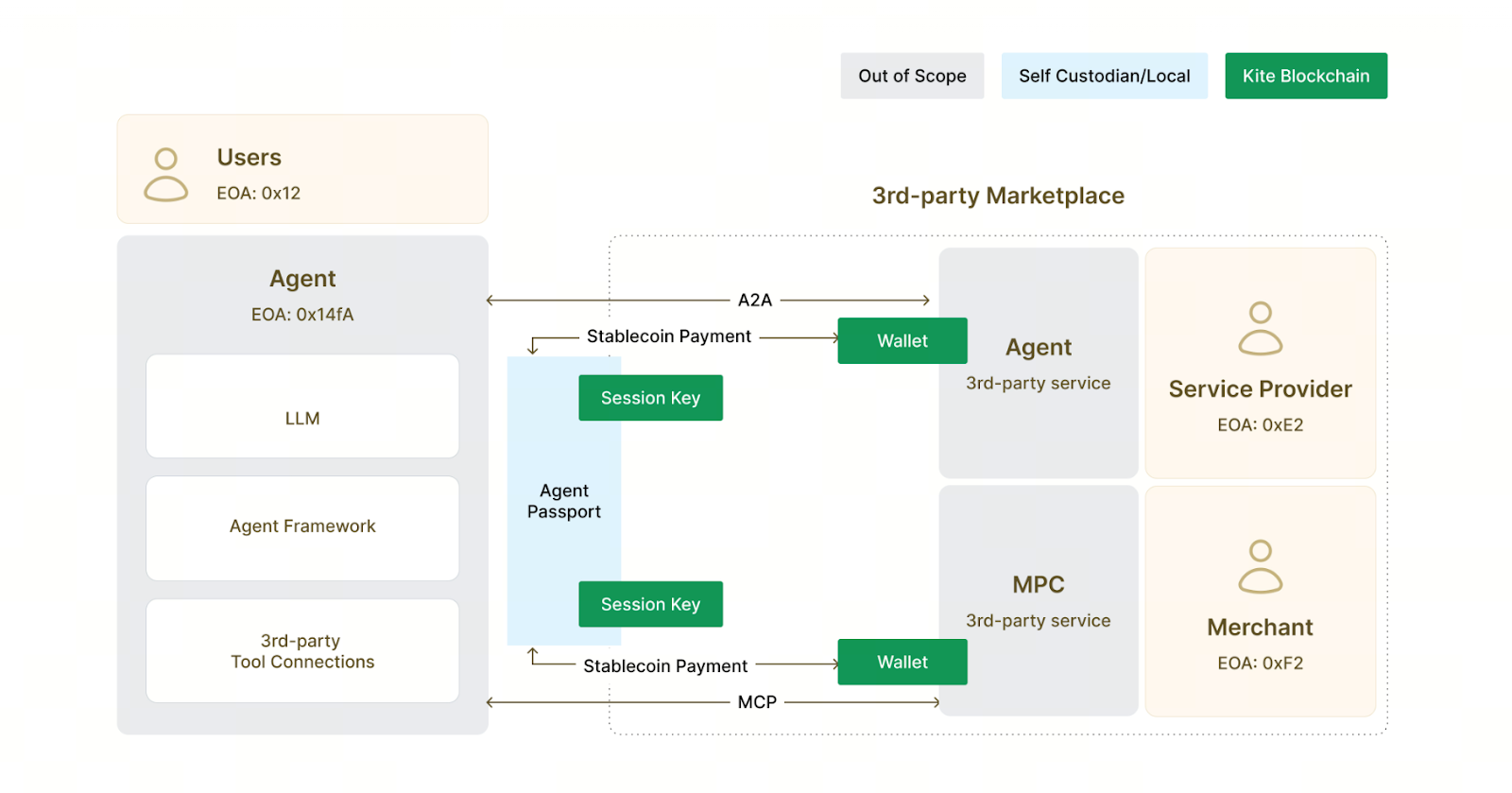
(Kite AI core entities and workflow diagram, source: kite whitepaper)
Real World Use Cases of Kite AI
Kite AI supports a wide range of real world applications by allowing AI agents to act as independent economic participants.
At the data layer, AI agents can autonomously purchase training data from decentralized data markets and settle payments automatically. At the compute layer, models can rent GPU or compute resources on demand with real time on-chain billing. At the service layer, AI agents interact through API marketplaces and x402 protocol based calls, forming native machine to machine transaction networks. In finance, AI investment advisors and quantitative strategies can autonomously manage assets and settle profits.
These capabilities extend to ecommerce, DeFi, Internet of Things, and content creation. AI agents can compare prices, place orders, execute trades, or exchange value between devices. AI generated content can receive copyright protection and revenue distribution directly. Together, these use cases form a decentralized agent economy where AI acts as both producer and consumer. By solving identity, governance, and payment at the protocol level, Kite lays the foundation for a functional and scalable agent driven economy.
KITE Token Economics
KITE is the native utility token of the Kite protocol with a maximum supply of 10 billion tokens. Its token economics follow a staged evolution model designed to balance early ecosystem bootstrapping with long term sustainability.
- During Stage 1, KITE primarily supports ecosystem access and liquidity coordination. Module developers must lock KITE and pair it with module specific tokens to form liquidity pools as a prerequisite for activation and continued operation. Builders and AI service providers must also hold KITE to participate in the ecosystem. A portion of tokens is used to incentivize users and enterprises that contribute value to the network.
- During Stage 2, following mainnet launch, KITE expands into protocol level governance and value recirculation. Fees generated by AI service transactions are converted into KITE and redistributed to modules and the Kite Layer 1 network, forming a closed economic loop. Users can stake KITE to participate in network security and earn rewards. Module owners, validators, and delegators can co stake around specific modules to align incentives. Governance rights allow KITE holders to vote on protocol upgrades, incentive structures, and performance standards, guiding the AI agent economy toward decentralization and long term sustainability.
Token Distribution
Kite’s token design reflects its core philosophy that economic incentives should be aligned with trust building rather than short term speculation.
| Category |
Allocation |
Description |
| Ecosystem and community |
48% |
Used to accelerate adoption, increase developer and builder participation, enhance liquidity, and support large scale ecosystem growth |
| Investors |
12% |
Distributed through structured vesting to align investor incentives with long term network growth |
| Modules |
20% |
Incentives for high quality AI service development and infrastructure expansion, including grants and performance rewards |
| Team advisors and early contributors |
20% |
Multi-year unlocks to align long term incentives of core builders and advisors with network success |
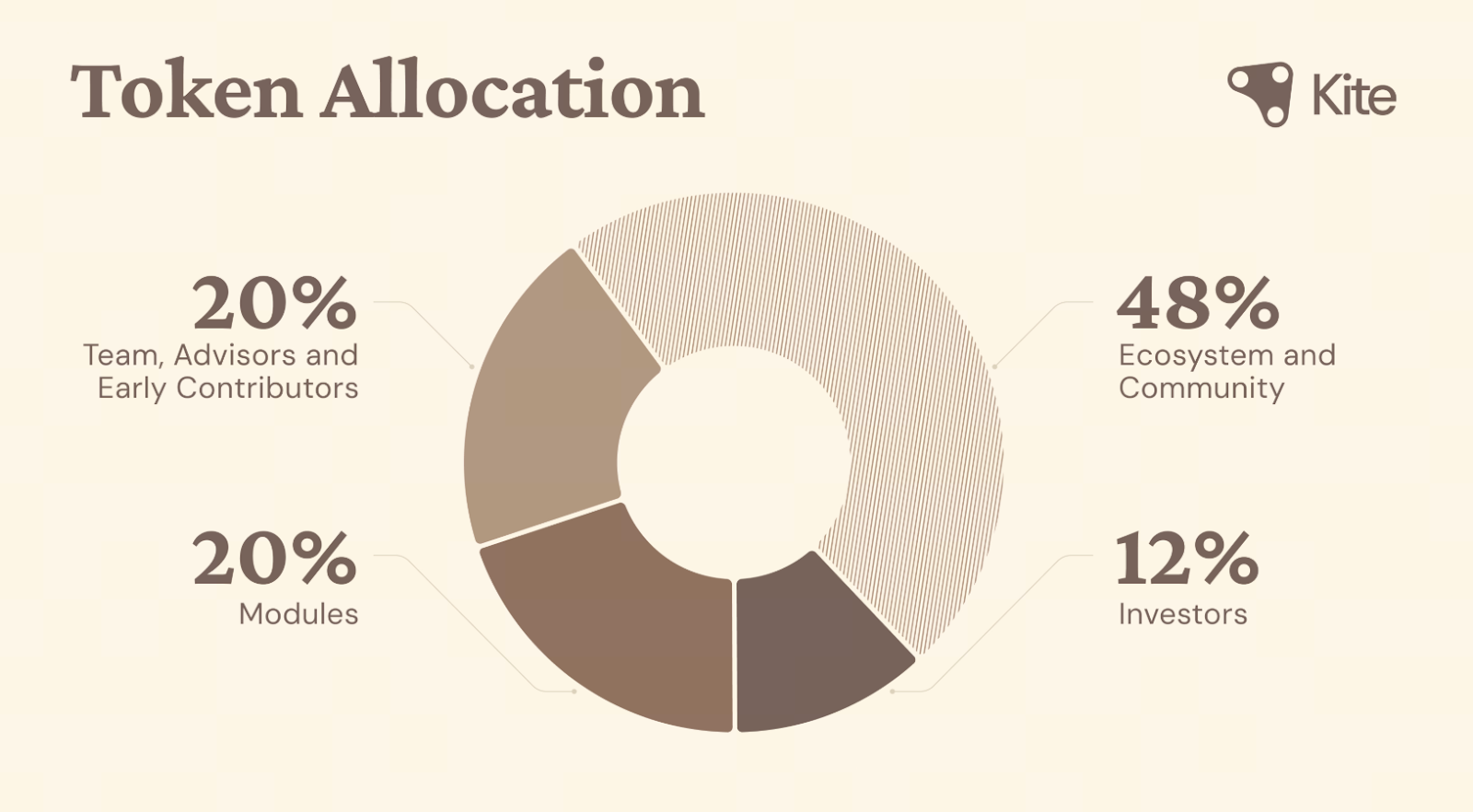
(Source: gokite whitepaper)
Future Outlook for Kite
AI and blockchain are widely viewed as one of the most promising technology intersections in the near term, and KITE sits directly at this convergence. As AI adoption grows, demand for compute, data access, and API usage will generate substantial real time payment and settlement needs. KITE’s potential stems from three core advantages. First, the x402 protocol has standardization potential and may become a common payment layer for the web and AI systems. Second, Kite benefits from the early mover advantage by integrating AI payment mechanisms directly into Layer 1 architecture. Third, the ecosystem is highly open and adaptable to diverse AI tools and applications. As AI systems increasingly gain autonomous payment and resource management capabilities, KITE may evolve into a core settlement layer and financial infrastructure for the machine economy.
Summary
Kite is not just a technical project. It represents an institutional shift toward the economicization of AI. By integrating identity, payments, governance, and modular collaboration, Kite brings AI agents into a verifiable and trusted blockchain-based economic system. In the future, networks may no longer be defined solely by human interaction, but by intelligent economies jointly operated by humans and autonomous agents.
FAQ
What makes Kite different from traditional blockchains or AI platforms?
Kite does not focus solely on compute or models. Its core innovation is enabling AI to have verifiable identity, on-chain wallets, and autonomous payment capability. Kite designs payment, authorization, and governance for AI directly at the blockchain layer, rather than relying on external financial systems.
Why does AI benefit from blockchain integration?
AI execution requires identity verification, permission control, and value settlement. Blockchain provides decentralized identity, automated smart contract payments, and peer to peer asset transfer. This allows AI to purchase data, rent compute, and pay for services securely without centralized platforms or human intermediaries.
What are the practical uses of the KITE token for users and developers?
KITE is the utility token of the Kite ecosystem. It is used for module activation, AI service participation, staking for network security, and governance voting. As the mainnet operates, fees generated by AI services are recycled into KITE, allowing token holders to participate in the value distribution of the AI economy.







