Visa Crypto Card Spending Surges 525%: On-Chain Payments Move Toward the Mainstream

Beginner
Quick Reads
Last Updated 2026-03-26 05:42:39
Reading Time: 1m
In 2025, Visa crypto card usage skyrocketed by 525%, increasing from $14.6 million to $91.3 million. Stablecoin payments and on-chain settlements also gained rapid traction. This article provides an objective analysis of the underlying drivers, market structure, major projects, and emerging trends shaping this evolution.

Visa Crypto Card Spending Soars 525%: A Major Signal for On-Chain Payments Entering the Real Economy
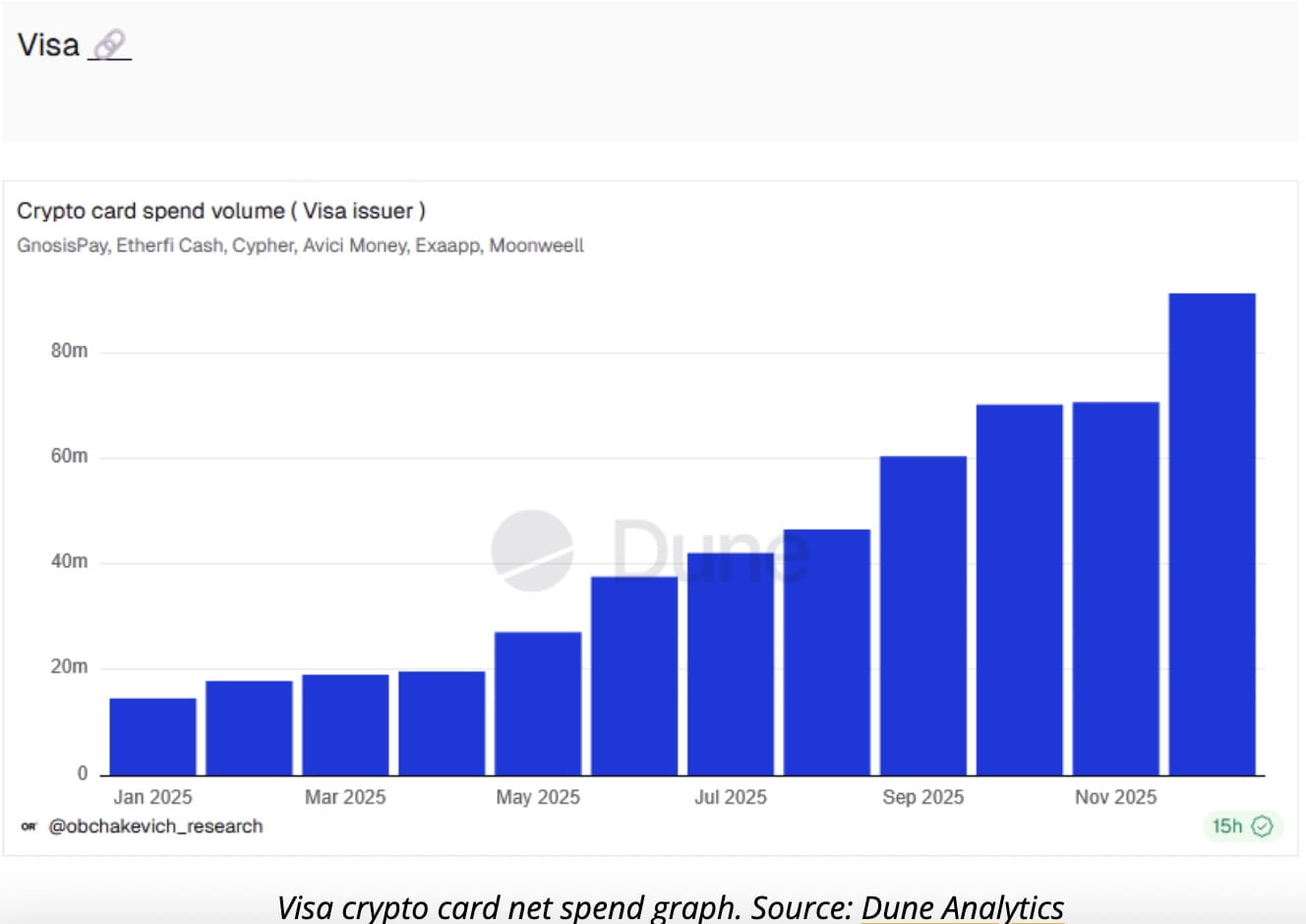
Recent on-chain data reveals that Visa-linked cryptocurrency spending is set for explosive growth in 2025. Annual spending is projected to jump from around $14.6 million at the start of the year to $91.3 million by year-end—a staggering 525% year-over-year increase. This surge isn’t just a numerical milestone; it marks a pivotal shift, signaling that on-chain payments are making significant inroads into real-world commerce.

As one of the world’s largest payment networks, Visa has steadily expanded its partnerships with leading crypto projects. By integrating APIs and stablecoin settlement solutions, Visa enables users to pay with crypto assets directly at millions of online and offline merchants worldwide.

Core Drivers Behind the Spending Surge

The 525% spike in Visa crypto card spending stems from a combination of structural factors, not a single event.

1. Dramatic Improvements in On-Chain Payment Experience

Early crypto payment processes were cumbersome, requiring users to convert crypto to fiat before making purchases. Today, this conversion happens automatically in the background, delivering a user experience nearly identical to traditional card payments:

  • Significantly faster settlement
  • Much simpler user flows
  • Lower barriers to entry

These improvements are essential for users to truly adopt crypto for everyday spending.

2. Broad Adoption of Stablecoins

Stablecoins, pegged to fiat currencies, effectively shield users from the psychological and financial risks of price volatility. This gives crypto assets real-world payment utility for the first time. Users no longer worry about wild price swings at checkout, making them more willing to use stablecoins for frequent transactions.

3. Ongoing Upgrades to Crypto Card Features

Some crypto cards now offer integrated yield features, such as:

  • Depositing funds into staking or yield pools to earn interest
  • Making payments directly without ending the yield status

This “earn while you spend” model significantly boosts capital efficiency and product stickiness for users.

Leading Projects and Market Structure Shifts

Visa crypto card spending growth isn’t driven by a single player. Instead, it reflects a trend of collaborative expansion across multiple projects.

Top contributors include:

  • EtherFi: Annual spending surpasses $55.4 million, capturing over half the market share
  • Cypher, GnosisPay, Avici Money, and Exa App have also delivered substantial growth

This pattern shows the crypto payment ecosystem is evolving from a “top-heavy pilot phase” to a mature market with multiple participants growing in parallel.

Stablecoin Settlement: The Key Catalyst for Mainstream Payment Adoption

Stablecoin settlement mechanisms are the critical infrastructure driving the 525% surge in Visa crypto card spending.

Their main advantages include:

  • Minimal volatility, making them more acceptable to merchants
  • High efficiency for cross-chain and cross-border settlements
  • Lower fees than traditional cross-border payment systems

Stablecoins are increasingly functioning as “on-chain dollars,” providing a stable and predictable value anchor for crypto payments.

Clear Signals of Crypto Payments Entering the Mainstream

This wave of growth sends several important signals:

  • User behavior is shifting from holding and investing in crypto assets to actively using and spending them
  • Major payment giants are becoming more involved in building Web3 infrastructure
  • Crypto assets are now used for dining, shopping, subscriptions, and other high-frequency scenarios
  • Cross-border payments are faster and significantly cheaper

Crypto payments are moving beyond speculation to become practical tools for everyday finance.

Risks and Challenges Remain

Despite strong growth, the sector still faces several challenges:

  • Regulatory uncertainty, with stablecoin policies varying widely across jurisdictions
  • Lack of unified compliance standards, slowing global expansion
  • Insufficient user education, increasing risks of operational errors or asset loss
  • Security concerns, including private key management and the maturity of anti-fraud systems

The industry must continue balancing security, regulatory coordination, and user experience.

Conclusion

In summary, the 525% surge in Visa crypto card spending reflects genuine user demand and signals the growing maturity of crypto payment infrastructure. As stablecoin adoption expands, user experience improves, and more mainstream institutions participate, crypto payments are poised for sustained, rapid growth and deeper integration into the global financial system in the years ahead.

Author: Max
Disclaimer
* The information is not intended to be and does not constitute financial advice or any other recommendation of any sort offered or endorsed by Gate.
* This article may not be reproduced, transmitted or copied without referencing Gate. Contravention is an infringement of Copyright Act and may be subject to legal action.

Related Articles

AI-Native Settlement Layers: How United Stables Is Building the Next Financial Rail
Beginner

AI-Native Settlement Layers: How United Stables Is Building the Next Financial Rail

Stablecoins were originally designed as dollar substitutes within exchanges, primarily used for asset pricing and trade settlement. As on-chain financial ecosystems have matured, their role has expanded beyond simple payments to include collateral assets, cross-chain liquidity mediums, and unified settlement units. In particular, as AI systems and automated agents begin to participate directly in economic activity, demand has risen sharply for programmable value units capable of instant settlement. This shift is pushing stablecoins toward the role of foundational financial infrastructure.
2026-03-25 03:16:17
The ve(3,3) Flywheel Explained: How AERO Tokenomics Powers Aerodrome’s DeFi Economy
Beginner

The ve(3,3) Flywheel Explained: How AERO Tokenomics Powers Aerodrome’s DeFi Economy

In the competition for DeFi liquidity, high-inflation mining alone is no longer enough to build lasting advantages. Aerodrome applies the ve(3,3) economic model to redesign token emissions, voting mechanisms, and revenue distribution, creating a liquidity flywheel centered on governance and cash flow. This article examines AERO tokenomics, the veAERO locking mechanism, and protocol revenue models to explain how Aerodrome builds a sustainable DeFi economic system.
2026-03-25 06:41:58
DePIN Identity Network and Real World Applications: How Humanity Protocol Brings on-chain Identity Into the Physical World
Beginner

DePIN Identity Network and Real World Applications: How Humanity Protocol Brings on-chain Identity Into the Physical World

Most Web3 identity systems remain confined to on-chain environments and struggle to achieve meaningful adoption in real world settings. Through a DePIN architecture and physical verification hardware, Humanity Protocol aims to bring decentralized identity into access control systems, hospitality, public services, and offline events, allowing on-chain identity to function not just as a digital credential, but as foundational infrastructure for real world access.
2026-03-25 07:40:53
Aerodrome Tokenomics: How ve(3,3) Powers Base's Most Profitable DEX
Beginner

Aerodrome Tokenomics: How ve(3,3) Powers Base's Most Profitable DEX

AERO is the native token of Aerodrome Finance, a core decentralized exchange and liquidity protocol in the Base ecosystem. It is primarily used for liquidity incentives and ecosystem operations. veAERO is a governance NFT that users receive by locking AERO, representing both voting power and the right to share protocol revenue. Through a dual track structure of AERO as a utility token and veAERO as a governance credential, Aerodrome separates liquidity usage value from long term governance power, allowing participants to act as liquidity providers, governance decision makers, and revenue sharers within the same system.
2026-03-25 06:40:31
Aster vs Hyperliquid: Which Perp DEX Will Prevail?
Beginner

Aster vs Hyperliquid: Which Perp DEX Will Prevail?

Aster and Hyperliquid are the two representative protocols of the "purpose-built L1 path" within the current decentralized perpetual exchange (Perp DEX) sector. As a pioneer in the field, Hyperliquid has built a deep liquidity moat through its highly mature order book architecture and strong community consensus. Conversely, Aster, as a rising challenger, seeks to leapfrog the competition in high-performance trading through more aggressive multi-chain aggregation logic, private transaction modules, and an underlying execution environment optimized for 2026 market demands.
2026-03-24 11:58:33
Gold Price Forecast for the Next Five Years: 2026–2030 Trend Outlook and Investment Implications, Could It Reach $6,000?
Beginner

Gold Price Forecast for the Next Five Years: 2026–2030 Trend Outlook and Investment Implications, Could It Reach $6,000?

Analyze current gold price trends alongside authoritative five-year forecasts, integrating an evaluation of market risks and opportunities. This gives investors insight into the potential trajectory of gold prices and the main drivers expected to shape the market over the next five years.
2026-03-25 18:13:30





