Token 2049 Singapore 2025 In-Depth Preview: The Blockchain Event You Can’t Miss

Beginner
Quick Reads
Last Updated 2026-03-28 18:24:01
Reading Time: 1m
Token2049 Singapore 2025 will be held on October 1-2, featuring over 25,000 participants and more than 300 speakers. Information on ticket prices, event highlights, and registration details is provided below.

Conference Overview: Dates and Location
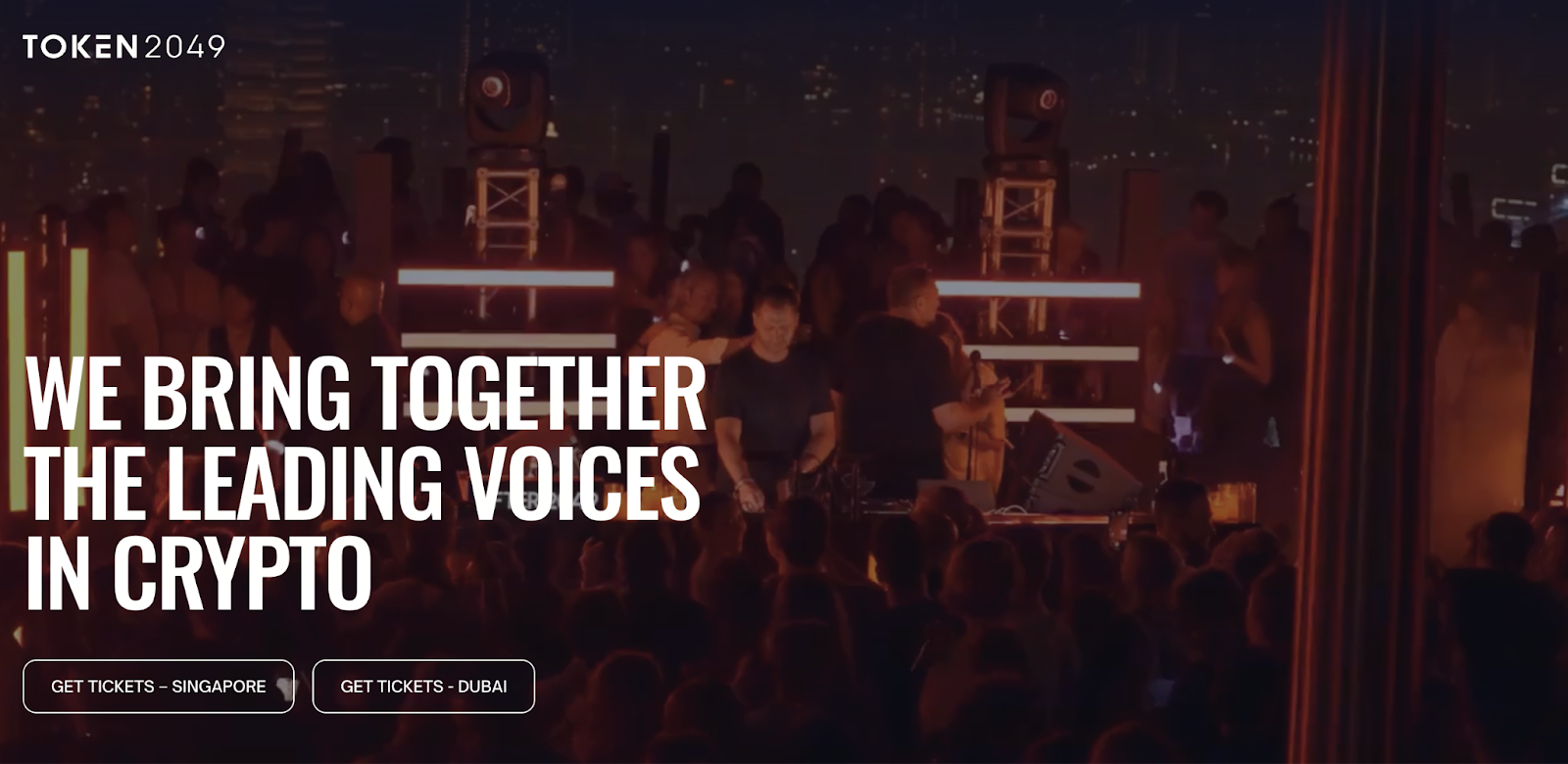

Image: https://www.token2049.com/

Token 2049 stands as one of the world’s largest conferences for cryptocurrency and Web3. The 2025 Token 2049 Singapore event will take place October 1–2, 2025, at Marina Bay Sands Expo and Convention Centre.

The event anticipates over 25,000 attendees, 300+ speakers, and more than 500 exhibitors. Organizers describe it as “the most immersive and largest edition” to date.

Throughout the conference, Singapore will host “Token 2049 Week,” a series of events from September 29 to October 5, including side events, parties, tech salons, and hackathons.

Ticket Types and Pricing Updates

Ticket pricing is structured in the following tiers:

  • Standard/Early Bird Ticket: approx. USD 499
  • Regular Ticket: approx. USD 999 (currently unavailable)
  • Special Access Pass: approx. USD 4,999, with additional exclusive perks

Prices will rise to USD 599 on August 29, 2025. Organizers frequently issue “almost sold out” alerts.

Some platforms offer discounts or coupons, such as 15% off.

We recommend that first-time attendees secure Early Bird tickets promptly to avoid price increases or sellouts.

Featured Speakers and Highlights

This year’s conference will showcase leading figures from crypto, finance, blockchain, and Web3.

Noteworthy speakers include:

  • Executives from Binance and Tether
  • Vlad Tenev, CEO of Robinhood
  • Balaji Srinivasan, author of “The Network State”
  • Top investor Tom Lee
  • Industry veterans Arthur Hayes, Paolo Ardoino, and more

The program covers DeFi, cross-chain solutions, NFTs, decentralized finance infrastructure, blockchain governance, regulatory trends, and more. Multiple stages will host breakout forums, roundtables, and project roadshows simultaneously.

Interactive offerings include water-based challenges, rope activities, live music, and installations, creating a genuine blockchain festival atmosphere.

Token 2049 Week and Side Events

Token 2049 Week runs September 29–October 5 and constitutes a key part of the conference experience.

During this week, Singapore will host 500+ side events, social gatherings, technical exchanges, hackathons, parties, and roundtables.

Typical activities include:

  • Crypto Fight Night, themed dinners, cross-chain liquidity meetups
  • Project roadshows and pitch sessions
  • Tech exchanges, workshops, hackathons
  • Social parties, music, art, and interactive experiences

For participants, side events offer outstanding opportunities for networking, deep engagement, and discovering new projects.

Registration Tips and Participant Guide

  • Register early to lock in ticket pricing and secure availability.
  • Set clear goals and plan your schedule. Choose sessions and speakers in advance.
  • Bring business cards, prepare presentations, and update your social media profiles.
  • Dress code and etiquette: business casual for daytime. Evenings at side events are more relaxed.
  • Transportation and lodging: book hotels near Marina Bay Sands whenever possible.
  • Participate in side events as much as possible. They are the best venues for building connections and finding opportunities.
Author: Max
Disclaimer
* The information is not intended to be and does not constitute financial advice or any other recommendation of any sort offered or endorsed by Gate.
* This article may not be reproduced, transmitted or copied without referencing Gate. Contravention is an infringement of Copyright Act and may be subject to legal action.

Related Articles

AI-Native Settlement Layers: How United Stables Is Building the Next Financial Rail
Beginner

AI-Native Settlement Layers: How United Stables Is Building the Next Financial Rail

Stablecoins were originally designed as dollar substitutes within exchanges, primarily used for asset pricing and trade settlement. As on-chain financial ecosystems have matured, their role has expanded beyond simple payments to include collateral assets, cross-chain liquidity mediums, and unified settlement units. In particular, as AI systems and automated agents begin to participate directly in economic activity, demand has risen sharply for programmable value units capable of instant settlement. This shift is pushing stablecoins toward the role of foundational financial infrastructure.
2026-03-25 03:16:17
The ve(3,3) Flywheel Explained: How AERO Tokenomics Powers Aerodrome’s DeFi Economy
Beginner

The ve(3,3) Flywheel Explained: How AERO Tokenomics Powers Aerodrome’s DeFi Economy

In the competition for DeFi liquidity, high-inflation mining alone is no longer enough to build lasting advantages. Aerodrome applies the ve(3,3) economic model to redesign token emissions, voting mechanisms, and revenue distribution, creating a liquidity flywheel centered on governance and cash flow. This article examines AERO tokenomics, the veAERO locking mechanism, and protocol revenue models to explain how Aerodrome builds a sustainable DeFi economic system.
2026-03-25 06:41:58
Aerodrome Tokenomics: How ve(3,3) Powers Base's Most Profitable DEX
Beginner

Aerodrome Tokenomics: How ve(3,3) Powers Base's Most Profitable DEX

AERO is the native token of Aerodrome Finance, a core decentralized exchange and liquidity protocol in the Base ecosystem. It is primarily used for liquidity incentives and ecosystem operations. veAERO is a governance NFT that users receive by locking AERO, representing both voting power and the right to share protocol revenue. Through a dual track structure of AERO as a utility token and veAERO as a governance credential, Aerodrome separates liquidity usage value from long term governance power, allowing participants to act as liquidity providers, governance decision makers, and revenue sharers within the same system.
2026-03-25 06:40:31
How Does PAXG Work? In-Depth Overview of the Physical Gold Tokenization Mechanism
Beginner

How Does PAXG Work? In-Depth Overview of the Physical Gold Tokenization Mechanism

PAXG (Pax Gold) is a tokenized asset backed by physical gold, issued by the fintech company Paxos and traded on the Ethereum blockchain as an ERC-20 token. The core concept is to tokenize physical gold on-chain, with each PAXG token representing ownership of a certain amount of gold. This structure enables investors to hold and trade gold in the form of a digital asset.
2026-03-24 19:12:51
How is the price of PAXG determined? Pegging mechanism, trading depth, and influencing factors
Beginner

How is the price of PAXG determined? Pegging mechanism, trading depth, and influencing factors

PAXG (Pax Gold) is a tokenized asset backed by physical gold reserves, launched by fintech firm Paxos and issued as an ERC-20 token on the Ethereum blockchain. The core concept is to digitally represent real-world gold assets, allowing investors to hold and trade gold via the blockchain network. Because each PAXG token corresponds to a specific quantity of physical gold, its price is theoretically expected to closely track the global gold market.
2026-03-24 19:11:40
DePIN Identity Network and Real World Applications: How Humanity Protocol Brings on-chain Identity Into the Physical World
Beginner

DePIN Identity Network and Real World Applications: How Humanity Protocol Brings on-chain Identity Into the Physical World

Most Web3 identity systems remain confined to on-chain environments and struggle to achieve meaningful adoption in real world settings. Through a DePIN architecture and physical verification hardware, Humanity Protocol aims to bring decentralized identity into access control systems, hospitality, public services, and offline events, allowing on-chain identity to function not just as a digital credential, but as foundational infrastructure for real world access.
2026-03-25 07:40:53





