SBF’s Challenge: Rethinking Institutional Boundaries
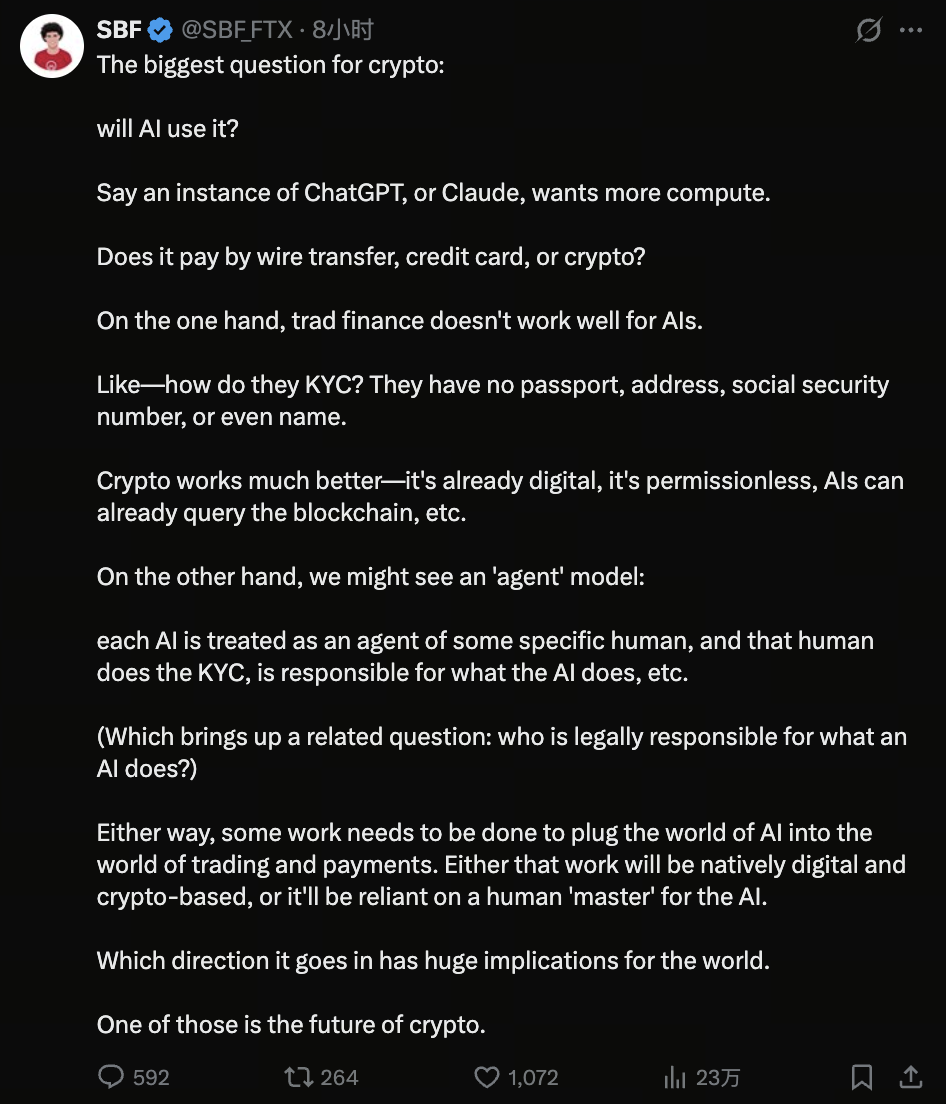
Image: https://x.com/SBF_FTX/status/2027167572454699446
On February 27, 2026, Sam Bankman-Fried (SBF) sparked widespread debate on social media by asking: When AI needs to purchase computing power or other services, will it pay through the banking system or use cryptocurrency? On the surface, this is a question about payment methods. But from a structural perspective, it probes the boundaries of the financial system itself—when transaction agents shift from humans to algorithms, do our current rules still apply?
With AI technology advancing rapidly, this question is highly relevant and extends far beyond theory.
The Core Logic of Financial Systems: Identity, Permission, and Accountability
Modern financial systems rest on three pillars:
- Each account must be tied to a clearly identifiable natural or legal person.
- Transactions must be traceable and attributable.
- Funds must move through licensed institutions.
KYC (Know Your Customer) is not just a compliance process; it is a system designed to ensure accountability. Financial institutions use identity verification to link financial activity to legal entities. This logic encounters significant tension when applied to AI.
AI lacks legal personhood and cannot independently assume civil or criminal liability. Even if it executes complex decisions, its actions must ultimately be attributed to a natural person or corporate entity. Under traditional financial frameworks, AI cannot directly hold accounts.
AI’s Growing Economic Capabilities—and Its Legal Void
AI has expanded in recent years from content generation to automated operations, data analytics, and trade execution. Some systems can already:
- Automatically call APIs
- Dynamically allocate computing power based on cost
- Execute investment strategies within defined rules
- Manage preset budgets
Functionally, these systems possess “economic agency.” Legally, however, they remain tools. The prevailing model is for enterprises to own accounts while AI operates within authorized limits. All responsibility ultimately falls to the enterprise.
In practice, AI is not yet an independent economic actor, but rather a component of enterprise automation systems.
Why Cryptocurrency’s Technical Structure Aligns with the Machine Economy
Technically, blockchain networks set minimal requirements for participants. Creating addresses and signing transactions do not require identity checks. Authority is determined by private keys, not legal status.
This makes cryptocurrency theoretically well-suited for machine-to-machine (M2M) transactions, particularly in:
- High-frequency micropayments
- Cross-border real-time settlements
- Automated contract execution
- Decentralized computing or data marketplaces
If large-scale resource transactions between AIs emerge, the traditional banking system could face challenges related to efficiency and compliance costs.
However, technical fit does not guarantee institutional acceptance. The permissionless nature of blockchain means regulators will be even more vigilant about anti-money laundering and risk management.
Regulatory Perspective: KYC, AML, and Accountability Constraints
Regulators focus on three core issues:
- Are the funds legitimate in origin?
- Are transactions linked to fraud or manipulation?
- Who is ultimately responsible in the event of losses?
If AI were allowed to directly hold assets, regulatory frameworks would have to answer a critical question: Who bears ultimate responsibility for AI’s actions? At present, no mature legal framework for “machine entities” exists worldwide. Even with advances in digital identity (DID), these are mainly for personal authentication, not for granting algorithms legal personhood.
In the foreseeable future, regulators are likely to support an “agency model,” where AI operates under the authority of a human or enterprise, rather than as an independent entity.
Commercial Reality: Does AI Really “Need” Cryptocurrency Today?
In practice, major AI companies currently rely on:
- Bank transfers
- Credit card payments
- Third-party payment platforms
These solutions already cover the needs for procuring computing power and managing operational expenses. In other words, cryptocurrency is not essential for AI development at this stage. Only if the following conditions are met will cryptocurrency’s structural advantages become clear:
- Large-scale direct transactions between AIs
- Payment frequency and volume surpass the limits of traditional systems
- Significantly increased machine autonomy
Currently, these scenarios remain in early exploration.
Potential Evolution: Three Medium- to Long-Term Scenarios
Over the medium to long term, the convergence of AI and financial systems may follow three paths:
- Status quo: AI remains an enterprise tool, with the financial system centered on humans. Cryptocurrency serves as a supplement.
- Limited autonomy: AI receives certain budgets and operational authority, but accounts stay under enterprise control. Blockchain may serve as backend settlement infrastructure.
- Machine economy: AI holds on-chain identities and assets, participating directly in resource allocation. This would require major legal and regulatory innovation.
Currently, the second scenario appears most likely.
Conclusion: For Cryptocurrency, Institutional Change Matters More Than Price
SBF’s question does not address short-term market trends, but rather a far-reaching institutional variable: As algorithms take on more economic decision-making, will financial systems rewrite the rules for machine participation? If future legislation recognizes some form of “digital economic entity,” blockchain networks—with their openness and programmability—could gain a structural edge. If the financial system continues to prioritize identity, AI will remain subordinate to human entities, and cryptocurrency will not see a decisive turning point from AI expansion alone.
The real significance of this debate is in highlighting a possible institutional fork in the decade ahead.
Whether cryptocurrency becomes foundational infrastructure in the AI era depends not on technical capability, but on how we define “who can be an economic participant.”







