As traditional financial institutions face growing pressure to digitize and improve operational efficiency, RWA tokenization has become a key technical pathway for enhancing asset liquidity, shortening settlement cycles, and reducing intermediary costs. The introduction of MiCA has further reshaped how Web3 infrastructure is designed, making compliance a foundational requirement rather than an afterthought. This shift is pushing blockchain technology away from experimental use cases and toward institutional grade financial infrastructure. At the same time, Europe’s strong emphasis on ESG standards, transparency, and investor protection is encouraging new intersections between blockchain technology, regulatory technology, and financial innovation.
This article explains why Europe is becoming the global hub for RWA tokenization, how MiCA is reshaping Web3 infrastructure design, and how Vision positions itself within institutional grade asset tokenization. It also outlines the full RWA lifecycle from legal structuring to on-chain liquidity, compares Vision with other RWA protocols, and examines the compliance and market challenges ahead. The goal is to provide a clear understanding of how Europe’s compliant Web3 ecosystem is developing and where its long term potential lies.
Why Europe Has Become the Global Center for RWA Tokenization
Europe is gradually emerging as one of the most important testing grounds for RWA tokenization. The core reason is not market size alone, but the combination of regulatory maturity and legal clarity. Compared with regions where regulatory direction remains uncertain, the European Union’s long established financial regulatory framework allows institutional investors to explore blockchain applications within a relatively predictable legal environment.
European banking systems and asset management firms are facing competitive pressure from digitally native financial platforms. Improving asset liquidity, shortening settlement cycles, and reducing intermediary costs have become central objectives of financial sector digital transformation. Tokenization technology enables traditional assets to be divided, moved on-chain, and settled efficiently, aligning closely with Europe’s demand for structural efficiency upgrades in financial markets.
In addition, Europe’s high standards for ESG compliance, transparency, and investor protection encourage the adoption of traceable and verifiable blockchain systems. As a result, RWA tokenization in Europe is not only a form of financial innovation, but also an increasing part of regulatory technology itself.
What Is MiCA and Why It Changes Web3 Infrastructure Design
(Source: prikhodko)
MiCA, or the Markets in Crypto Assets Regulation, is the European Union’s first comprehensive regulatory framework for crypto assets. It establishes clear legal boundaries for token issuers, trading platforms, and custodians. Beyond regulating market behavior, MiCA fundamentally reshapes how Web3 infrastructure must be designed.
Before MiCA, many Web3 projects prioritized technical experimentation and addressed compliance later. Under MiCA, compliance becomes the starting point of system architecture. Platforms must integrate KYC and AML requirements, asset segregation, transparency disclosures, and risk management mechanisms from the design stage. Infrastructure is no longer just an on-chain toolset, but a hybrid system that combines regulatory compliance with engineering discipline.
Over time, MiCA is likely to accelerate Web3’s transition from experimental applications to institutional financial infrastructure, while encouraging more organizations to launch compliant products within the European market.
How Vision Positions Itself as an Institutional Tokenization Layer
Vision does not position itself primarily as a retail focused platform. Instead, it aims to become a foundational layer for institutional grade asset tokenization. Its core strategy is to combine regulatory compliance with blockchain efficiency, allowing financial institutions to move assets on-chain without compromising regulatory requirements.
By integrating wallet infrastructure, public chain technology, and cross chain interoperability protocols, Vision enables asset issuance, custody, and circulation to operate within a unified system. Banks and asset managers can experiment with RWA issuance and trading models without building blockchain capabilities from scratch. Vision’s compliance first design philosophy also makes it easier to establish partnerships with traditional financial institutions, regulators, and custodians, forming a more structured and institutionally compatible Web3 foundation.
RWA On-chain Workflow: From Assets to On-chain Liquidity
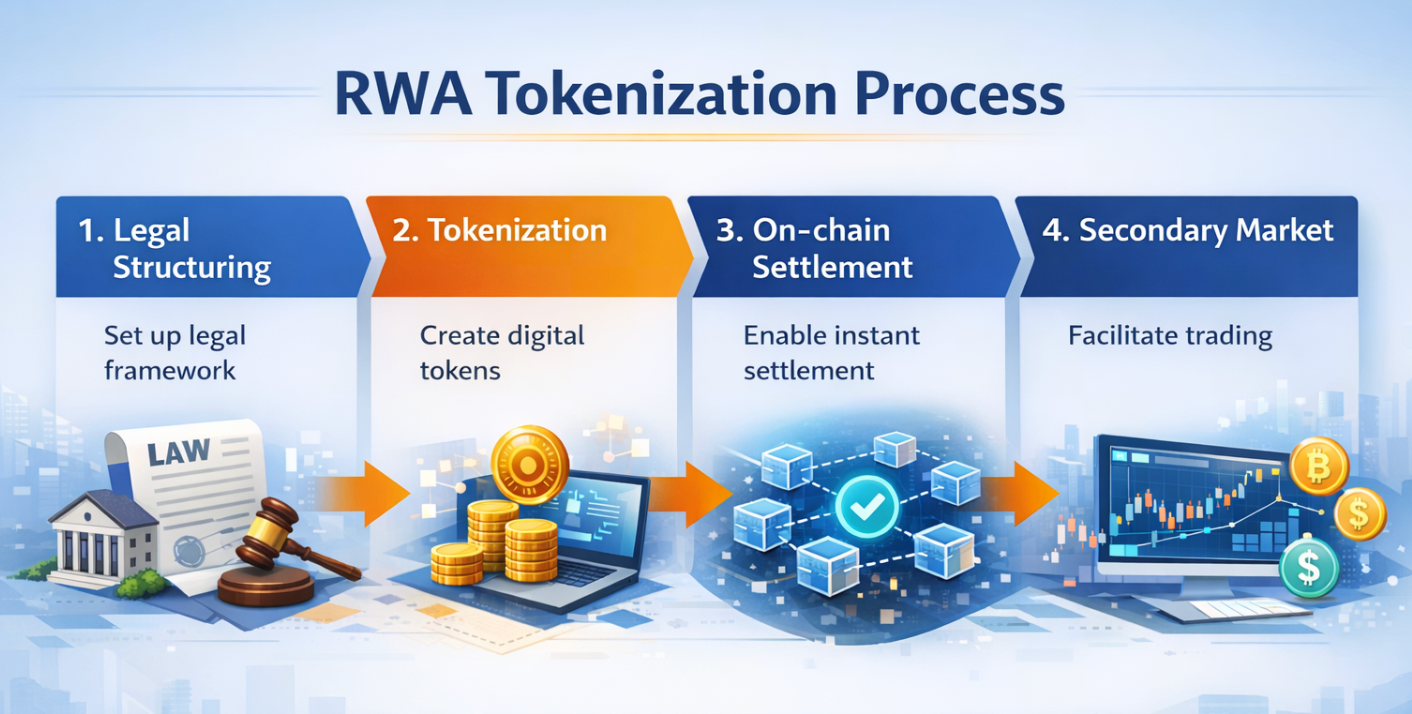
RWA tokenization can typically be broken down into four core stages:
Legal Structuring
The first step in bringing real world assets on-chain is establishing a clear legal structure. This is often done through SPVs, trusts, or fund vehicles that package physical or financial assets into legally defined entities. The goal is to ensure that on-chain tokens represent enforceable rights and obligations. This stage defines ownership, revenue distribution, and investor protection mechanisms, forming the compliance foundation for token issuance.
Tokenization
Once legal structuring is complete, smart contracts are used to convert asset rights into divisible digital tokens and register them on-chain. Tokenization makes assets programmable and divisible, lowers investment thresholds, supports multi party ownership, and increases overall market participation.
on-chain Settlement
Blockchain based settlement enables transactions to be finalized instantly or near instantly, significantly reducing traditional T plus two or T plus three settlement cycles. Smart contracts automate clearing and settlement, lowering intermediary costs while improving transparency and operational efficiency.
Secondary Market Liquidity
For tokenized assets to achieve real economic value, they must enter secondary markets. Tradability enables price discovery and portfolio reallocation. Continuous market activity helps establish fair valuation and increases the practical relevance of RWA within digital financial systems.
How Vision Differs From Other RWA Protocols
Unlike many RWA projects that originate from DeFi ecosystems, Vision benefits from a CeFi background and deep experience within Europe’s regulated financial markets. This makes it easier for Vision to form partnerships with banks, regulators, and asset managers. Its strategy does not prioritize immediate decentralization, but instead focuses on building standardized and repeatable tokenization frameworks within regulated environments.
Vision emphasizes infrastructure over individual financial products. It focuses on cross chain interoperability, compliant issuance processes, and institutional grade security architecture. Rather than operating as a yield driven protocol, Vision aims to serve as a bridge between traditional finance and Web3. This approach may sacrifice short term market hype, but it offers the potential to build more durable advantages within institutional markets.
Real-World Challenges Of RWA-Compliant Web3 Infrastructure
Although RWA tokenization is widely viewed as a key direction for the next phase of Web3 infrastructure, its real-world implementation continues to face multiple practical challenges, including the following:
- Complex cross-border compliance and legal responsibility: Legal definitions of securities and assets differ across jurisdictions, which limits the speed at which RWA tokens can circulate and be deployed across borders.
- Liquidity still in the early stages: Most tokenized assets remain at an early stage, with limited trading depth. Combined with lengthy traditional financial processes, this affects product rollout timelines and price discovery efficiency.
- Evolving regulatory environment: Regulatory frameworks are still developing, requiring infrastructure to remain highly adaptable. This also means that RWA is a long-term development path that depends on sustained investment and gradual accumulation of market trust.
From a long-term perspective, RWA is not a short-term market narrative. Instead, it represents an infrastructure path that requires continuous commitment, progressive trust-building, and the establishment of durable institutional foundations.
Conclusion
The introduction of MiCA has positioned Europe as one of the most institutionally advantaged regions for Web3 and RWA development. Vision seeks to combine regulatory frameworks with blockchain infrastructure, creating a technical layer that allows traditional financial assets to move on-chain safely and compliantly. The true value of RWA tokenization lies not in creating new speculative instruments, but in redefining how assets circulate and settle. Over the coming years, infrastructure platforms that successfully balance regulatory requirements, technical efficiency, and market liquidity are likely to become core components of the next generation financial system.