KBC Bank Launches Regulated Bitcoin and Ether Trading in Belgium: A New Era for Europe’s Crypto Market

Beginner
Quick Reads
Last Updated 2026-03-25 23:01:54
Reading Time: 1m
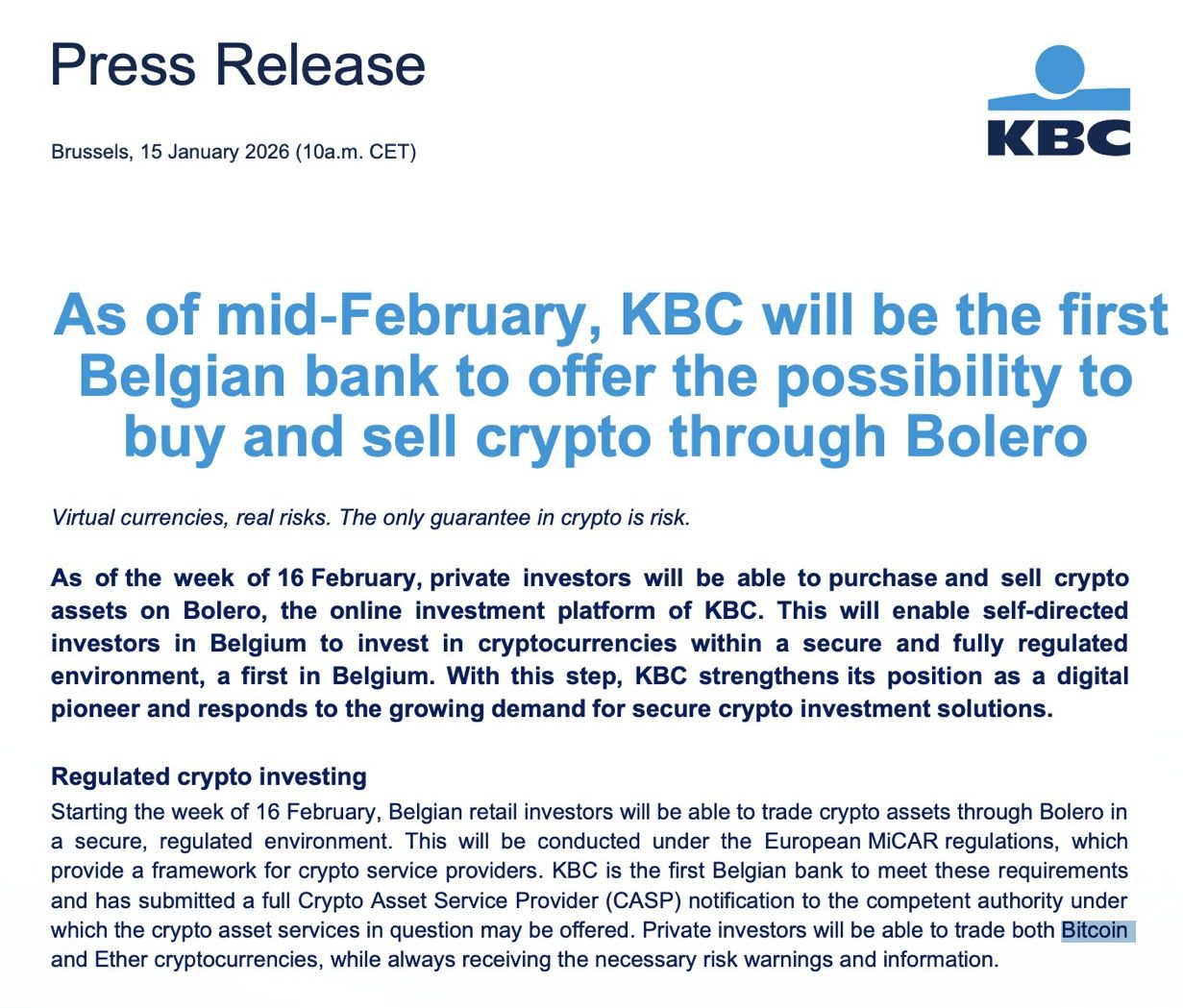
KBC Bank has announced plans to introduce regulated Bitcoin and Ether trading services in Belgium on February 16, 2026, utilizing the EU MiCA framework to advance retail crypto investment. Explore market responses and price trends.


Image source: https://newsroom.kbc.com/as-of-mid-february-kbc-will-be-the-first-belgian-bank-to-offer-the-possibility-to-buy-and-sell-crypto-through-bolero

KBC Bank, Belgium’s second-largest financial institution, has officially announced it will offer Bitcoin and Ether trading services to retail clients in Belgium starting February 16, 2026, through its online investment platform Bolero. This initiative positions KBC as the first traditional Belgian bank to directly support cryptocurrency trading under a regulated framework.

Until now, most investors relied on overseas exchanges such as Binance or Coinbase. Moving forward, users will be able to buy and sell crypto assets through a familiar banking interface, which is expected to enhance both regulatory compliance and user trust.

KBC Platform Service Details

Based on official and media reports, the service will:

  • Enable Bitcoin and Ethereum trading via the Bolero platform;
  • Implement a closed-loop trading mechanism, meaning assets can only be bought and sold within the platform and cannot be transferred to external wallets or exchanges;
  • KBC will retain custody of private keys, without granting users direct control over them;
  • Require all users to complete a knowledge assessment prior to trading to ensure they understand the volatility and risks associated with crypto assets.

This closed-loop approach helps mitigate risks such as self-custody errors and private key loss, but it also means users forfeit direct control over their assets. Compared to crypto-native exchanges, this model closely resembles traditional financial trading practices.

The Impact of the MiCA Regulatory Framework

This service rollout is driven by the official implementation of the EU’s Markets in Crypto-Assets Regulation (MiCA). MiCA will take effect at the end of 2025, establishing unified crypto asset regulatory standards across EU member states. According to Belgium’s regulatory timeline, these regulations will become effective under Belgian law on January 3, 2026.

Under the MiCA framework, financial institutions like KBC Bank must register as Crypto Asset Service Providers (CASP) and comply with requirements covering risk management, investor protection, anti-money laundering, and more. KBC has officially disclosed its completion of the necessary filings and, as a regulated institution, is qualified to participate.

Latest Bitcoin and Ethereum Price Trends

At the time of this announcement—in mid-January 2026—the market has responded steadily. According to market data:

  • Bitcoin’s price is fluctuating around $95,000;
  • Ethereum is trading near $3,300.

This pattern indicates the market has not shown significant short-term volatility in response to the bank’s entry, though as trading opens in February, potential price swings may arise.

Investor Risk Notice and Market Outlook

For investors:

  • The regulated trading environment offered by the bank lowers the entry barrier but lacks crypto-native private key control;
  • The closed-loop model restricts asset flexibility;
  • Investors should be aware of price volatility risks, especially the increased risk of short-term decisions in highly volatile markets.

In the long term, traditional banks entering the market are likely to boost mainstream financial acceptance of crypto assets. However, this also underscores the growing importance of regulatory compliance and investor education.

Conclusion

In summary, KBC Bank’s launch of regulated Bitcoin and Ether trading in Belgium offers local investors greater convenience and signals the growing maturity of European financial institutions in the crypto sector. As MiCA is further implemented and other major banks potentially join these services, the EU crypto market may enter a new phase of development.

Author: Max
Disclaimer
* The information is not intended to be and does not constitute financial advice or any other recommendation of any sort offered or endorsed by Gate.
* This article may not be reproduced, transmitted or copied without referencing Gate. Contravention is an infringement of Copyright Act and may be subject to legal action.

Related Articles

AI-Native Settlement Layers: How United Stables Is Building the Next Financial Rail
Beginner

AI-Native Settlement Layers: How United Stables Is Building the Next Financial Rail

Stablecoins were originally designed as dollar substitutes within exchanges, primarily used for asset pricing and trade settlement. As on-chain financial ecosystems have matured, their role has expanded beyond simple payments to include collateral assets, cross-chain liquidity mediums, and unified settlement units. In particular, as AI systems and automated agents begin to participate directly in economic activity, demand has risen sharply for programmable value units capable of instant settlement. This shift is pushing stablecoins toward the role of foundational financial infrastructure.
2026-03-25 03:16:17
The ve(3,3) Flywheel Explained: How AERO Tokenomics Powers Aerodrome’s DeFi Economy
Beginner

The ve(3,3) Flywheel Explained: How AERO Tokenomics Powers Aerodrome’s DeFi Economy

In the competition for DeFi liquidity, high-inflation mining alone is no longer enough to build lasting advantages. Aerodrome applies the ve(3,3) economic model to redesign token emissions, voting mechanisms, and revenue distribution, creating a liquidity flywheel centered on governance and cash flow. This article examines AERO tokenomics, the veAERO locking mechanism, and protocol revenue models to explain how Aerodrome builds a sustainable DeFi economic system.
2026-03-25 06:41:58
Aerodrome Tokenomics: How ve(3,3) Powers Base's Most Profitable DEX
Beginner

Aerodrome Tokenomics: How ve(3,3) Powers Base's Most Profitable DEX

AERO is the native token of Aerodrome Finance, a core decentralized exchange and liquidity protocol in the Base ecosystem. It is primarily used for liquidity incentives and ecosystem operations. veAERO is a governance NFT that users receive by locking AERO, representing both voting power and the right to share protocol revenue. Through a dual track structure of AERO as a utility token and veAERO as a governance credential, Aerodrome separates liquidity usage value from long term governance power, allowing participants to act as liquidity providers, governance decision makers, and revenue sharers within the same system.
2026-03-25 06:40:31
How Does PAXG Work? In-Depth Overview of the Physical Gold Tokenization Mechanism
Beginner

How Does PAXG Work? In-Depth Overview of the Physical Gold Tokenization Mechanism

PAXG (Pax Gold) is a tokenized asset backed by physical gold, issued by the fintech company Paxos and traded on the Ethereum blockchain as an ERC-20 token. The core concept is to tokenize physical gold on-chain, with each PAXG token representing ownership of a certain amount of gold. This structure enables investors to hold and trade gold in the form of a digital asset.
2026-03-24 19:12:51
How is the price of PAXG determined? Pegging mechanism, trading depth, and influencing factors
Beginner

How is the price of PAXG determined? Pegging mechanism, trading depth, and influencing factors

PAXG (Pax Gold) is a tokenized asset backed by physical gold reserves, launched by fintech firm Paxos and issued as an ERC-20 token on the Ethereum blockchain. The core concept is to digitally represent real-world gold assets, allowing investors to hold and trade gold via the blockchain network. Because each PAXG token corresponds to a specific quantity of physical gold, its price is theoretically expected to closely track the global gold market.
2026-03-24 19:11:40
DePIN Identity Network and Real World Applications: How Humanity Protocol Brings on-chain Identity Into the Physical World
Beginner

DePIN Identity Network and Real World Applications: How Humanity Protocol Brings on-chain Identity Into the Physical World

Most Web3 identity systems remain confined to on-chain environments and struggle to achieve meaningful adoption in real world settings. Through a DePIN architecture and physical verification hardware, Humanity Protocol aims to bring decentralized identity into access control systems, hospitality, public services, and offline events, allowing on-chain identity to function not just as a digital credential, but as foundational infrastructure for real world access.
2026-03-25 07:40:53





