Iran Conflict Sparks Hashrate Fears, Analysts Say Bitcoin Network Impact Limited

Last Updated 2026-03-24 22:16:11
Reading Time: 1m
US and Israeli military actions targeting Iran have ignited widespread discussion in the community. Some participants caution that Bitcoin's hash rate may decline significantly, potentially triggering a sell-off. Nonetheless, multiple industry analysts and mining firms emphasize that Iran contributes only a small portion of global hash rate. Even in the event of power disruptions, the impact on Bitcoin network security would remain minimal.

Rising Community Concerns: Will Hashrate Disappear Overnight?

Following US and Israeli military strikes on Iran, social platforms have seen a surge in posts warning of potential major disruptions to Bitcoin mining, including:

  • A 2%–5% drop in global hashrate
  • Hundreds of thousands of mining rigs going offline
  • Large-scale forced BTC sell-offs

Some even predict that if Iran’s regime collapses, the market could face a supply shock. However, many industry observers consider these claims to be exaggerated.

Impact Not Comparable to Historical Events

Wolfie Zhao, Research Director at TheMinerMag, noted that even if Iran’s power grid is disrupted by conflict, it would not pose a significant threat to the global network. He emphasized that Iran’s mining scale is much smaller than what was seen during China’s comprehensive mining crackdown in 2021, which remains the benchmark for global hashrate volatility.

Data Shows Hashrate Remains at High Levels

According to CoinWarz:

  • February 28 (after the initial attack): Hashrate was about 986 EH/s
  • March 1: Briefly peaked at 1.136 ZH/s
  • Early Tuesday: Pulled back to around 1 ZH/s
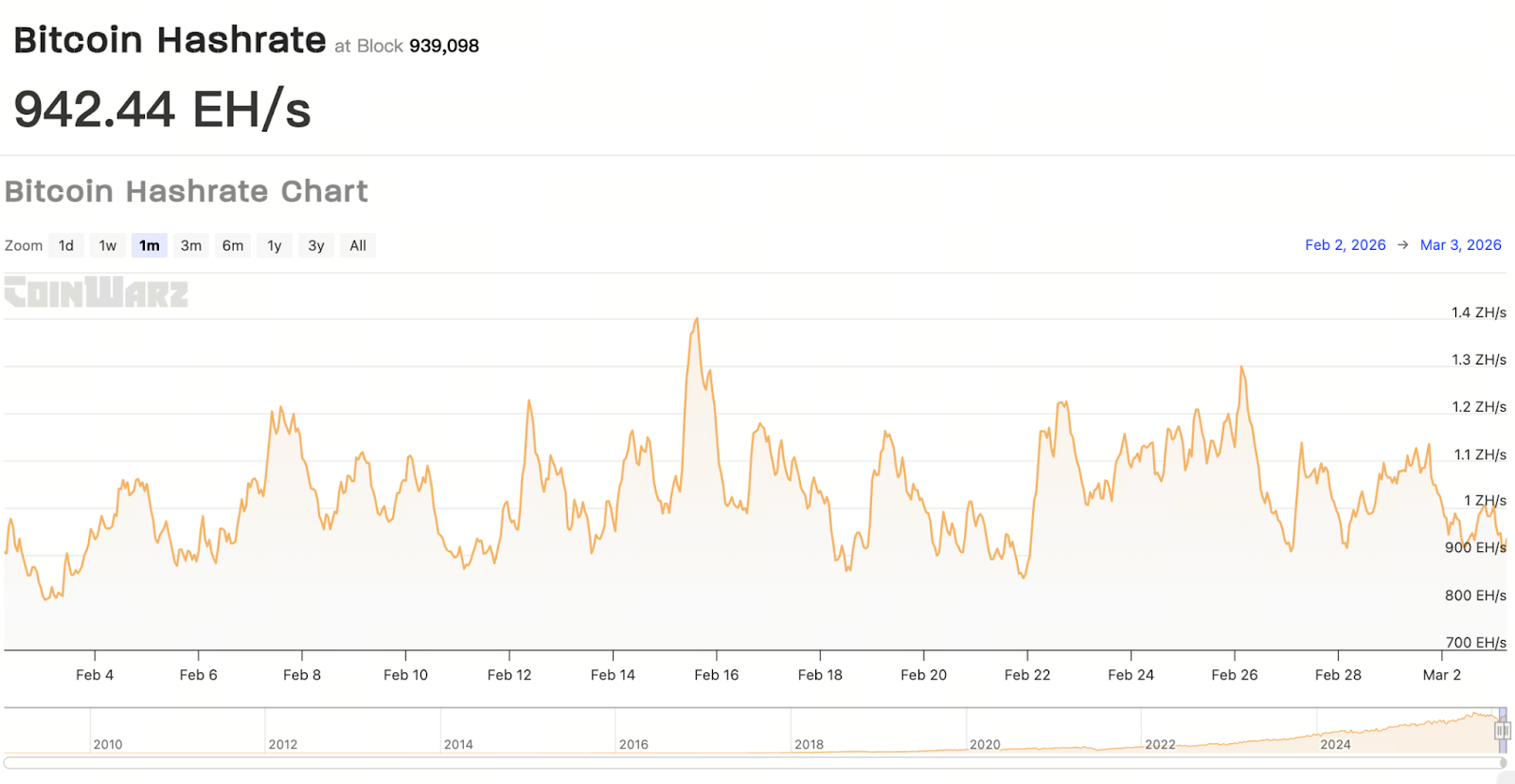
Data Shows Hashrate Remains at High Levels
(Source: CoinWarz)

Overall, hashrate fluctuations remain near historic highs, and the dramatic collapse rumored in the market has not occurred.

Iran’s Mining Share Has Always Been Low

Since 2019, Iran has legalized cryptocurrency mining, but the industry faces several constraints:

  • Unstable power supply
  • High equipment import costs
  • Complex regulatory environment

Ethan Vera, COO of Luxor Technology, stated that even if Iranian mining farms temporarily halt operations, block generation times and network security are virtually unaffected. He estimates Iran’s global hashrate share at less than 1%, far below figures circulating in the community.

Price Volatility Driven Primarily by Sentiment
Price Volatility Driven Primarily by Sentiment

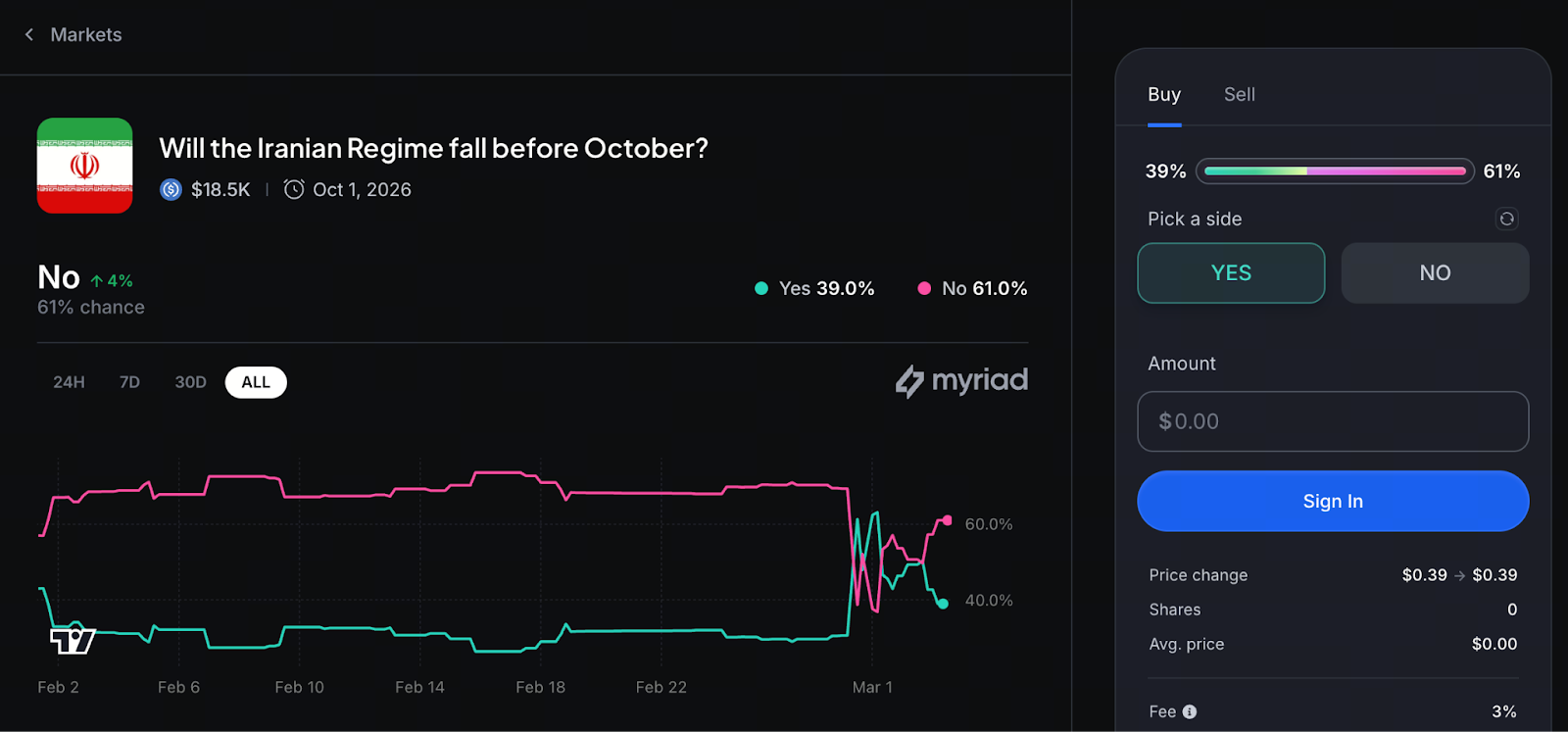
After the conflict broke out, Bitcoin’s price briefly dropped before rebounding. Analysts point out that short-term volatility is mainly driven by market risk sentiment rather than any substantive issues on the mining supply side. As of press time, on the prediction market Myriad, the estimated probability of Iran’s regime collapsing before October had fallen to 39%, highlighting a clear cooling in market sentiment.

Iran’s Crypto Economy: Scale and Capital Flows

Blockchain analytics firm Chainalysis reported earlier this year that Iran’s crypto economy could reach $7.78 billion by 2025, with some activities linked to state-affiliated entities. Meanwhile, analytics firm Elliptic found that in the minutes following the initial military strike, outflows from Iranian exchanges surged 700%, reflecting investors’ rapid asset reallocation.

Summary

While heightened geopolitical risks have fueled market speculation, most experts agree that Iran’s mining activity is limited in scale and unlikely to pose a substantial threat to Bitcoin network operations. In the short term, price volatility is more likely to be driven by market sentiment and macro risk appetite than by any systemic collapse in hashrate supply.

Author: Allen
Disclaimer
* The information is not intended to be and does not constitute financial advice or any other recommendation of any sort offered or endorsed by Gate.
* This article may not be reproduced, transmitted or copied without referencing Gate. Contravention is an infringement of Copyright Act and may be subject to legal action.

Related Articles

AI-Native Settlement Layers: How United Stables Is Building the Next Financial Rail
Beginner

AI-Native Settlement Layers: How United Stables Is Building the Next Financial Rail

Stablecoins were originally designed as dollar substitutes within exchanges, primarily used for asset pricing and trade settlement. As on-chain financial ecosystems have matured, their role has expanded beyond simple payments to include collateral assets, cross-chain liquidity mediums, and unified settlement units. In particular, as AI systems and automated agents begin to participate directly in economic activity, demand has risen sharply for programmable value units capable of instant settlement. This shift is pushing stablecoins toward the role of foundational financial infrastructure.
2026-03-25 03:16:17
DePIN Identity Network and Real World Applications: How Humanity Protocol Brings on-chain Identity Into the Physical World
Beginner

DePIN Identity Network and Real World Applications: How Humanity Protocol Brings on-chain Identity Into the Physical World

Most Web3 identity systems remain confined to on-chain environments and struggle to achieve meaningful adoption in real world settings. Through a DePIN architecture and physical verification hardware, Humanity Protocol aims to bring decentralized identity into access control systems, hospitality, public services, and offline events, allowing on-chain identity to function not just as a digital credential, but as foundational infrastructure for real world access.
2026-03-25 07:40:53
Gold Price Forecast for the Next Five Years: 2026–2030 Trend Outlook and Investment Implications, Could It Reach $6,000?
Beginner

Gold Price Forecast for the Next Five Years: 2026–2030 Trend Outlook and Investment Implications, Could It Reach $6,000?

Analyze current gold price trends alongside authoritative five-year forecasts, integrating an evaluation of market risks and opportunities. This gives investors insight into the potential trajectory of gold prices and the main drivers expected to shape the market over the next five years.
2026-03-25 18:13:30
Aster vs Hyperliquid: Which Perp DEX Will Prevail?
Beginner

Aster vs Hyperliquid: Which Perp DEX Will Prevail?

Aster and Hyperliquid are the two representative protocols of the "purpose-built L1 path" within the current decentralized perpetual exchange (Perp DEX) sector. As a pioneer in the field, Hyperliquid has built a deep liquidity moat through its highly mature order book architecture and strong community consensus. Conversely, Aster, as a rising challenger, seeks to leapfrog the competition in high-performance trading through more aggressive multi-chain aggregation logic, private transaction modules, and an underlying execution environment optimized for 2026 market demands.
2026-03-24 11:58:33
Aerodrome Tokenomics: How ve(3,3) Powers Base's Most Profitable DEX
Beginner

Aerodrome Tokenomics: How ve(3,3) Powers Base's Most Profitable DEX

AERO is the native token of Aerodrome Finance, a core decentralized exchange and liquidity protocol in the Base ecosystem. It is primarily used for liquidity incentives and ecosystem operations. veAERO is a governance NFT that users receive by locking AERO, representing both voting power and the right to share protocol revenue. Through a dual track structure of AERO as a utility token and veAERO as a governance credential, Aerodrome separates liquidity usage value from long term governance power, allowing participants to act as liquidity providers, governance decision makers, and revenue sharers within the same system.
2026-03-25 06:40:31
The ve(3,3) Flywheel Explained: How AERO Tokenomics Powers Aerodrome’s DeFi Economy
Beginner

The ve(3,3) Flywheel Explained: How AERO Tokenomics Powers Aerodrome’s DeFi Economy

In the competition for DeFi liquidity, high-inflation mining alone is no longer enough to build lasting advantages. Aerodrome applies the ve(3,3) economic model to redesign token emissions, voting mechanisms, and revenue distribution, creating a liquidity flywheel centered on governance and cash flow. This article examines AERO tokenomics, the veAERO locking mechanism, and protocol revenue models to explain how Aerodrome builds a sustainable DeFi economic system.
2026-03-25 06:41:58





