Users searching for SATO’s governance mechanism usually want to understand how a Community Takeover project continues operating after the original team exits. Unlike traditional projects led by a core team, SATO governance depends more on community consensus, multisig management, and open collaboration processes.
This question usually involves three layers: how Woof DAO coordinates community governance, how the multisig treasury manages ecosystem resources, and how Community Takeover changes SATO’s decentralization structure.
What Is Woof DAO
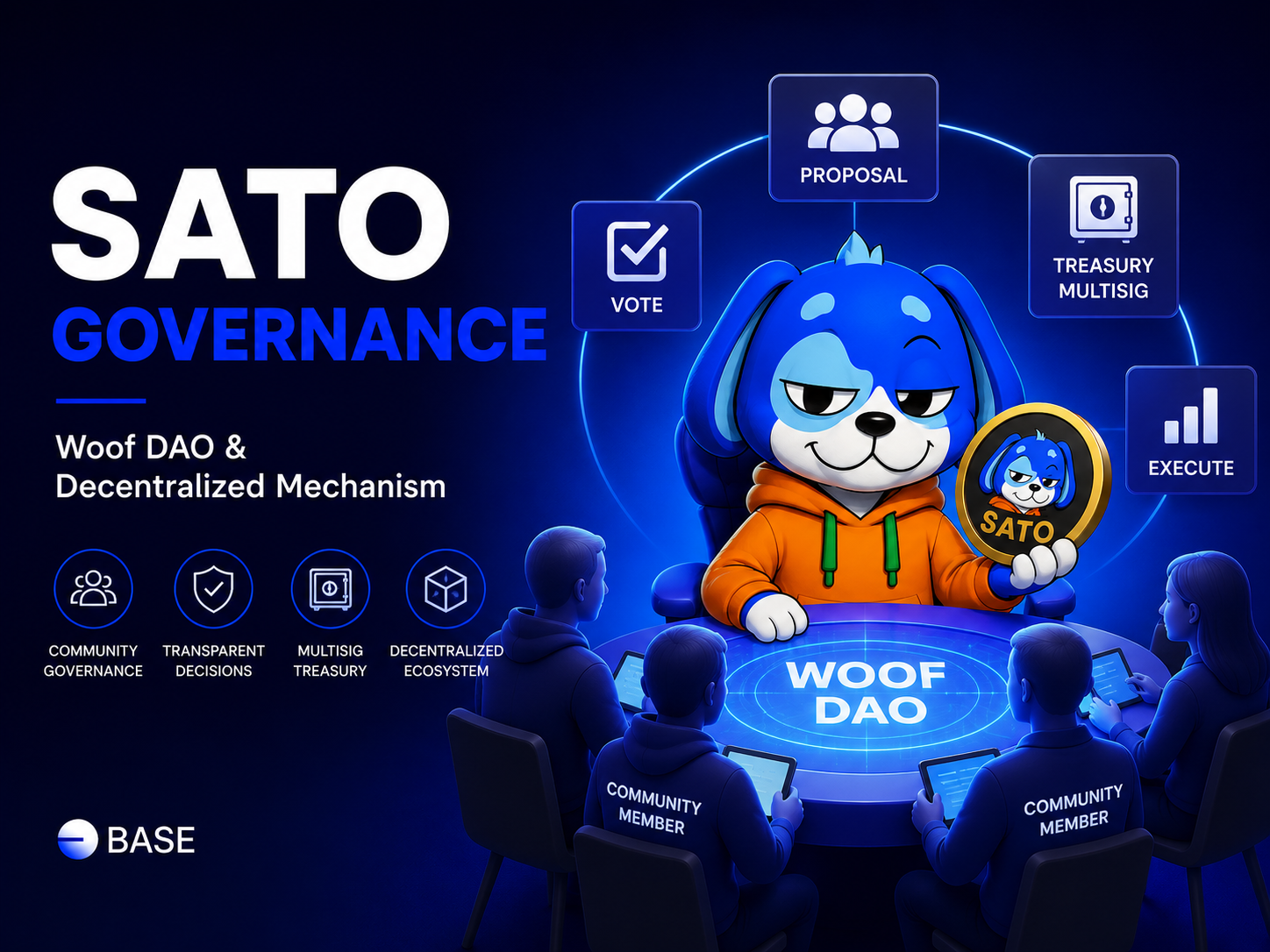
Woof DAO is the coordination structure within SATO community governance. It is mainly used to organize community members, manage ecosystem direction, and promote transparent use of project resources.
Structurally, Woof DAO is not a traditional company style management body. It is a decentralized collaboration organization formed around the SATO community. Its role is to connect community discussions, resource allocation, ecosystem activities, and governance decisions, allowing the project to keep operating without a single centralized team.
First, community members propose ideas around SATO ecosystem development. Woof DAO then organizes the discussion direction and turns key topics into clearer community matters. Next, the multisig treasury or community coordinators move resource use forward based on consensus. In the end, governance outcomes influence SATO’s communication, partnerships, and application progress within the Base ecosystem.
The importance of Woof DAO is that it moves SATO governance beyond community chat and into a relatively clear collaboration framework. For a Community Takeover project, the existence of a DAO can reduce the project’s reliance on a single manager.
SATO’s community governance formed after the Community Takeover. Its core background is that, after the original team exited, community members took over the project and maintained ecosystem operations.
From a mechanism perspective, SATO’s governance was not led by a complete DAO framework from the beginning. Instead, it gradually developed during the community takeover process. First, the original team stopped leading the project. Community members then began taking over social channels, resource coordination, and ecosystem maintenance. Next, the community collaborated around project direction, market communication, NFTs, and application scenarios. In the end, SATO formed an operating model centered on community governance.
The importance of this governance structure is that it changes the centralized operating path often seen in Meme Coin projects. SATO no longer relies mainly on a development team, but uses community consensus to determine ecosystem direction.
Structurally, SATO’s community governance is more like a continuous collaboration mechanism. Community members are both communicators and participants. They can contribute content and also take part in decision discussions. This model makes the continuity of SATO’s ecosystem directly connected to community activity.
How the Multisig Treasury Manages SATO Resources
The multisig treasury is an important tool for managing SATO resources. It is used to reduce the risk of funds being controlled by a single address and to improve the transparency of community resource use.
The core of a multisig mechanism is that fund transfers or resource calls require confirmation from multiple authorized parties, rather than being decided by one person alone. For a community takeover project like SATO, the multisig treasury can help the community manage operating resources, activity expenses, ecosystem partnerships, and market communication budgets.
First, the community or governance members raise a resource use request. Multisig members then confirm it based on community discussion and project direction. Next, once the signature requirements are met, the relevant resources are allocated. In the end, the results of fund use are reported back to the community, creating a transparent governance record.
| Governance Module |
Main Role |
Impact on SATO |
| Woof DAO |
Coordinates community governance |
Improves collaboration efficiency |
| Multisig treasury |
Manages ecosystem resources |
Reduces single point control |
| Community proposals |
Collects member opinions |
Strengthens participation |
| Open discussion |
Builds community consensus |
Improves transparency |
| Community Takeover |
Rebuilds project operations |
Strengthens community leadership |
This structure shows that SATO governance is not a single step, but a combination of DAO coordination, multisig management, and community feedback. The value of the multisig treasury lies in providing greater security and supervision for the use of community resources.
SATO community members mainly participate in project decisions by joining discussions, submitting proposals, voting, contributing content, and promoting ecosystem activities.
Structurally, community members are not only token holders. They can also be governance participants, content creators, activity organizers, or ecosystem builders. Under the Community Takeover model, the quality of project operations depends more on whether community members continue contributing than on whether a single team keeps publishing roadmaps.
First, community members raise questions, directions, or activity ideas in the community. Related discussions are then organized into more specific governance topics. Next, the community moves execution forward through voting, consensus discussions, or multisig coordination. In the end, the project direction is continuously adjusted based on community feedback.
The importance of this participation mechanism is that it makes SATO governance closer to open community collaboration. Users are not merely passive observers of the project. They can influence the ecosystem’s direction through content, discussion, and governance participation.
What Are the Features of SATO’s Decentralized Structure
SATO’s decentralized structure is mainly reflected in contract permissions, liquidity control, community governance, and resource management.
From a mechanism perspective, SATO emphasizes 0% tax, burned liquidity, Ownership Renounced, and community takeover. Together, these designs reduce the room for the project side to affect the ecosystem through contract permissions or liquidity control.
First, 0% tax reduces extra contract based fees during trading. Burned liquidity then reduces the possibility of a single entity withdrawing liquidity. Next, Ownership Renounced lowers the risk of contract parameters being changed in a centralized way. In the end, community governance and the multisig treasury take on the coordination role in the project’s later operations.
The importance of this structure is that SATO’s decentralization is not just a slogan. It is reflected in contract permissions, resource management, and community participation. For a Meme Coin, a decentralized structure can improve users’ understanding of project transparency, but it also means the project relies more heavily on long term community collaboration.
Community Takeover changed SATO’s governance model by shifting the project from team led to community led.
The core of the CTO model is that, after the original team exits or stops operating, the community takes over project resources and ecosystem narrative, then maintains project operations through new collaboration mechanisms. For SATO, this model changed not only the operating body, but also the logic of governance.
First, the project moved from original team management to community coordination. The community then needed to rebuild trust mechanisms, including the multisig treasury, open discussion, and governance collaboration. Next, project communication, application building, and community culture were all advanced jointly by members. In the end, SATO’s governance stability depends on whether community consensus can continue to form.
This mechanism means that SATO’s value narrative comes not only from its Meme image, but also from the process by which the community reorganized the project. Community Takeover makes the community the center of governance, while also placing higher demands on organization and coordination.
What Challenges Does SATO’s Governance Mechanism Face
The challenges facing SATO’s governance mechanism mainly come from community consensus, execution efficiency, resource coordination, and long term participation.
Structurally, decentralized governance can reduce single point control risk, but it may also lead to slower decision making, divided opinions, and unclear responsibility boundaries. For a Community Takeover project, the community is both a governance advantage and a source of governance pressure.
First, the community needs to form consensus around the project direction. The multisig treasury and governance members then need to turn discussions into executable matters. Next, the community must continue providing support through content, communication, activities, and ecosystem building. In the end, if participation declines, governance efficiency and ecosystem progress will both be affected.
This challenge shows that SATO’s governance mechanism is not the same as fully automated operation. It depends more on sustained community participation, open communication, and resource collaboration. Compared with the centralized team model, community governance has the advantage of openness and transparency, while its limitation is that execution stability is harder to maintain over the long term.
Conclusion
SATO’s community governance revolves around Woof DAO, a multisig treasury, community proposals, and the Community Takeover mechanism. Woof DAO coordinates community direction, the multisig treasury manages ecosystem resources, and community members participate in project decisions through discussions, proposals, voting, and content contributions.
From a governance structure perspective, SATO’s focus is not on continuous control by a single team. Instead, it maintains Meme culture and onchain interaction within the Base ecosystem through community collaboration. Community Takeover gives SATO a stronger community led identity, but it also makes governance efficiency, resource coordination, and long term participation key issues the project must face.
FAQs
What Is Woof DAO
Woof DAO is the coordination organization within SATO community governance. It is used to support community discussions, resource management, and ecosystem direction. It helps SATO form a clearer governance structure after the Community Takeover.
SATO’s community governance formed after the original team exited. Community members took over project resources and maintained operations through Woof DAO, the multisig treasury, open discussions, and community proposals.
What Role Does the Multisig Treasury Play in SATO
The multisig treasury is used to manage SATO’s community resources. Fund use requires confirmation from multiple authorized parties, which can reduce the risk of a single address controlling resources and improve governance transparency.
How Can SATO Holders Participate in Governance
SATO holders can participate in governance through community discussions, proposals, voting, content creation, and ecosystem activities. Their participation is closer to community collaboration than traditional company style management.
Community Takeover shifted SATO from team led to community led. It strengthens community participation, while also increasing the project’s dependence on community consensus and long term collaboration.
What Risks Exist in SATO’s Governance Mechanism
SATO’s governance risks include divided community opinions, lower execution efficiency, complex resource coordination, and unstable long term participation. Decentralized governance improves transparency, but it also increases coordination difficulty.