GUSD: Bridging Stability and Yield for the Next Generation of On-Chain Assets

Beginner
Quick Reads
Last Updated 2026-03-27 23:59:15
Reading Time: 1m
GUSD marks a new era for stablecoins, shifting from static stores of value to yield-generating assets. Each GUSD stablecoin is structured to produce income, backed by real-world assets (RWA) that provide interest payments.

The New Era of Stablecoins: From Storing Value to Creating Value
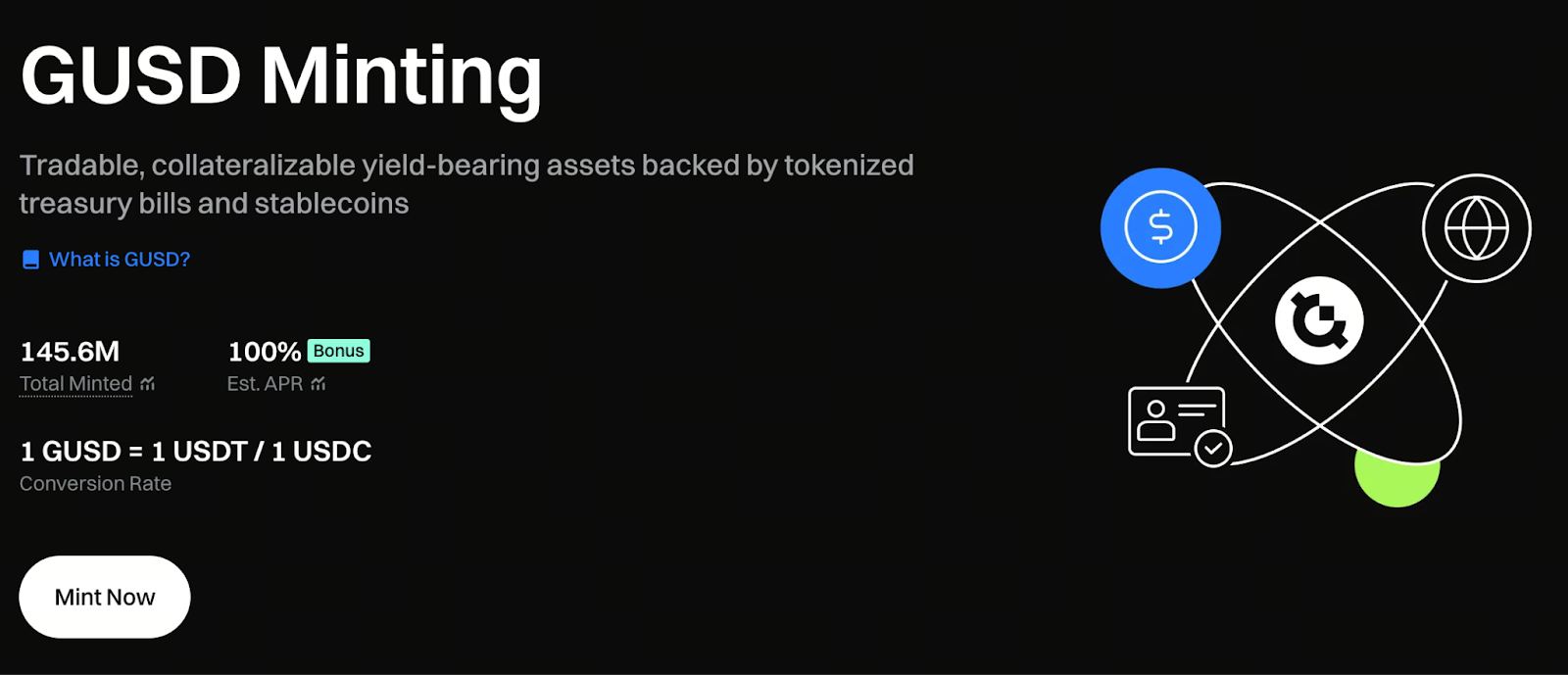
In the past, stablecoins primarily served as tools for risk mitigation or means of payment, with users holding them for price stability and transactional convenience. Now, GUSD redefines this paradigm, transforming stablecoins from passive stores of value into on-chain assets that automatically generate yield.

GUSD’s core philosophy is simple: every stablecoin should have cash flow value. Holding GUSD is like owning a digital asset that accrues interest over time, enabling a new model of capital management that generates returns while maintaining stability.

RWA Backing: Making Returns Real and Predictable

The yield from GUSD is not arbitrary; it is backed by Real World Assets (RWA), including U.S. short-term Treasuries and high-grade financial notes. These low-risk assets provide reliable interest income, ensuring that returns are authentic and sustainable.

This structure makes the interest mechanisms of traditional finance transparent and blockchain-based, allowing GUSD to maintain its peg to the U.S. dollar while continuously generating robust yields. Unlike stablecoins backed by cash or bank deposits, GUSD acts as a yield-bearing dollar, combining stability with growth potential.

Flexible Entry Mechanisms

To meet users’ diverse capital needs, GUSD offers two entry options:

  • Exchange Swap: Instantly exchange USDT or other stablecoins for GUSD on supported exchanges—ideal for short-term liquidity management.
  • On-Chain Minting: If you hold USDT or USDC, you can mint GUSD 1:1 via smart contracts and participate directly in RWA yield allocation—suited for long-term investors.

This dual approach allows users to choose strategies that best fit their needs, balancing liquidity and efficiency.

Mint GUSD today and earn daily annualized yield: https://www.gate.com/staking/GUSD?gt_disable_intercept_jump=1

Yield Mechanism

GUSD employs an accrual interest and maturity settlement model. For example, minting GUSD with 100 USDT at a 20% annual yield allows you to redeem approximately 120 USDC at maturity.

This design, similar to bond interest accrual, enables natural growth of returns over time and eliminates the complexity of daily compounding. It also provides DeFi users with a return experience closer to traditional finance.

Building a Multi-Tiered Ecosystem

GUSD is more than a stablecoin—it’s a key building block of the on-chain financial ecosystem. Its use cases continue to expand:

  • Staking and Lock-Up Rewards: Holders earn additional yield.
  • Limited-Time Airdrops and Promotions: Encouraging early adoption and community engagement.
  • Multi-Functional Integrations: Enables lending, wealth management, launchpool participation, margin trading, and more to maximize asset utilization.

Through these applications, GUSD evolves beyond the stablecoin definition, becoming a flexible financial instrument with appreciation potential.

Three Key Advantages of GUSD

  • Time-Accrued Value: The longer you hold, the greater the return—ideal for long-term strategies.
  • High Liquidity Architecture: Supports both exchange swaps and on-chain minting for seamless fund movement.
  • Robust Application Ecosystem: From payments and wealth management to investments, enhancing capital efficiency.

If GUSD continues to maintain transparent reserve disclosures and regular audits, its market credibility will further improve.

Liquidity and Operational Guidance

GUSD is designed for easy redemption and can typically be converted to USDC or USDT with minimal hassle. However, cross-chain or cross-platform transactions may involve fees or time delays. Users should verify current market liquidity and fee rates before transacting to ensure the best trading experience.

Risk Disclosure

This article is for informational purposes only and does not constitute investment advice or solicitation. Before engaging with GUSD or other yield-generating stablecoins, users should fully understand product features and risks, and consult a professional financial advisor. Some users may face regional restrictions; please comply with platform policies.

User Agreement: https://www.gate.com/legal/user-agreement

Conclusion

By integrating RWA yield models and transparent on-chain settlement, GUSD exemplifies the fusion of traditional finance and DeFi. As Web3 financial infrastructure advances, yield-generating stablecoins are emerging as the new mainstream in crypto asset allocation. For users seeking stability, transparency, and continuous returns, GUSD is not just a stablecoin—it’s a pivotal tool for ushering in the era of autonomous asset appreciation.

Author: Allen
Disclaimer
* The information is not intended to be and does not constitute financial advice or any other recommendation of any sort offered or endorsed by Gate.
* This article may not be reproduced, transmitted or copied without referencing Gate. Contravention is an infringement of Copyright Act and may be subject to legal action.

Related Articles

AI-Native Settlement Layers: How United Stables Is Building the Next Financial Rail
Beginner

AI-Native Settlement Layers: How United Stables Is Building the Next Financial Rail

Stablecoins were originally designed as dollar substitutes within exchanges, primarily used for asset pricing and trade settlement. As on-chain financial ecosystems have matured, their role has expanded beyond simple payments to include collateral assets, cross-chain liquidity mediums, and unified settlement units. In particular, as AI systems and automated agents begin to participate directly in economic activity, demand has risen sharply for programmable value units capable of instant settlement. This shift is pushing stablecoins toward the role of foundational financial infrastructure.
2026-03-25 03:16:17
DePIN Identity Network and Real World Applications: How Humanity Protocol Brings on-chain Identity Into the Physical World
Beginner

DePIN Identity Network and Real World Applications: How Humanity Protocol Brings on-chain Identity Into the Physical World

Most Web3 identity systems remain confined to on-chain environments and struggle to achieve meaningful adoption in real world settings. Through a DePIN architecture and physical verification hardware, Humanity Protocol aims to bring decentralized identity into access control systems, hospitality, public services, and offline events, allowing on-chain identity to function not just as a digital credential, but as foundational infrastructure for real world access.
2026-03-25 07:40:53
Gold Price Forecast for the Next Five Years: 2026–2030 Trend Outlook and Investment Implications, Could It Reach $6,000?
Beginner

Gold Price Forecast for the Next Five Years: 2026–2030 Trend Outlook and Investment Implications, Could It Reach $6,000?

Analyze current gold price trends alongside authoritative five-year forecasts, integrating an evaluation of market risks and opportunities. This gives investors insight into the potential trajectory of gold prices and the main drivers expected to shape the market over the next five years.
2026-03-25 18:13:30
Aster vs Hyperliquid: Which Perp DEX Will Prevail?
Beginner

Aster vs Hyperliquid: Which Perp DEX Will Prevail?

Aster and Hyperliquid are the two representative protocols of the "purpose-built L1 path" within the current decentralized perpetual exchange (Perp DEX) sector. As a pioneer in the field, Hyperliquid has built a deep liquidity moat through its highly mature order book architecture and strong community consensus. Conversely, Aster, as a rising challenger, seeks to leapfrog the competition in high-performance trading through more aggressive multi-chain aggregation logic, private transaction modules, and an underlying execution environment optimized for 2026 market demands.
2026-03-24 11:58:33
Aerodrome Tokenomics: How ve(3,3) Powers Base's Most Profitable DEX
Beginner

Aerodrome Tokenomics: How ve(3,3) Powers Base's Most Profitable DEX

AERO is the native token of Aerodrome Finance, a core decentralized exchange and liquidity protocol in the Base ecosystem. It is primarily used for liquidity incentives and ecosystem operations. veAERO is a governance NFT that users receive by locking AERO, representing both voting power and the right to share protocol revenue. Through a dual track structure of AERO as a utility token and veAERO as a governance credential, Aerodrome separates liquidity usage value from long term governance power, allowing participants to act as liquidity providers, governance decision makers, and revenue sharers within the same system.
2026-03-25 06:40:31
The ve(3,3) Flywheel Explained: How AERO Tokenomics Powers Aerodrome’s DeFi Economy
Beginner

The ve(3,3) Flywheel Explained: How AERO Tokenomics Powers Aerodrome’s DeFi Economy

In the competition for DeFi liquidity, high-inflation mining alone is no longer enough to build lasting advantages. Aerodrome applies the ve(3,3) economic model to redesign token emissions, voting mechanisms, and revenue distribution, creating a liquidity flywheel centered on governance and cash flow. This article examines AERO tokenomics, the veAERO locking mechanism, and protocol revenue models to explain how Aerodrome builds a sustainable DeFi economic system.
2026-03-25 06:41:58





