The Metals Market Leaves Behind the Low-Volatility Era
In 2026, the metals market has seen a clear shift in price dynamics. Precious metals like gold and silver, as well as industrial metals such as copper and aluminum, no longer follow the prolonged consolidation trends of the past. Instead, prices now frequently surge and retreat rapidly.
This transformation stems from persistent global macroeconomic uncertainty. Capital now flows back and forth between safe-haven and risk assets, turning metals from stable allocation vehicles into high-activity trading instruments. As a result, short- and medium-term capital has entered the market in significant volumes.
Multiple Structural Factors Amplify Market Volatility
Current metals market volatility is driven by several structural factors acting in concert—not a single cause.
- Global economic recovery is uneven, causing repeated shifts in industrial metals demand expectations. Manufacturing is rebounding in some regions, while others face slowing growth. As a result, the market’s outlook for future demand remains unstable.
- Energy costs and geopolitical risks also directly affect metals production and transportation efficiency. Any supply chain bottleneck can trigger a sharp price reaction, while a return to stable supply can prompt swift market corrections.
- Financial market capital structures are also evolving. More institutional and quantitative investors are integrating metals into their trading models, increasing volatility and making trend-driven moves more common.
Opportunities and Risks in a High-Volatility Environment
For traders, increased price swings are a double-edged sword. When clear trends emerge, metals can post substantial moves in a short time, offering strong potential for trend-following strategies. However, market reversals also accelerate, and without robust risk controls, losses can quickly mount.
In today’s market, traders pay more attention to three core practices:
- Reasonable position sizing
- Clear entry and exit discipline
- Timely execution
This environment has led more investors to trade metals through digital platforms, seeking greater flexibility and extended trading hours.
Gate Metals Zone: A New Trading Experience
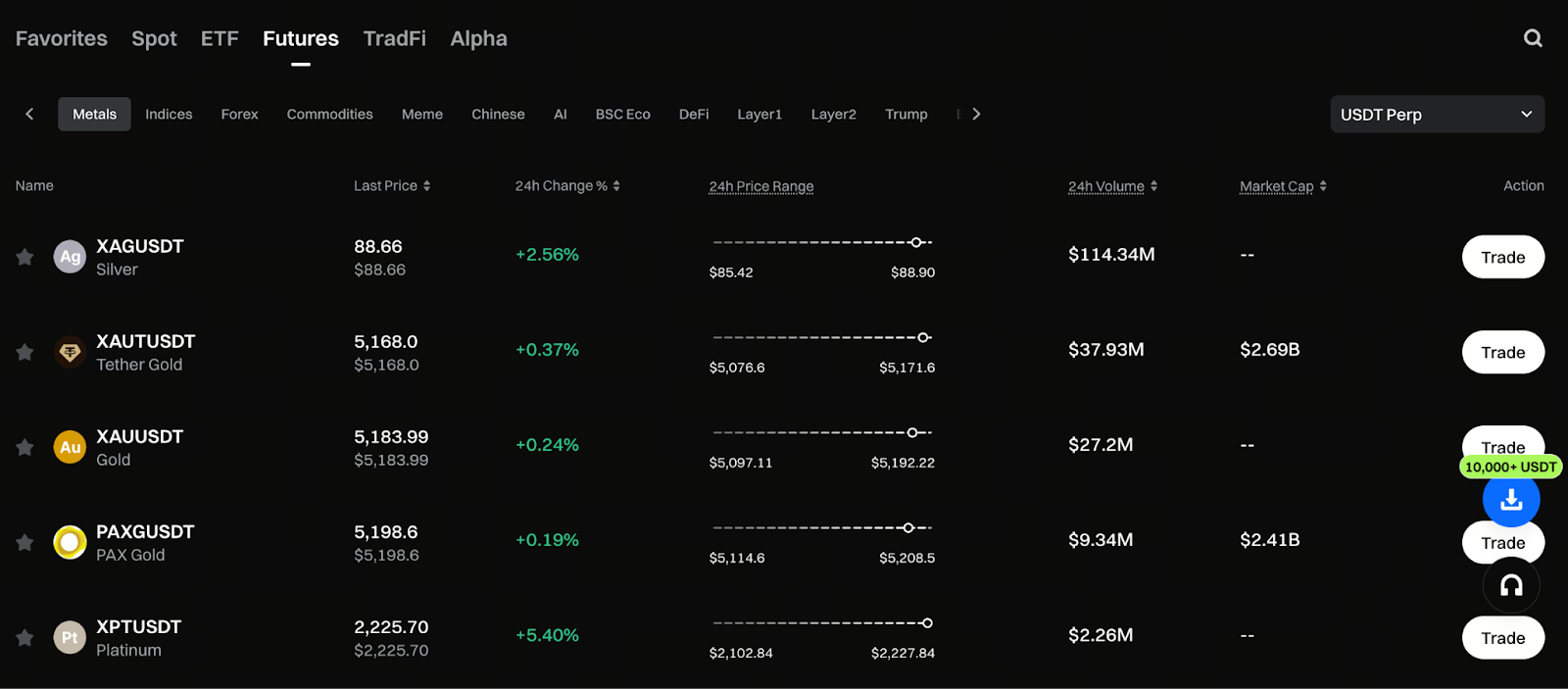
To meet evolving market needs, Gate has launched the Metals Zone—a focused, efficient gateway for metals trading. This dedicated interface lets users browse and trade multiple mainstream metals without switching between markets. The unified account system and robust matching engine ensure smooth trading, even during high volatility.
Digital contract mechanisms eliminate traditional market hour restrictions, enabling users to execute strategies around the clock. For those familiar with crypto trading, this model is intuitive and greatly increases allocation flexibility.
Trade now in the Gate Precious Metals Zone: https://www.gate.com/price/futures/category-metals/usdt
Metals Trading Strategies Are Becoming More Diverse
As the market participant mix evolves, trading strategies in metals are also diversifying. Some traders favor short-term swing trading to capture intraday or periodic price moves. Others use metals as a defensive allocation, hedging when market risks rise.
Cross-market strategies are also on the rise, such as exploiting capital flow differences between crypto and traditional assets for rotation or arbitrage. Gate’s Metals Zone allows these strategies to be executed on a single platform, greatly reducing operational complexity.
The Long-Term Value of Metals Assets Persists
From a long-term perspective, metals remain a cornerstone in global asset allocation—serving as both a safe-haven and a core material for new energy and manufacturing. Structural demand for metals remains robust.
As traditional assets integrate with digital trading frameworks, metals trading is evolving toward greater efficiency and lower barriers to entry. For investors aiming to keep pace with the market, platforms offering stable systems, comprehensive product lines, and flexible trading environments will be key to future participation in the metals market.
Conclusion
The metals market is no longer just a haven for long-term holding—it’s becoming a highly active trading arena. Macro uncertainty, evolving capital structures, and the rise of digital trading tools will keep metals price volatility elevated. For traders, this means higher risks and denser opportunities. Developing effective strategies amid volatility and leveraging high-efficiency tools like the Gate Metals Zone will define who can remain a steady participant in the market going forward.







