Market Rhythms Have Changed—Risk No Longer Waits for a Time Buffer
Financial markets were once governed by clear time frames. Stocks opened and closed at set hours, futures separated day and night sessions, and risk events mostly clustered during periods of high activity. Traders could adjust their strategies around these time cycles.
But in today’s globally interconnected markets, this framework is fading. Policy news, geopolitical conflicts, and sudden events can break at any moment, with prices reacting in minutes. The market has shifted from “rhythmic volatility” to “continuous, real-time movement.” Risk no longer waits for the opening bell, while trading tools remain restricted by time.
The Question Isn’t Whether to Hedge—It’s Whether You Can Hedge Instantly
When assets are still limited to fixed trading hours, even the strongest risk awareness can’t overcome structural execution delays. If the market shifts dramatically outside trading hours, traders must passively endure price gaps and only adjust positions when trading resumes. This time lag becomes a new source of risk. Hedging logic remains relevant—what’s outdated is the operational rhythm of the tools themselves.
Perpetual Contracts Officially Bring Precious Metals into the 24/7 Market
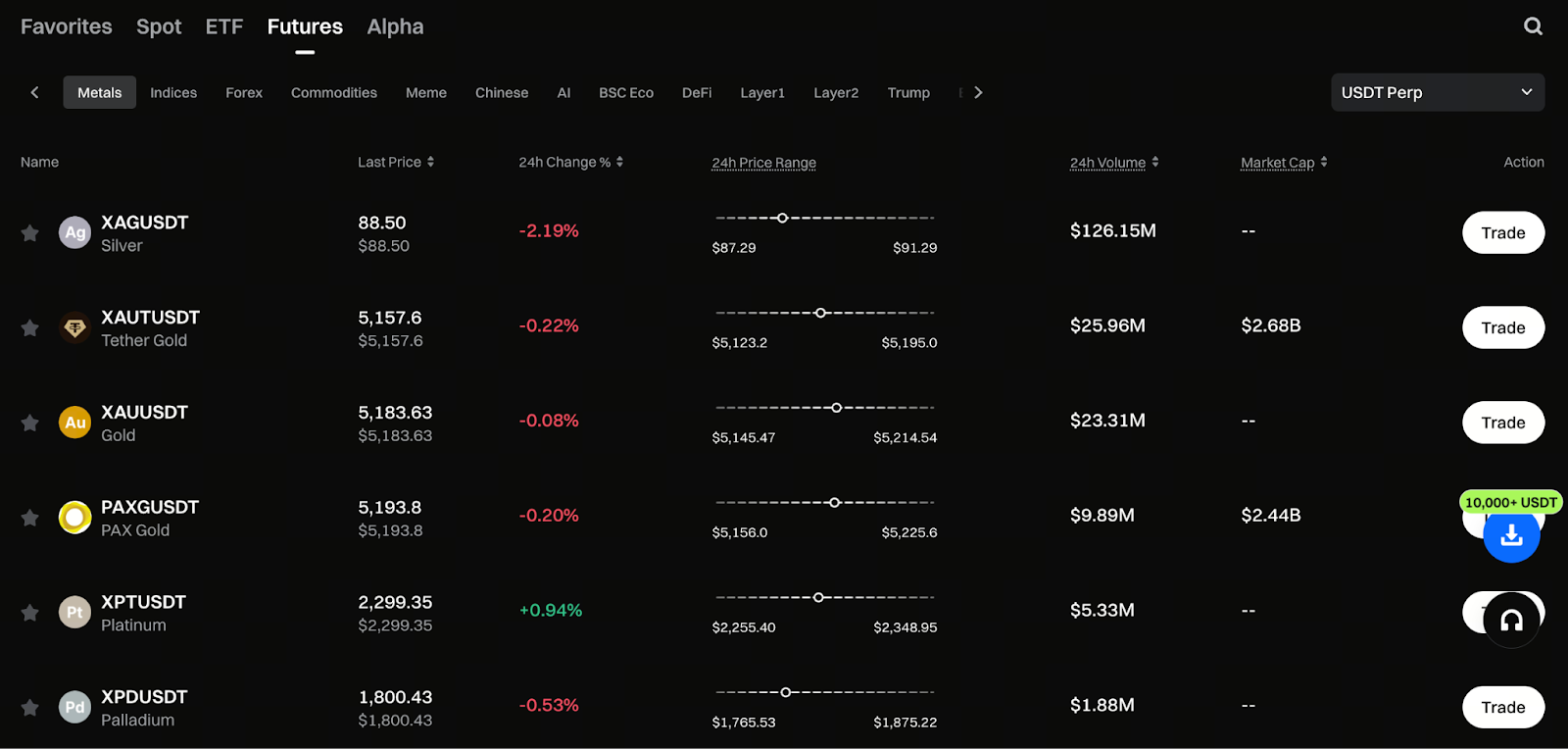
Gate’s launch of gold (XAU) and silver (XAG) USDT-margined perpetual contracts solves this time gap issue. With perpetual contracts, precious metals are now fully integrated into an always-on trading system, free from traditional financial market opening cycles. This means:
- Positions can be adjusted immediately whenever risk signals arise
- Hedging shifts from post-event corrections to real-time, synchronized decision-making
- Asset allocation is now aligned with global market rhythms
Precious metals have evolved from time-bound assets into real-time trading instruments.
Join trading in Gate’s precious metals section now: https://www.gate.com/price/futures/category-metals/usdt
Add New Assets Without Changing Your Trading Habits
Gate hasn’t created a separate system for precious metals perpetual contracts—they’re seamlessly integrated into the existing contract trading framework.
XAU and XAG fully adopt:
- The original order interface
- The same leverage logic
- Take-profit and stop-loss settings
- Existing margin and risk control mechanisms
For contract trading veterans, precious metals aren’t an unfamiliar market—they’re a new variable that fits directly into existing trading strategies.
From Defensive Asset to Strategic Tool
With high volatility becoming the norm, gold and silver’s roles are changing. They’re no longer just assets for long-term holding and passive defense—they’re increasingly:
- Cross-market hedging tools
- Portfolio volatility balancers
- Tradable assets for short- and medium-term swings
For traders, precious metals now offer the ability to participate in market rhythms—not just to reduce risk.
Multi-Source Index Pricing Makes Price a Core Part of Risk Control
In leveraged markets, price quoting itself is a key risk management mechanism. Gate’s precious metals perpetual contracts use a multi-source index as the pricing benchmark, integrating multiple market feeds to reduce deviation risk from any single data anomaly.
This design ensures:
- Liquidation and stop-loss logic remain stable
- Hedging strategies are less likely to fail due to price distortion
- Price rationality is maintained even in volatile conditions
For traders who value fund security, the pricing structure is a core defensive line.
Where TradFi and Crypto Markets Intersect
From an asset perspective, precious metals perpetual contracts sit at the intersection of traditional finance and crypto markets:
- For TradFi traders, these are familiar assets with strong reference value
- For crypto users, they provide a hedging tool with a volatility structure fundamentally different from crypto assets
This makes precious metals one of the few derivatives suitable for both market logics—and a practical entry point for cross-asset strategies.
A Critical Piece of Gate’s Derivatives Ecosystem
From a platform strategy perspective, precious metals perpetual contracts are more than a product update—they’re a crucial milestone in Gate’s multi-asset derivatives market expansion. By leveraging existing liquidity and risk control frameworks, Gate is expanding its trading landscape from pure crypto markets to a cross-asset price operation platform. Gate’s role is evolving from a crypto exchange to a multi-market price integration platform.
Summary
As financial markets move to round-the-clock operations, real risk isn’t just about price volatility—it’s about whether trading tools can participate in market rhythms instantly. The value of Gate’s precious metals perpetual contracts isn’t just enabling gold and silver on-chain trading—it’s about freeing hedging logic from time constraints. As TradFi and crypto boundaries blur, precious metals are no longer just defensive assets—they’re now core tools for real-time operation, strategic management, and cross-market allocation.







