Gate introduces TradFi contract-for-difference (CFD) trading, offering an innovative trading experience that merges cryptocurrency with traditional financial markets.

Beginner
Quick Reads
Last Updated 2026-03-25 20:32:28
Reading Time: 1m
Gate has officially introduced TradFi CFD trading, offering access to traditional financial assets including gold, forex, indices, commodities, and stocks. With USDx-denominated pricing, the MT5 platform, and robust risk management mechanisms, Gate delivers a seamless multi-asset trading experience for users.

Gate Accelerates TradFi Expansion, Broadens Multi-Asset Trading Horizons

As global financial markets move toward greater diversity and digitalization, crypto asset trading platforms are continually exploring new product models. Recently, Gate, a leading global crypto asset trading platform, introduced TradFi contract for difference (CFD) trading, formally expanding its trading offerings from crypto assets to traditional financial asset pricing.

With Gate TradFi, users can trade CFDs for traditional financial assets—including gold, forex, global indices, commodities, and select popular stocks—all on a single platform. This initiative marks Gate’s development of a multi-asset trading system that spans both crypto and traditional financial markets, delivering users a more comprehensive set of trading options.

USDx Pricing Model Lowers TradFi Trading Barriers

Gate TradFi uses USDx as its margin and account display unit. USDx is not a fiat currency or on-chain asset; rather, it’s an internal pricing unit for TradFi scenarios at Gate, anchored 1:1 to USDT.

Users simply transfer USDT from their main account to their TradFi account, and the system automatically displays the balance in USDx—no extra conversion steps, fees, or custody costs required. All TradFi trading assets remain fully backed by USDT, enabling users to participate in traditional financial market price movements within the familiar crypto asset ecosystem.

CFD Mechanism Aligned with Traditional Market Rules

Unlike crypto perpetual contracts, Gate TradFi contracts strictly follow the logic of traditional financial markets. These contracts feature clearly defined trading hours and market closures, with overnight fees incurred during non-trading periods. The overall structure mirrors mainstream CFD market practices.

TradFi contracts employ a fixed leverage model, with no option for users to manually adjust the leverage multiplier. The margin system is cross-margin, allowing long and short positions in the same trading pair to be hedged by lot calculation. This design reduces risk misjudgment from complex operations, enabling users to manage risk more clearly when trading traditional financial assets.

High Leverage and Low Fees Optimize Trading Costs

Gate TradFi offers up to 500x leverage for major assets such as forex and indices, while stock CFDs support up to 5x leverage—consistent with traditional financial market standards for different asset risk levels.

Gate TradFi also maintains a competitive fee structure, with transaction fees as low as $0.018 per trade, providing users with transparent and manageable trading costs. This fee advantage makes TradFi contracts particularly appealing for high-frequency and short-term trading strategies.

MT5 System Integration Enhances Risk Management and Trading Stability

Gate TradFi is powered by the MT5 (MetaTrader 5) trading system. Users can trade via the Gate App or MT5 client, with account data, positions, and trading history synchronized across all interfaces.

For risk management, Gate TradFi implements a forced liquidation mechanism based on margin ratio. When the account margin ratio falls to 50% or below, the system initiates a step-by-step forced liquidation process according to established rules, preventing further risk escalation. This approach is fully aligned with standard practices in traditional CFD markets.

Experience Campaign Supports First-Time TradFi Trading
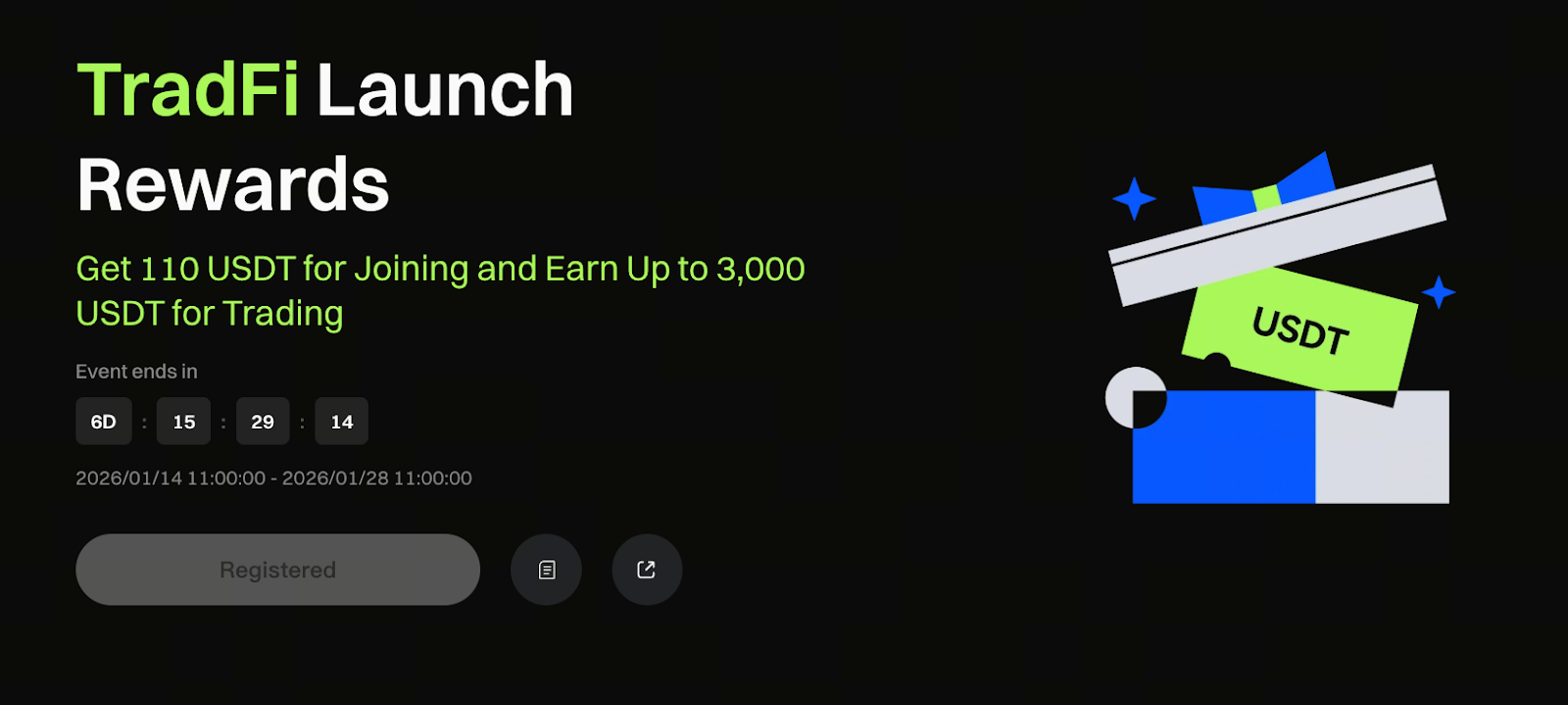

Image: https://www.gate.com/campaigns/3817

To make TradFi trading more accessible, Gate has launched an experience campaign. Eligible users who register can earn up to $110 in experience rewards, and by completing designated trading tasks, unlock additional phased incentives up to $3,000 to support their first TradFi trading experience.

This campaign offers crypto users a low-cost, practical entry point to explore traditional financial asset trading mechanisms.

A Key Step Toward Multi-Asset Integration

The launch of Gate TradFi extends the platform’s trading system beyond crypto assets to encompass a broad range of traditional financial asset price trading. Users can conduct multi-market price analysis, risk hedging, and strategy combinations all on one platform, streamlining the complexity of cross-platform operations.

As the boundaries between crypto and traditional financial markets continue to blur, Gate’s ongoing development in the TradFi space may prove to be a pivotal step in building integrated trading infrastructure, providing the industry with new reference models for merging diverse asset classes within a compliant framework.

Author: Max
Disclaimer
* The information is not intended to be and does not constitute financial advice or any other recommendation of any sort offered or endorsed by Gate.
* This article may not be reproduced, transmitted or copied without referencing Gate. Contravention is an infringement of Copyright Act and may be subject to legal action.

Related Articles

AI-Native Settlement Layers: How United Stables Is Building the Next Financial Rail
Beginner

AI-Native Settlement Layers: How United Stables Is Building the Next Financial Rail

Stablecoins were originally designed as dollar substitutes within exchanges, primarily used for asset pricing and trade settlement. As on-chain financial ecosystems have matured, their role has expanded beyond simple payments to include collateral assets, cross-chain liquidity mediums, and unified settlement units. In particular, as AI systems and automated agents begin to participate directly in economic activity, demand has risen sharply for programmable value units capable of instant settlement. This shift is pushing stablecoins toward the role of foundational financial infrastructure.
2026-03-25 03:16:17
The ve(3,3) Flywheel Explained: How AERO Tokenomics Powers Aerodrome’s DeFi Economy
Beginner

The ve(3,3) Flywheel Explained: How AERO Tokenomics Powers Aerodrome’s DeFi Economy

In the competition for DeFi liquidity, high-inflation mining alone is no longer enough to build lasting advantages. Aerodrome applies the ve(3,3) economic model to redesign token emissions, voting mechanisms, and revenue distribution, creating a liquidity flywheel centered on governance and cash flow. This article examines AERO tokenomics, the veAERO locking mechanism, and protocol revenue models to explain how Aerodrome builds a sustainable DeFi economic system.
2026-03-25 06:41:58
Aerodrome Tokenomics: How ve(3,3) Powers Base's Most Profitable DEX
Beginner

Aerodrome Tokenomics: How ve(3,3) Powers Base's Most Profitable DEX

AERO is the native token of Aerodrome Finance, a core decentralized exchange and liquidity protocol in the Base ecosystem. It is primarily used for liquidity incentives and ecosystem operations. veAERO is a governance NFT that users receive by locking AERO, representing both voting power and the right to share protocol revenue. Through a dual track structure of AERO as a utility token and veAERO as a governance credential, Aerodrome separates liquidity usage value from long term governance power, allowing participants to act as liquidity providers, governance decision makers, and revenue sharers within the same system.
2026-03-25 06:40:31
DePIN Identity Network and Real World Applications: How Humanity Protocol Brings on-chain Identity Into the Physical World
Beginner

DePIN Identity Network and Real World Applications: How Humanity Protocol Brings on-chain Identity Into the Physical World

Most Web3 identity systems remain confined to on-chain environments and struggle to achieve meaningful adoption in real world settings. Through a DePIN architecture and physical verification hardware, Humanity Protocol aims to bring decentralized identity into access control systems, hospitality, public services, and offline events, allowing on-chain identity to function not just as a digital credential, but as foundational infrastructure for real world access.
2026-03-25 07:40:53
How is the price of PAXG determined? Pegging mechanism, trading depth, and influencing factors
Beginner

How is the price of PAXG determined? Pegging mechanism, trading depth, and influencing factors

PAXG (Pax Gold) is a tokenized asset backed by physical gold reserves, launched by fintech firm Paxos and issued as an ERC-20 token on the Ethereum blockchain. The core concept is to digitally represent real-world gold assets, allowing investors to hold and trade gold via the blockchain network. Because each PAXG token corresponds to a specific quantity of physical gold, its price is theoretically expected to closely track the global gold market.
2026-03-24 19:11:40
Aster vs Hyperliquid: Which Perp DEX Will Prevail?
Beginner

Aster vs Hyperliquid: Which Perp DEX Will Prevail?

Aster and Hyperliquid are the two representative protocols of the "purpose-built L1 path" within the current decentralized perpetual exchange (Perp DEX) sector. As a pioneer in the field, Hyperliquid has built a deep liquidity moat through its highly mature order book architecture and strong community consensus. Conversely, Aster, as a rising challenger, seeks to leapfrog the competition in high-performance trading through more aggressive multi-chain aggregation logic, private transaction modules, and an underlying execution environment optimized for 2026 market demands.
2026-03-24 11:58:33





