As Market Dynamics Accelerate, Asset Allocation Logic Must Evolve
The crypto market has moved beyond a one-way, long-term growth environment. It now operates with high volatility and rapid capital rotation as the norm. In this climate, the core of investment strategy is not simply chasing the highest returns, but ensuring positions can be adjusted at any moment.
For many ETH holders, traditional staking delivers steady yields but introduces a critical challenge: once assets are locked, market flexibility disappears. When prices swing sharply or new opportunities emerge, funds are stuck in contracts and cannot be moved—this is a hidden risk in itself.
Why Is Traditional ETH Staking Increasingly Unsuitable?
After experiencing ETH staking firsthand, most users face several classic dilemmas:
First, when the market trend reverses, staked assets cannot be withdrawn instantly, resulting in missed opportunities for adjustment.
Second, locked ETH cannot participate in other investment opportunities simultaneously, leading to inefficient capital use.
Third, while staking yields are stable, it is difficult to dynamically manage them as part of an overall asset allocation strategy.
What was intended as a tool to amplify asset value instead becomes a liquidity constraint in high-frequency markets.
GTETH: Core Philosophy
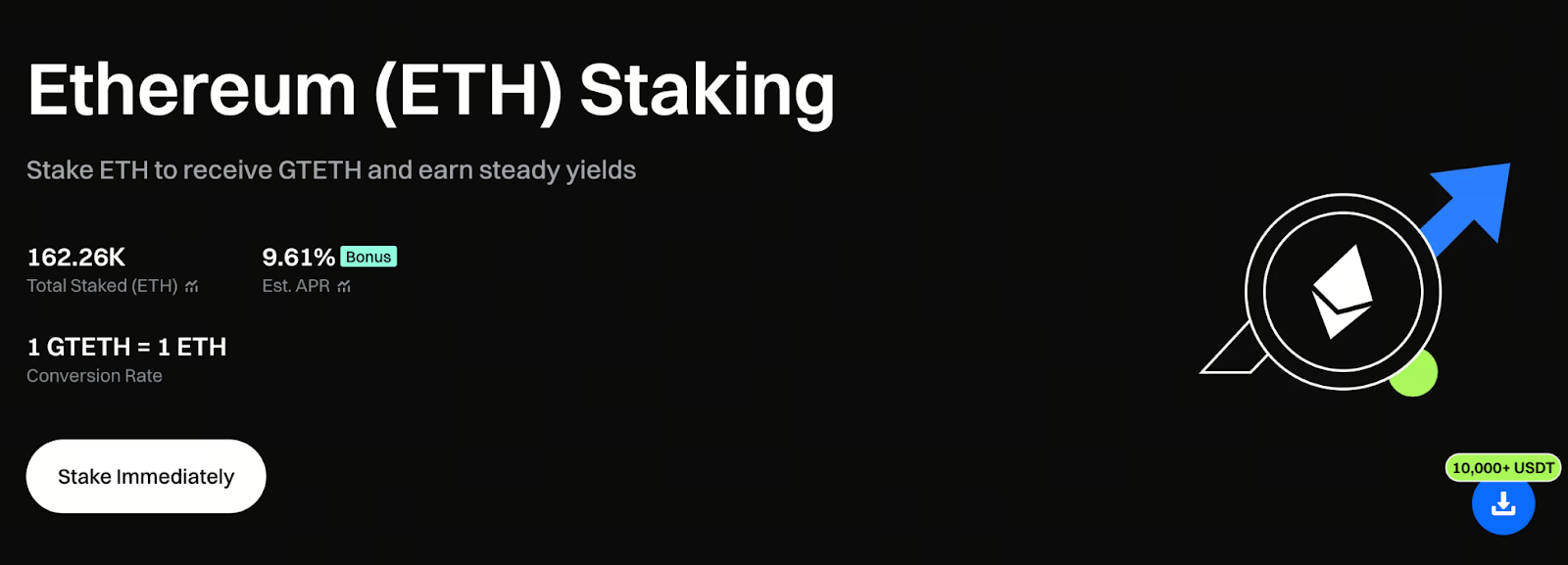
GTETH is not just an extra layer added to the existing staking process—it fundamentally redefines ETH’s asset structure. When users convert ETH to GTETH, staking is no longer a separate action. It is built directly into the asset, so holders possess not ETH waiting to be unlocked, but an asset that automatically accumulates yield. GTETH is ETH in a form that generates interest autonomously.
Yield Is Reflected Directly in Price—No Extra Steps Required
GTETH features a yield-inclusive design. Returns are automatically reflected in the asset’s price, with no need for claims, applications, or periodic settlements.
Yield comes from two primary sources:
- Staking rewards from the Ethereum PoS network
- Additional GT incentives provided by Gate
Simply holding GTETH allows the system to automatically accumulate these rewards. All data is available on-chain, offering transparency and verifiability.
The Key Difference: Yield and Liquidity No Longer Compete
The most fundamental distinction from traditional staking is that GTETH imposes no lock-up restrictions. Holders can:
- Redeem GTETH for ETH at any time
- Trade GTETH directly in the market
- Adjust positions as part of their asset allocation
For the first time, ETH can generate ongoing yield while maintaining full liquidity. Investors no longer need to choose between returns and flexibility.
From Passive Storage Asset to Strategic Unit
Under the GTETH framework, ETH shifts from a passive yield tool to a strategic unit that can be adjusted in sync with market movements. Whether you aim to reduce risk, rebalance in the short term, or wait for new opportunities, GTETH enables flexible capital management without interrupting yield accumulation. ETH is elevated to an operational asset, not just a long-term holding.
Simple Return Structure—Long-Term Efficiency Is Easier to Evaluate
GTETH’s sources of yield are clear, mainly consisting of two figures:
- Ethereum PoS annual yield: approximately 2.61%
- Gate’s GT incentive: approximately 7%
All rewards are reflected in the asset’s value when GTETH is redeemed for ETH, making overall return rates easy to calculate and compare with other asset allocation strategies.
Start your Gate ETH staking journey and unlock on-chain mining rewards: https://www.gate.com/staking/ETH?ch=ann46659
VIP Level Directly Impacts Your Final Returns
Within the GTETH mechanism, fee rates are adjusted based on Gate VIP level:
- VIP 5–7: 20% fee discount
- VIP 8–11: 40% fee discount
- VIP 12–14: 60% fee discount
Short-term differences may be minor, but over the long run, compounding makes fee structure a critical variable in final returns.
Beyond Liquid Staking—An ETH Asset Management Solution
Most LSTs (Liquid Staking Tokens) still follow a lock-up mapping design, while GTETH is more akin to a comprehensive ETH asset management tool. It does not require lock-up commitments or restrict capital mobility, yet continuously accumulates staking yields. ETH now combines yield, liquidity, and strategic flexibility.
Summary
GTETH’s value lies in making staking more seamless, not more complicated. By embedding yield directly into the asset and removing lock-up restrictions, GTETH enables ETH to combine yield generation with market agility. In a market where high-frequency volatility is the new normal, asset efficiency is about more than just returns—it’s about capital management. GTETH is the ETH solution built for this rhythm.