Caldera Airdrop Officially Launched: How Beginners Can Participate in the ERA Token Airdrop

Last Updated 2026-04-03 21:02:52
Reading Time: 1m
The Caldera Airdrop is now live, with ERA tokens being distributed to early users and developers. This article provides a detailed overview of Caldera’s background, the airdrop participation rules, and an introductory guide for new participants to ensure eligibility.

What Is Caldera? Modular Rollup Deployment Platform

Source: https://caldera.xyz/

Caldera is a Rollup-as-a-Service (RaaS) platform that enables users to deploy Layer-2 blockchains in a single step. Caldera supports rapid, dedicated, high-performance rollup network deployment for a range of use cases, including NFT projects, DeFi protocols, and blockchain games.

Core features of the platform:

  • Multi-virtual machine support for EVM and SolanaVM
  • Native Metalayer Cross-Chain Communication System
  • Customizable Data Availability Layers (Ethereum, Celestia, and others)
  • Developer-focused Rollup Engine API and SDK

Caldera has attracted several prominent projects, such as Injective, RARI, and Ozean. As a result, the platform’s total value locked (TVL) has surpassed $600 million.

Caldera Airdrop Eligibility

The current Caldera Airdrop primarily rewards the following groups:

  • Testnet participants: Early users who conducted transactions or deployed contracts on the Caldera testnet
  • .era domain registrants: Users who registered decentralized identity domains through the platform
  • Developers: Project teams submitting applications, using the SDK, or integrating Metalayer
  • Active community members: Participants engaging in Caldera’s Discord and X (Twitter), completing surveys, or participating in activities
  • Early contributors: Users who previously supported and contributed to ecosystem development and may be eligible for retroactive airdrop allocation

A point-based system determines airdrop allocation by evaluating user engagement frequency, task completion, and on-chain activity to ensure fairness.

How to Participate in Caldera Airdrop Tasks

If you missed the early testing phase but want an opportunity to receive the Caldera Airdrop, follow these steps:

  1. Follow official channels: Monitor Caldera’s Twitter and the official website for the latest task announcements.
  2. Join the testnet: Use test tokens to conduct transactions, add liquidity, or register a decentralized identity on the Caldera testnet.
  3. Register a .era domain: Create a decentralized username ending with .era. This is a key eligibility requirement for the airdrop.
  4. Integrate Metalayer: Developers can apply to integrate Metalayer’s cross-chain tools to earn significant airdrop points.
  5. Submit the airdrop form: For certain tasks, submit your wallet address and interaction screenshots via a Google Form. Be sure to submit on time.

ERA Token Utility and Value Proposition

The Caldera Airdrop distributes ERA tokens, with a total supply of 1 billion. ERA serves the following functions:

  • Payment of transaction fees on the Caldera network
  • Participation in future staking and security mechanisms
  • Governance: Token holders can vote on proposals and protocol upgrades
  • Ecosystem projects use ERA to incentivize developers and liquidity providers

ERA is now listed on Gate, with available trading pairs including ERA/USDT and ERA/BTC, providing liquidity and trading access for users.

Important Notes and Future Opportunities

  • Airdrop distribution may not coincide with immediate token listings; some qualifications may depend on on-chain snapshots or official community announcements.
  • Beware of phishing scams—always verify links from official sources and safeguard your wallet address.
  • Watch for future airdrop rounds. Caldera ecosystem projects, such as Ozean and zkXPLA, may conduct independent sub-airdrop campaigns.

The Caldera Airdrop provides access to next-generation Layer-2 infrastructure. By completing tasks and staying engaged with the ecosystem, participants can earn ERA rewards and further integrate into the modular blockchain environment.
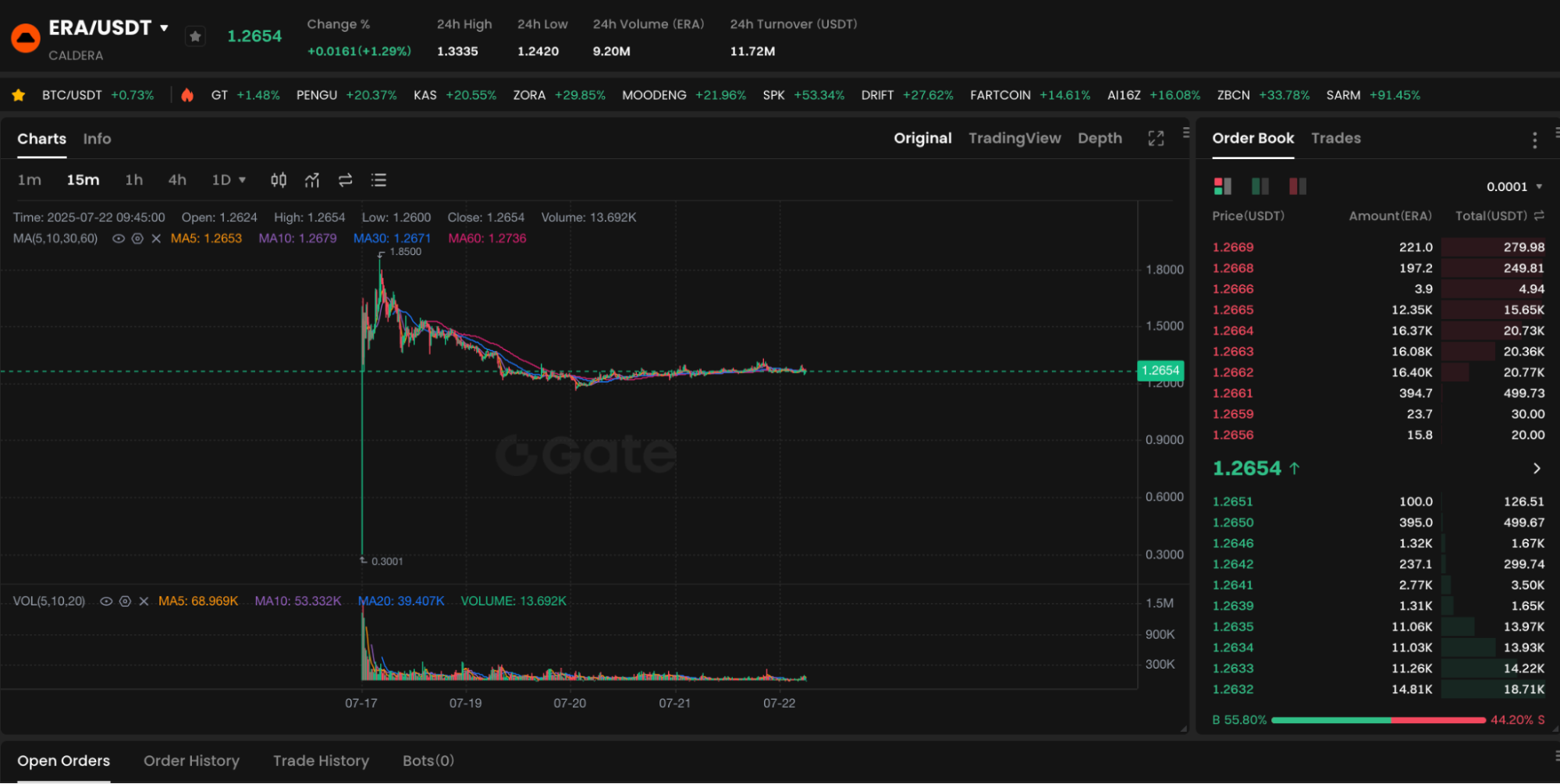

Source: https://www.gate.com/trade/ERA_USDT

As of July 22, 2025, ERA is live on Gate’s spot market at a price of approximately $1.26.

Author: Max
Disclaimer
* The information is not intended to be and does not constitute financial advice or any other recommendation of any sort offered or endorsed by Gate.
* This article may not be reproduced, transmitted or copied without referencing Gate. Contravention is an infringement of Copyright Act and may be subject to legal action.

Related Articles

AI-Native Settlement Layers: How United Stables Is Building the Next Financial Rail
Beginner

AI-Native Settlement Layers: How United Stables Is Building the Next Financial Rail

Stablecoins were originally designed as dollar substitutes within exchanges, primarily used for asset pricing and trade settlement. As on-chain financial ecosystems have matured, their role has expanded beyond simple payments to include collateral assets, cross-chain liquidity mediums, and unified settlement units. In particular, as AI systems and automated agents begin to participate directly in economic activity, demand has risen sharply for programmable value units capable of instant settlement. This shift is pushing stablecoins toward the role of foundational financial infrastructure.
2026-03-25 03:16:17
The ve(3,3) Flywheel Explained: How AERO Tokenomics Powers Aerodrome’s DeFi Economy
Beginner

The ve(3,3) Flywheel Explained: How AERO Tokenomics Powers Aerodrome’s DeFi Economy

In the competition for DeFi liquidity, high-inflation mining alone is no longer enough to build lasting advantages. Aerodrome applies the ve(3,3) economic model to redesign token emissions, voting mechanisms, and revenue distribution, creating a liquidity flywheel centered on governance and cash flow. This article examines AERO tokenomics, the veAERO locking mechanism, and protocol revenue models to explain how Aerodrome builds a sustainable DeFi economic system.
2026-03-25 06:41:58
Aerodrome Tokenomics: How ve(3,3) Powers Base's Most Profitable DEX
Beginner

Aerodrome Tokenomics: How ve(3,3) Powers Base's Most Profitable DEX

AERO is the native token of Aerodrome Finance, a core decentralized exchange and liquidity protocol in the Base ecosystem. It is primarily used for liquidity incentives and ecosystem operations. veAERO is a governance NFT that users receive by locking AERO, representing both voting power and the right to share protocol revenue. Through a dual track structure of AERO as a utility token and veAERO as a governance credential, Aerodrome separates liquidity usage value from long term governance power, allowing participants to act as liquidity providers, governance decision makers, and revenue sharers within the same system.
2026-03-25 06:40:31
DePIN Identity Network and Real World Applications: How Humanity Protocol Brings on-chain Identity Into the Physical World
Beginner

DePIN Identity Network and Real World Applications: How Humanity Protocol Brings on-chain Identity Into the Physical World

Most Web3 identity systems remain confined to on-chain environments and struggle to achieve meaningful adoption in real world settings. Through a DePIN architecture and physical verification hardware, Humanity Protocol aims to bring decentralized identity into access control systems, hospitality, public services, and offline events, allowing on-chain identity to function not just as a digital credential, but as foundational infrastructure for real world access.
2026-03-25 07:40:53
How is the price of PAXG determined? Pegging mechanism, trading depth, and influencing factors
Beginner

How is the price of PAXG determined? Pegging mechanism, trading depth, and influencing factors

PAXG (Pax Gold) is a tokenized asset backed by physical gold reserves, launched by fintech firm Paxos and issued as an ERC-20 token on the Ethereum blockchain. The core concept is to digitally represent real-world gold assets, allowing investors to hold and trade gold via the blockchain network. Because each PAXG token corresponds to a specific quantity of physical gold, its price is theoretically expected to closely track the global gold market.
2026-03-24 19:11:40
Aster vs Hyperliquid: Which Perp DEX Will Prevail?
Beginner

Aster vs Hyperliquid: Which Perp DEX Will Prevail?

Aster and Hyperliquid are the two representative protocols of the "purpose-built L1 path" within the current decentralized perpetual exchange (Perp DEX) sector. As a pioneer in the field, Hyperliquid has built a deep liquidity moat through its highly mature order book architecture and strong community consensus. Conversely, Aster, as a rising challenger, seeks to leapfrog the competition in high-performance trading through more aggressive multi-chain aggregation logic, private transaction modules, and an underlying execution environment optimized for 2026 market demands.
2026-03-24 11:58:33





