As the blockchain industry moves from single-asset use cases toward broader application ecosystems, RPC node services have become a key part of Web3 infrastructure. Whether an application is checking wallet balances, calling smart contracts, reading NFT data, or broadcasting on-chain transactions, it ultimately depends on communication between the application and blockchain nodes.
In today’s Web3 infrastructure sector, Alchemy and QuickNode are among the most representative RPC platforms. Both provide developers with multichain node access and API services, but their product direction and ecosystem strategies differ noticeably. Alchemy puts more emphasis on developer tools, enhanced data APIs, and the account abstraction ecosystem, while QuickNode focuses more on node performance, global deployment, and plugin-based extensibility.
Overview of Alchemy and QuickNode
Alchemy is a blockchain infrastructure platform built for Web3 developers. It mainly provides RPC nodes, on-chain data APIs, smart wallets, and account abstraction tools. Its product suite covers NFT API, Transfers API, Webhooks, Account Kit, Gas Sponsorship, and several other areas, which is why it is often described as the “AWS of Web3.”
QuickNode, as a Web3 infrastructure platform, mainly provides developers with multichain node access and high-performance RPC services.
Compared with Alchemy, QuickNode places greater emphasis on node performance, global deployment, and a modular plugin ecosystem. Its Marketplace plugin system allows developers to expand node capabilities based on their needs, such as NFT data analytics, wallet monitoring, or enhanced Solana tools.
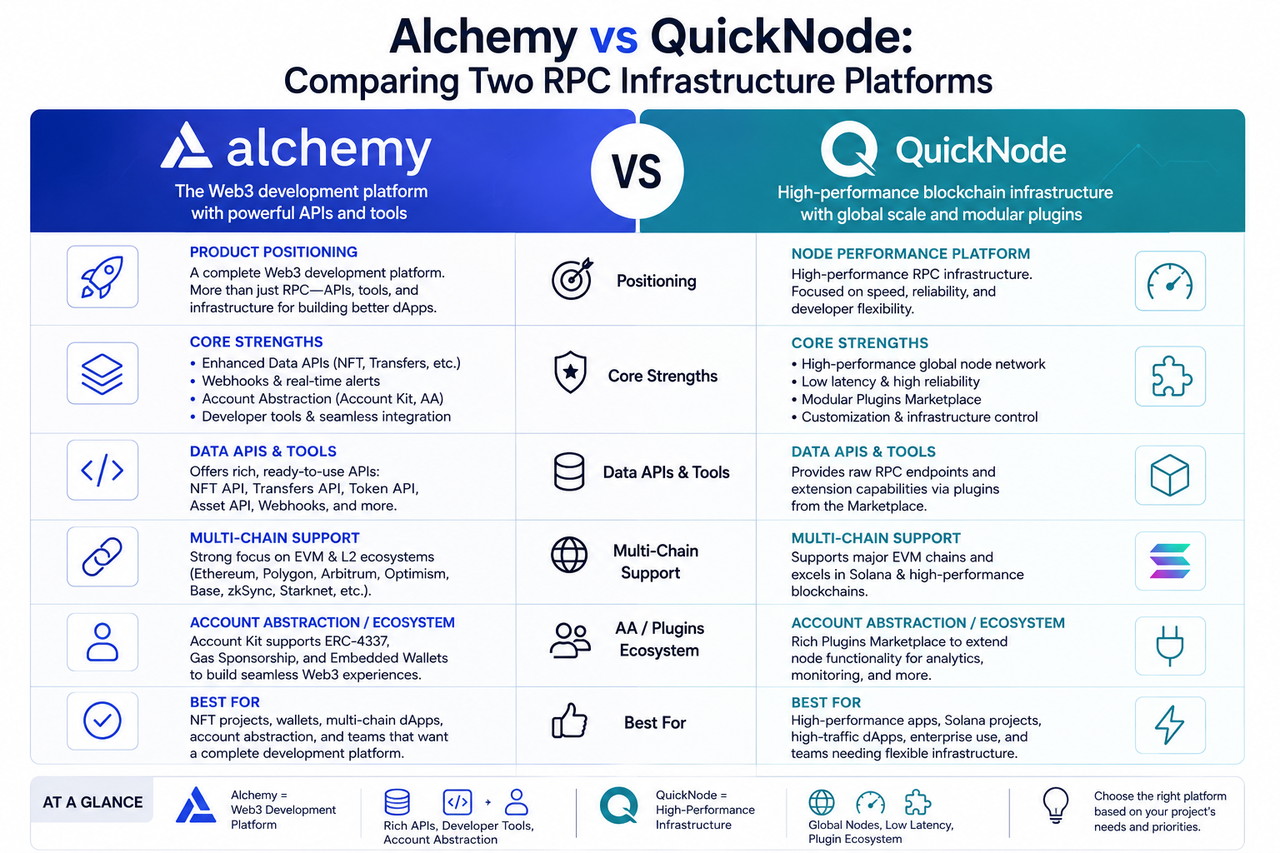
How Do Alchemy and QuickNode Differ in Their Core Positioning?
Although both platforms belong to the Web3 RPC service category, their product logic is clearly different.
Alchemy is more oriented toward being a “development platform.” Its focus is on enhanced data APIs, account abstraction, and a developer tools ecosystem. In addition to basic RPC services, it also provides NFT data indexing, real-time Webhooks, smart wallets, and AA, or account abstraction, tools. This makes it especially suitable for NFT platforms, wallets, and multichain DApps.
QuickNode, by contrast, is more focused on being a “high-performance node platform.” Its priorities are global node deployment, low-latency access, and plugin-based extensibility, making it better suited for high-frequency trading, enterprise-grade node deployment, and Solana-related use cases.
This distinction determines which types of Web3 applications each platform is best suited for.
How Do Alchemy and QuickNode Differ in Node Architecture?
Alchemy and QuickNode both use distributed node architectures, but they optimize for different goals.
Alchemy places greater emphasis on data processing and the API enhancement layer. Its system caches and indexes on-chain data, allowing it to provide NFT API, Transfers API, real-time notifications, and other structured features. Developers can quickly obtain usable results without directly handling complex on-chain data.
QuickNode focuses more on node performance and global deployment. Its core priorities are reducing request latency, improving node stability, and supporting more custom extension capabilities. This model is better suited for applications with high requirements for response speed and concurrency.
One of Alchemy’s main strengths is its enhanced data APIs.
Its APIs provide more than raw RPC requests. They also include advanced features such as NFT queries, token transfer history, wallet asset aggregation, and real-time event notifications. This structure helps developers reduce backend development work and the burden of data indexing.
For example, NFT platforms usually need to read NFT images, collection information, and holder addresses, while traditional RPC nodes do not directly return this kind of structured data. Alchemy processes this information in advance, enabling it to provide data interfaces that better fit Web3 application needs.
QuickNode’s defining feature is its plugin ecosystem. Developers can install different plugins according to their business needs, such as on-chain analytics, wallet monitoring, or Solana extension tools. This model gives projects more flexibility and also suits scenarios that require customized functionality.
How Do Alchemy and QuickNode Differ in Multichain Support?
Alchemy and QuickNode both support major EVM networks such as Ethereum, Polygon, Arbitrum, Optimism, and Base, but their areas of focus are slightly different.
Alchemy places more emphasis on Layer 2 and the account abstraction ecosystem, so it has invested more in Base, zkSync, Starknet, and smart account-related areas.
QuickNode is more active in supporting Solana and high-performance chains. Some of its products and plugin systems are also built around Solana development scenarios.
As multichain ecosystems gradually become a mainstream trend in Web3, competition among infrastructure platforms has expanded from basic RPC services to cross-chain development capabilities.
How Do Account Kit and the Plugin Ecosystem Differ?
Alchemy is currently focused on building out the account abstraction, or AA, ecosystem.
Its Account Kit supports ERC-4337, Gas Sponsorship, and Embedded Wallet, helping developers build smart wallets that do not require seed phrases or direct gas fee management. This direction mainly addresses user experience challenges in Web3.
QuickNode places greater emphasis on a modular plugin system. Developers can choose different extension modules based on project needs to strengthen node capabilities.
From a product logic perspective:
Alchemy vs QuickNode: How Should Web3 Projects Choose?
Different types of projects have different infrastructure needs.
For projects focused on NFTs, smart wallets, account abstraction, or multichain DApps, Alchemy’s enhanced APIs and developer tools are usually more advantageous.
For projects that care more about node performance, Solana development, high-concurrency requests, or enterprise-grade deployment, QuickNode’s global nodes and plugin ecosystem may be a better fit.
There is no absolute winner between the two. They are designed for different development scenarios.
Many Web3 applications currently rely on third-party RPC services, so infrastructure centralization has long been a concern.
When a large number of DApps use the same platform, a service outage could affect many applications at once. This issue has sparked industry discussion during periods of peak activity on the Ethereum network.
As a result, the Web3 industry has also begun exploring decentralized RPC networks, modular data layers, and distributed infrastructure architectures in hopes of reducing dependence on any single service provider.
Summary
Alchemy and QuickNode are both important RPC service platforms in today’s Web3 infrastructure sector, but they differ clearly in product direction and development logic.
Alchemy places greater emphasis on enhanced APIs, account abstraction, and developer tool systems, positioning itself closer to a complete Web3 development platform. QuickNode, on the other hand, focuses more on high-performance nodes, multichain support, and a plugin extension ecosystem, making it more suitable for scenarios that emphasize performance and customization.
FAQs
What Is the Difference Between Alchemy and QuickNode?
Alchemy puts more emphasis on developer tools, data APIs, and account abstraction, while QuickNode focuses more on high-performance nodes and a plugin extension ecosystem.
What Is an RPC Node?
An RPC node is the data interface that Web3 applications use to access blockchain networks. It is used to read on-chain data and send transactions.
Alchemy provides relatively complete support for NFT APIs and on-chain data indexing, so it is often used in NFT platform development.
Why Does QuickNode Emphasize Its Plugin Ecosystem?
QuickNode allows developers to extend node capabilities through plugins, helping meet the needs of different application scenarios.
Both Alchemy and QuickNode support Solana, but QuickNode is more active in high-performance Solana node services.