Understanding Gold Contract Trading and Its Core Features
Gold contract trading refers to derivatives transactions based on gold price movements. Unlike spot trading, these contracts allow investors to use leverage, take both long and short positions, and benefit from features such as perpetual settlement. By trading on margin, participants can maximize capital efficiency without requiring physical gold delivery. The main advantages of contract trading include flexible capital allocation, risk hedging, and strategic variety, making it a vital tool for today’s traders to manage gold-related risks and returns.
Gate Gold Perpetual Contracts: Overview and Latest Pricing
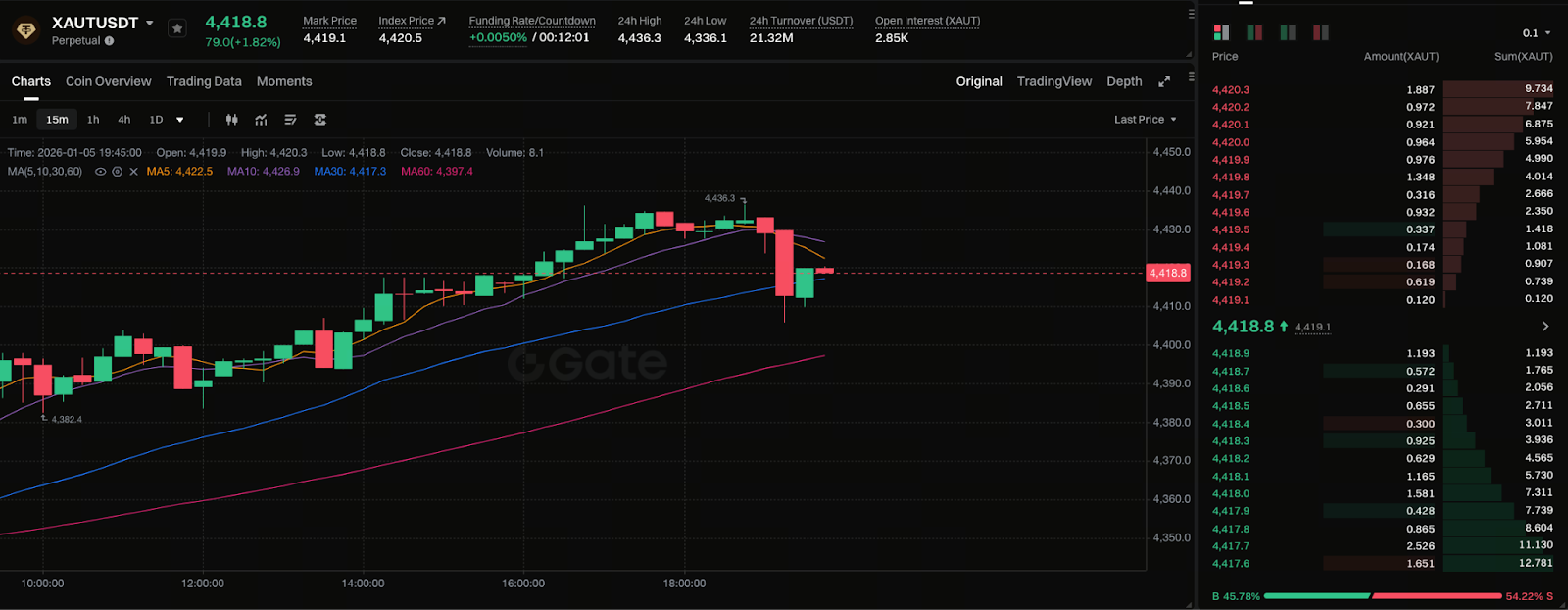
Chart: https://www.gate.com/futures/USDT/XAUT_USDT
On Gate Exchange, the XAUT_USDT perpetual contract is pegged to the Tether Gold (XAUT) token. This product lets users speculate on gold price changes using USDT as the settlement currency, with no physical gold delivery required. The contract offers multiple leverage options for improved capital utilization, and positions can be opened or closed at any time. It’s well-suited for traders seeking to capture opportunities from gold price volatility.
According to the latest data, the XAUT_USDT perpetual contract is performing as follows:
- 24-hour high: approximately 4,529 USDT
- 24-hour low: approximately 4,437 USDT
- Current mark price: around 4,480 USDT
- Total trading volume: over ten million USDT
These figures show that the contract remains highly liquid and actively traded.
Meanwhile, the spot price of Tether Gold (XAUt)—the underlying asset for this contract—fluctuates near US$4,400. Data from CoinMarketCap and CoinGecko indicate XAUt has recently traded between $4,410 and $4,430 per ounce.
These levels closely track traditional spot gold prices, reflecting the strong correlation between digital gold tokens and physical gold.
Gold Market Review and Outlook: 2025-2026
In 2025, gold prices posted an exceptionally strong rally, reaching an all-time high of about $4,550 per ounce. The year ended with gains of over 60%, making gold one of the top-performing assets in decades. Analysts attribute this surge to macroeconomic uncertainty, sustained central bank gold purchases, inflation expectations, and heightened global geopolitical tensions.
In 2026, gold prices have held near their highs. After periods of extreme volatility, the market has stabilized, signaling continued robust demand for safe-haven assets.
Other precious metals, such as silver, also experienced sharp swings. Silver prices surpassed $78 per ounce in 2025; though they later pulled back, annual gains still far exceeded those of gold.
Overall, the precious metals market has become significantly more active and volatile. This environment offers more opportunities for gold contract traders, but also increases trading risks.
Advantages and Risk Management in Gold Contract Trading
Key advantages:
- Diversified trading strategies — Traders can profit by going long when gold rises or shorting during pullbacks.
- Enhanced capital efficiency — Leverage allows greater returns from smaller margin requirements.
- Risk hedging — Contracts can serve as effective hedges for spot gold holdings, strategically strengthening portfolio risk resistance.
Risk considerations:
- Heightened volatility — Gold markets are highly volatile, increasing the risk of margin calls and forced liquidations.
- Leverage risk — While leverage can amplify profits, it also increases potential losses proportionally.
- Trading costs — Funding rates, fees, and other expenses all impact net returns.
As such, participants should always set appropriate stop-losses, diversify positions, and use market signals to guide trading decisions.
Maximizing Returns with Gold Contract Trading Features
To make the most of gold contract trading, consider the following:
- Leverage both technical and fundamental analysis: Track global macroeconomic data, central bank gold reserve trends, and medium- to long-term market trends. Use technical indicators such as moving averages and support/resistance levels.
- Plan strategies and manage risk: Set clear trading plans, stop-loss and take-profit levels, and control risk exposure.
- Use leverage prudently: Adjust leverage based on your risk tolerance and avoid excessive leverage that can introduce unnecessary risks.
Summary and Forward-Looking Investment Guidance
Gold contract trading bridges traditional precious metals markets with digital asset derivatives. Gate Gold Perpetual Contracts and similar products offer investors flexible tools and strategic options. With gold prices staying volatile at elevated levels, contract traders enjoy abundant opportunities, but effective risk management is essential.
Looking forward, if global economic uncertainty persists, demand for precious metals as safe-haven assets will likely remain strong, and gold contract trading will continue to offer strategic value. Investors should stay alert to price swings, leverage available trading tools, and continually refine their strategies in response to evolving market conditions.







