



On June 1, 2026, Gate launched its stock trading service. Users can now buy and sell over 10,000 US stocks and ETFs directly on the platform using USDT, covering major US exchanges like NYSE and Nasdaq. Clearing and custody are handled through integration with licensed brokerages, with assets registered in sub-accounts at the broker. This is more than just a new feature—it’s a landmark moment marking the transformation of a crypto exchange from a "digital asset trading platform" to a "multi-asset integrated trading infrastructure."
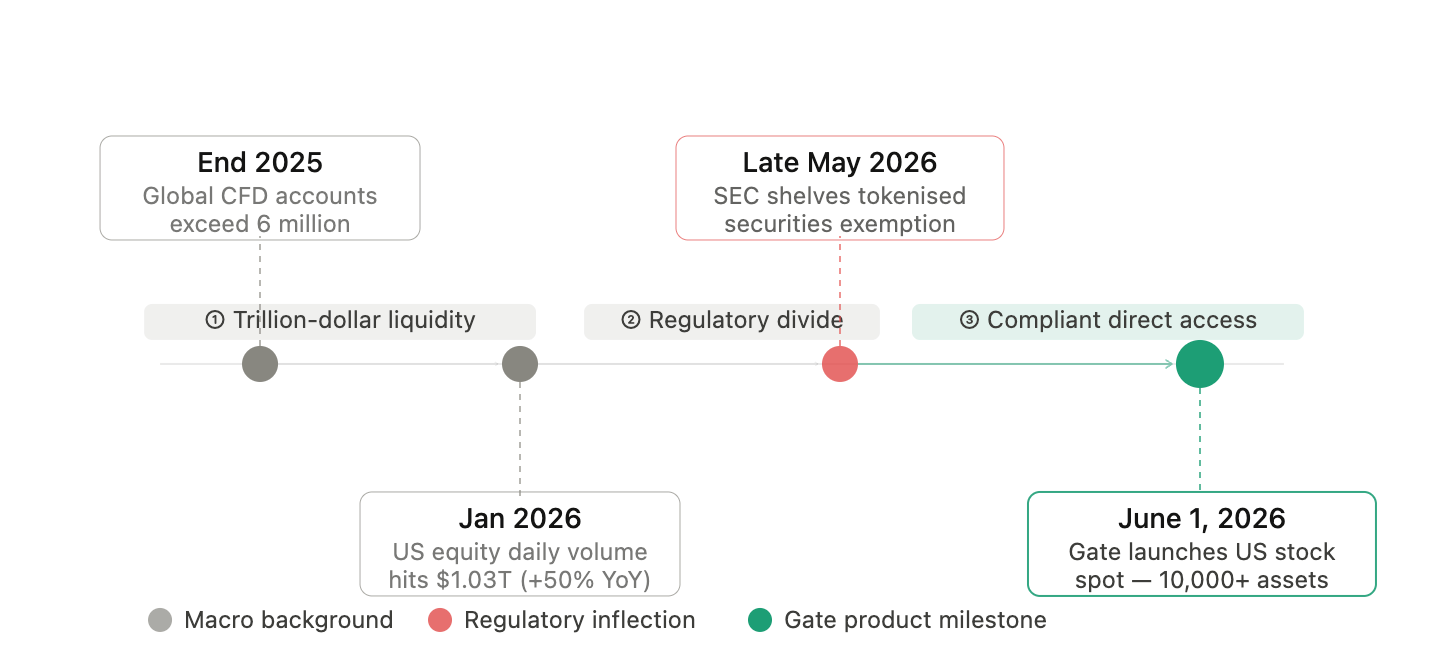
From Digital Assets to Equities—Key Milestones in Gate’s US Stock Trading Rollout
In January 2026, the US stock market hit a record high, with average daily trading volume surpassing $1.03 trillion, a 50% increase year-over-year. By the end of 2025, the number of active global CFD accounts exceeded 6 million. The unprecedented convergence of massive liquidity in traditional financial markets and the asset pools of crypto platforms is underway. Gate’s choice of a direct stock trading model—distinct from third-party tokenized securities—has become a highly valuable example in this integration process.
Is Crypto Platform Access to US Stocks an Infrastructure Upgrade or a Regulatory Strategy?
Why did crypto platforms pivot en masse toward the US stock market in 2026? The answer is multi-faceted.
From the user demand side, crypto asset holders, having weathered multiple bull and bear cycles, now have a much stronger desire for diversified asset allocation. USDT holders want to participate in the world’s largest equity market without converting to fiat or leaving the platform. On the supply side, growth in spot trading fee revenue is slowing, and competition in the perpetual futures market is intense. Adding stocks and other traditional financial products opens new revenue streams and increases user stickiness.
A deeper driver comes from regulatory changes. In late May 2026, the SEC shelved its "Innovation Exemption" plan for tokenized securities at the last minute. The plan would have allowed third parties to issue and trade tokenized stocks on decentralized crypto platforms, but faced strong opposition from Nasdaq, , CME Group, and other traditional exchanges. The main concerns were inadequate investor protection, challenges in on-chain ownership verification, and risks from unauthorized third-party issuers. The SEC’s hesitation sent a clear message: the third-party tokenization route is unlikely to get regulatory approval in the short term.
Gate’s compliant broker integration model has proven more viable in this regulatory vacuum. By partnering with licensed brokers, this approach does not rely on any "innovation exemption" or special regulatory arrangements and fits entirely within existing securities laws. Therefore, Gate’s integration of US stocks is not just a functional upgrade, but a proactive response to regulatory uncertainty—trading regulatory certainty for room to expand its product offerings.
US Stock Trading vs. Tokenized Securities: How Two Technical Paths Are Reshaping the Market
Currently, there are two distinct technical approaches for crypto platforms to access the US stock market. The first is Gate’s "direct US stock trading" model, where users trade US stocks through sub-accounts at platform-affiliated brokers on traditional exchanges. Assets are held by compliant brokers, and every trade is matched with an actual order on the NYSE or Nasdaq order book. The second is the "tokenized securities" model, where third parties map stock assets to blockchain tokens, enabling 24/7 trading on decentralized or centralized crypto platforms. Here, users own crypto tokens representing underlying asset rights, not the stocks themselves.
The differences between these two paths go beyond technology—they profoundly affect investor rights, regulatory compliance, and market structure. In the direct US stock trading model, users have direct legal recourse, assets are protected at the broker level, and regulators can supervise under traditional frameworks. In the tokenized securities model, user rights depend on the proper execution of smart contracts and third-party custody. If there’s an on-chain attack or custodian default, the protection chain is weaker and legal ownership is unclear.
The SEC’s May 2026 decision clarified its regulatory preference. While Nasdaq’s own tokenized securities scheme (requiring all trades to occur within the exchange and retaining full shareholder rights) was approved, the "innovation exemption" for third-party tokenized stocks was shelved indefinitely. This distinction means regulators are open to tokenization within the traditional exchange framework but will not tolerate parallel markets outside their oversight. For Gate and similar crypto platforms, choosing the compliant broker model over third-party tokenization is a rational response to this regulatory signal.
Proponents of tokenized securities argue that tokenization enables 24/7 trading, reduces clearing and settlement costs, and increases global accessibility. However, the SEC’s cautious stance means that, at least in the medium term (12–24 months), the direct US stock trading model will remain the mainstream and most sustainable way for crypto platforms to offer US stock access.
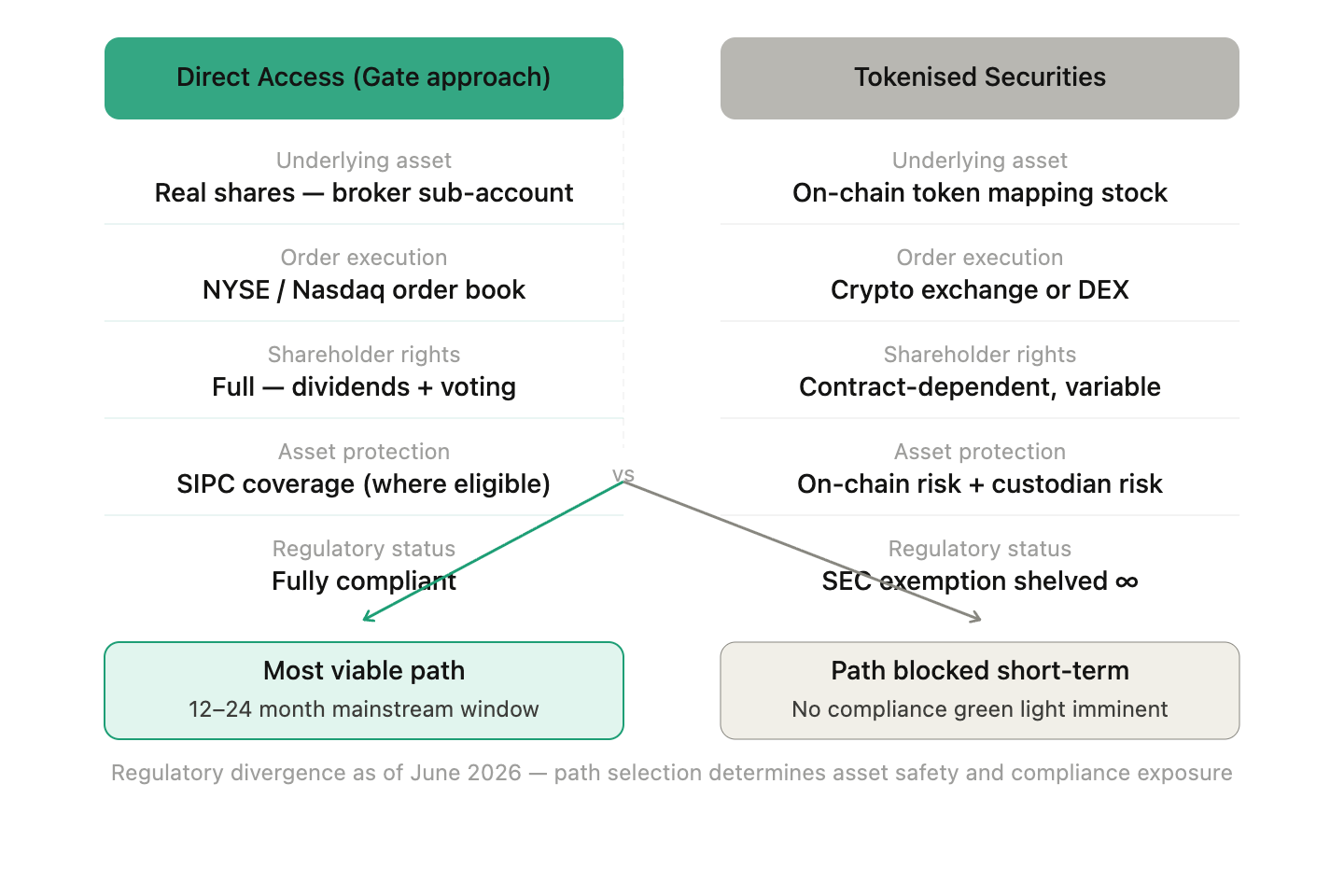
The Fork in the Road—Direct US Stock Trading vs. Tokenized Securities
From Spot to Futures to CFDs: Gate’s US Stock Product Matrix and User Choice
Gate has built a three-layered, complementary product matrix for the US stock market: US stock spot trading, US stock futures, and US stock CFDs. Understanding the differences among these is key for users to allocate assets wisely.
US stock spot trading is the foundation. When users place orders through Gate, they are routed via partner brokers directly to liquidity pools on NYSE, Nasdaq, and other exchanges. Once executed, stocks are registered in user sub-accounts under the broker. Spot trading involves no leverage, no overnight holding costs, or funding rates, and users enjoy full upside, dividends, and voting rights. As of June 2, 2026, Gate’s US stock spot trading covers over 10,000 assets, including blue chips like Apple, NVIDIA, Tesla, and various sector ETFs. Spot trading is ideal for long-term investors, especially those seeking real equity exposure beyond crypto assets.
US stock futures are designed for short-term traders seeking leveraged exposure. Futures are derivatives; users don’t own the underlying stocks but gain directional exposure to US stock price movements through margin. Key features include adjustable leverage (e.g., 5x, 10x), funding rate mechanisms (positions pay fees to the opposite side), and liquidation risk. Futures suit traders with strong market views who want to amplify returns in the short term while accepting higher risk.
US stock CFDs (Contracts for Difference) are similar in positioning to futures but operate differently. Like futures, CFDs are OTC derivatives that let users go long or short on asset price movements without owning the stock. Unlike perpetual futures, CFDs typically involve daily swap or overnight fees and don’t have fixed funding rate cycles. CFDs are better for short-term, two-way trading strategies, especially when users expect high volatility but are uncertain of the direction.
| Product Dimension | US Stock Spot | US Stock Futures | US Stock CFD |
|---|---|---|---|
| Underlying Asset | US stocks | Price index derivatives | OTC contracts for difference |
| Shareholder Rights | Full (dividends/voting) | None | None |
| Leverage | None | Supported | Supported (varies by product) |
| Overnight Holding Cost | None | Funding rate | Swap/overnight fee |
| Trading Hours | US market hours | Depends on product design | Depends on platform rules |
| Target Users | Long-term allocators | Directional leveraged traders | Two-way volatility traders |
By offering all three product types, Gate meets a wide range of user needs—from conservative to aggressive, long-term to short-term. Users should note: spot trading involves no extra costs and is suitable for holding; futures and CFDs offer leverage but incur funding or overnight fees that can erode returns over time, making them best for short-term tactical trades.
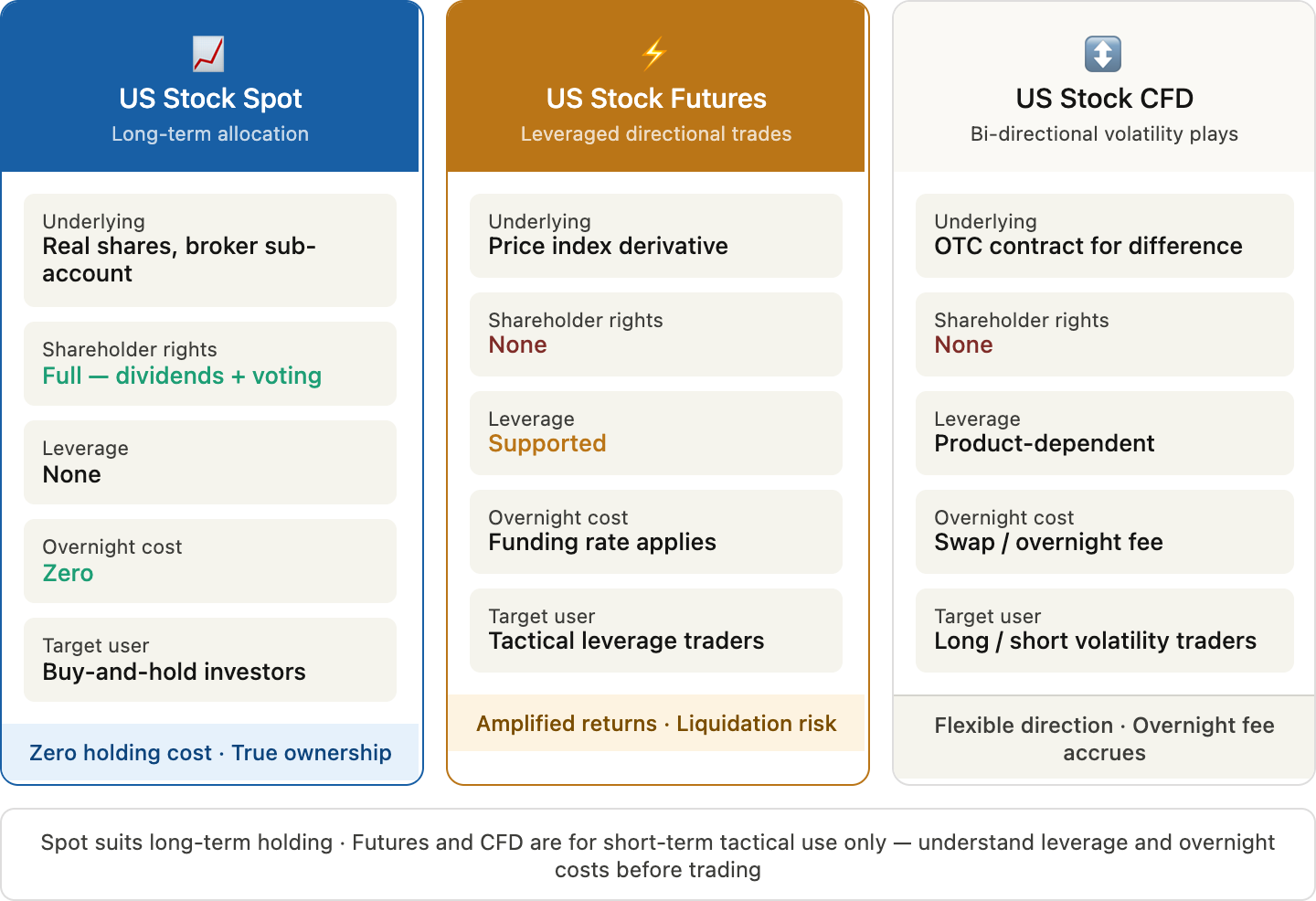
Three Pillars—Comparing Gate’s US Stock Spot, Futures, and CFD Product Structures
Gate’s US Stock Product Matrix: Core Advantages and Differentiators
Compared to other platforms offering US stock trading, Gate’s spot, futures, CFD, and direct access services provide clear competitive advantages.
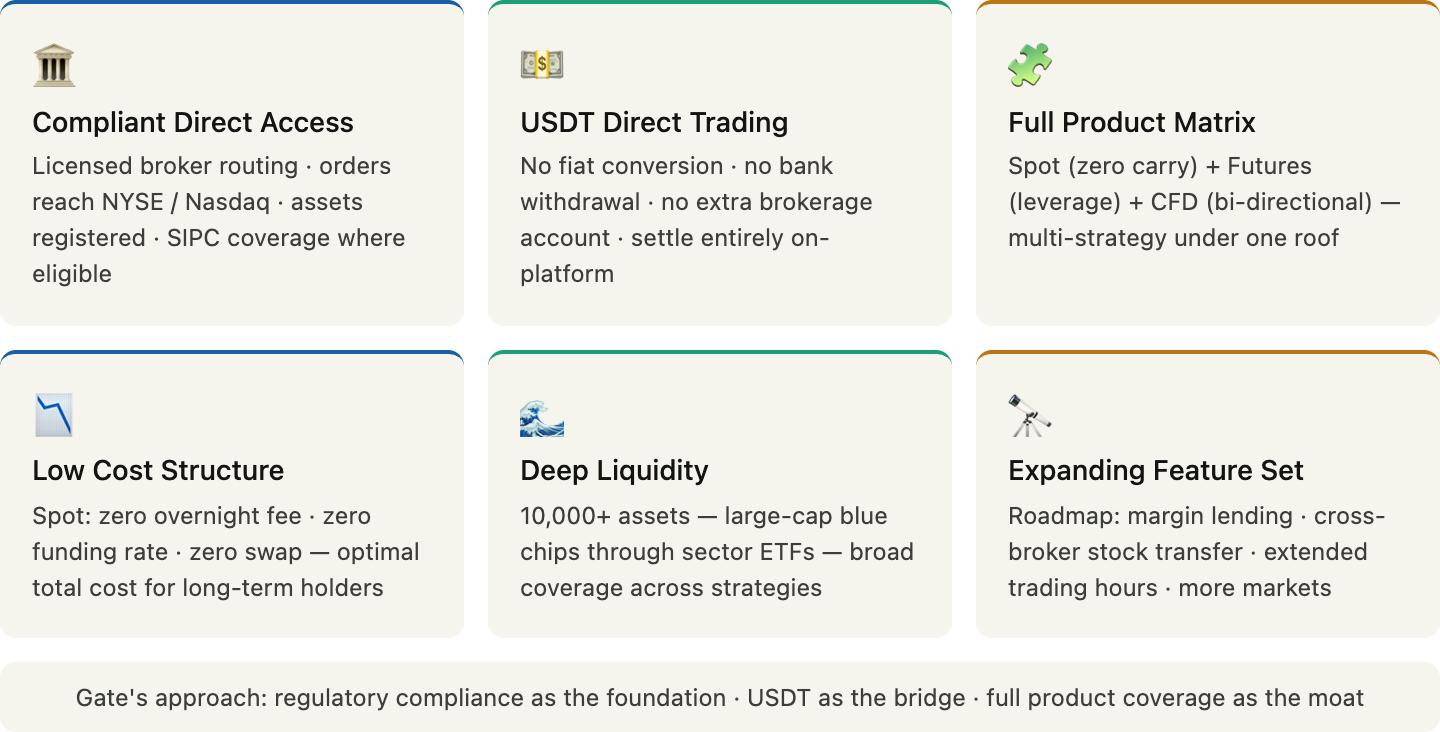
Core Advantages of Gate’s US Stock Product Matrix
Compliant direct access, real asset ownership. Gate’s direct US stock access is not a tokenized proxy—it routes orders directly to NYSE and Nasdaq via licensed brokers. Every share bought is registered with the broker, and users enjoy SIPC protection at the broker level. This model fits squarely within US securities regulations, eliminating compliance gray areas.
Trade directly with USDT, no fiat conversion required. Users don’t need to convert USDT to USD, withdraw to a bank, or open an overseas brokerage account. Crypto and US stock accounts are integrated within Gate, making allocation from digital assets to US stocks a one-click process. This convenience is a significant advantage over similar offerings.
Comprehensive product matrix for diverse strategies. The platform offers spot (no leverage, no overnight fees), futures (leverage + funding rates), and CFD (two-way + swap fees) US stock exposure tools. Long-term investors, short-term trend traders, and volatility strategists can all find products matching their risk preferences on Gate—no need to switch platforms.
Low-cost structure, zero holding fees for spot. US stock spot trading incurs no overnight, funding, or swap fees. For users planning to hold US stocks for weeks, months, or years, Gate spot is the most cost-effective choice. Futures and CFDs do involve fees, but rates are transparent and in line with market standards.
Deep liquidity, 10,000+ assets covered. As of June 2, 2026, Gate’s US stock spot trading supports over 10,000 stocks and ETFs, covering nearly all liquid assets on NYSE and Nasdaq. From large-cap blue chips to niche sector ETFs, users don’t have to worry about insufficient asset coverage.
Ongoing feature expansion. Gate plans to roll out margin trading, one-click stock transfers between brokers, and extended trading hours. This means the product suite is dynamic, evolving with user needs and regulatory developments.
Macro Liquidity Transmission: How Trillions in US Stock Trading Are Changing Crypto Market Pricing
In January 2026, US stock average daily trading volume hit $1.03 trillion, up 50% from the previous year. This surge reflects several macro factors: the S&P 500 rose 15% over the past 12 months, sector rotation spread from the "Magnificent Seven" to energy and industrials, ETFs continued to attract passive inflows, and high-frequency/algorithmic trading became widespread. For crypto market participants, the key takeaway is that US stock liquidity is now directly connected to crypto asset pools via platforms like Gate.
When users can instantly convert USDT into Apple or NVIDIA stock, the valuation anchor between crypto and traditional equities shifts. For example, a user bullish on tech stocks no longer needs to convert USDT to USD, withdraw to a bank, and fund a brokerage account—all can be done within Gate in milliseconds instead of days. This convenience will gradually change the relative demand elasticity between the two asset classes. If US stocks offer more attractive risk-adjusted returns, capital may flow from crypto to stocks; if crypto enters a bull market, users might shift stock positions back to USDT to seize on-chain opportunities.
Gate’s direct US stock spot service effectively creates a low-friction cross-market capital channel, allowing US stock liquidity to influence crypto platform fund flows more directly and rapidly. The Federal Reserve’s monetary policy plays a key role in this transmission. In H1 2026, the US Dollar Index fluctuated between 100 and 105, with market expectations for Fed rate cuts shifting repeatedly. If the Fed enters an easing cycle, increased dollar liquidity typically boosts both US stocks and crypto prices; but if cuts are due to recession fears, US stocks may suffer from falling earnings, and crypto could also weaken on risk-off sentiment.
Institutional players are already using these cross-market platforms for multi-asset arbitrage—going long crypto while shorting correlated tech stocks, or statistical arbitrage between US stocks and BTC price divergences. While traditional giants like BlackRock, Fidelity, and JPMorgan don’t trade directly on Gate, their BTC ETFs and tokenized funds are reshaping institutional crypto holdings, further strengthening the pricing link between US stocks and crypto markets.
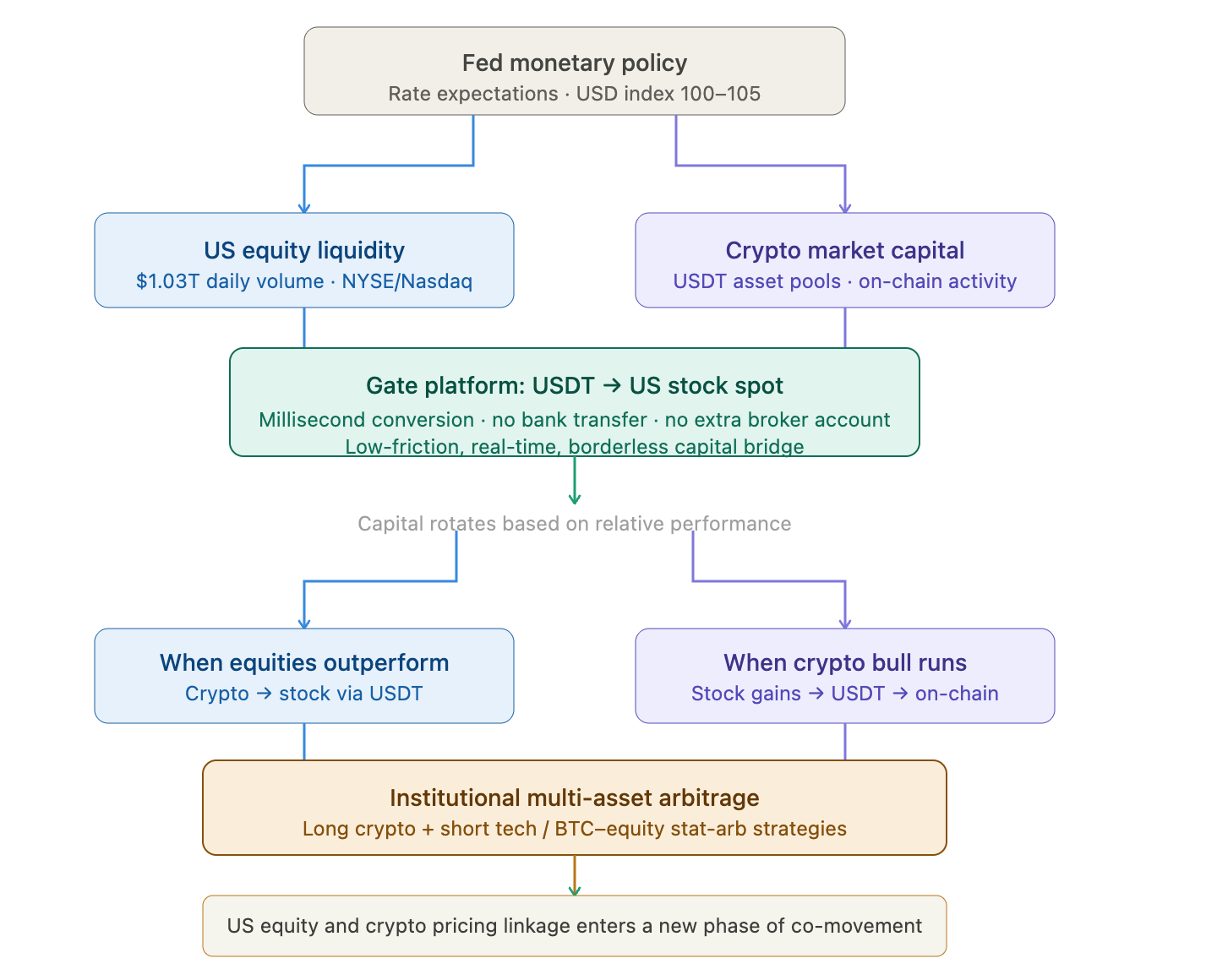
Cross-Market Transmission—How Trillions in US Stock Liquidity Influence Crypto Pricing via Gate
Conclusion
Crypto exchanges integrating US stock markets is not a fleeting experiment—it’s an irreversible structural shift in the global digitalization of assets. Gate’s direct US stock trading model strikes the optimal balance among compliance, user protection, and product completeness at this stage. The trio of spot, futures, and CFD products serve long-term allocation, leveraged trading, and two-way strategies, together forming a comprehensive suite for mainstream investment needs.
In the medium term, three core variables will drive this trend: the SEC’s final stance on tokenized securities, the degree of regulatory coordination among global financial centers, and the real demand from crypto users for cross-market allocation. For everyday investors, understanding the cost structure and risk profile of spot, futures, and CFDs is more important than chasing short-term trends. US stock trading involves no leverage or overnight fees, making it ideal for long-term holdings. Futures and CFDs, while flexible, are not designed for long-term holding due to funding and swap costs.
Gate’s direct US stock access lowers the barrier to the world’s largest equity market, but investment decisions should remain prudent despite increased convenience. As the line between crypto and stock assets blurs in 2026, maintaining a clear grasp of product logic is more important than ever.
FAQ
What is the fundamental difference between Gate US Stock Spot and US Stock CFDs?
Gate US Stock Spot means you actually own the stock and have shareholder rights. US Stock CFDs are over-the-counter contracts for difference, giving you only profit or loss from price changes.
Are there funding or overnight fees for trading US stocks on Gate, like with futures?
Gate US Stock Spot trading does not incur any overnight holding or funding fees.
Which exchanges does Gate’s US Stock Direct Access cover?
Gate’s direct US stock access covers NYSE, Nasdaq, NYSE Arca, NYSE American, and BATS.
If the SEC approves tokenized securities in the future, will Gate change its product model?
Gate currently uses a compliant broker direct access model and does not rely on tokenized securities exemptions. Whether to introduce them in the future will depend on the regulatory framework.
What is the maximum leverage for Gate US Stock Futures?
Leverage ratios are dynamically adjusted for each trading pair. Users can view the current range on the trading page.
How long does cross-market fund transfer (crypto to US stocks) take?
The process of converting USDT to USD and buying stocks is completed internally on the Gate platform. Once the order is executed, the stock is registered in real time.


